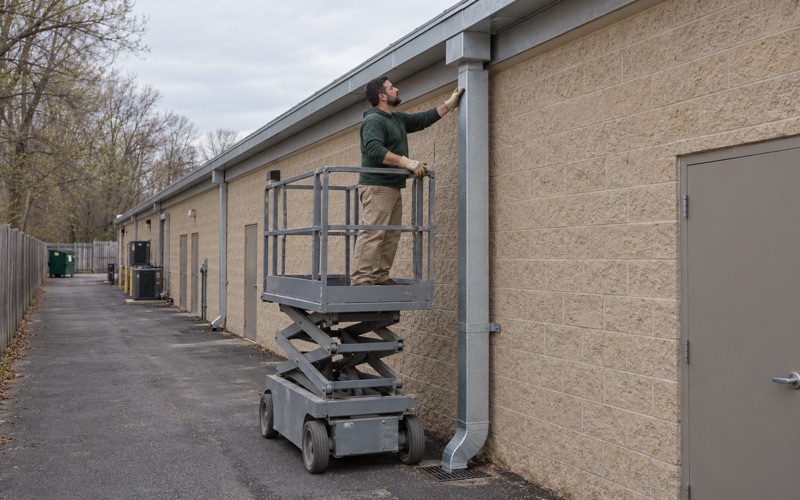
Howell Gutters has spent more than 20 years installing, repairing and cleaning gutters in Wall, and the job we care most about is the one a homeowner rarely sees: where the water goes after it leaves the roof. A gutter that fills and spills, or a downspout that empties against the foundation, sends a whole roof’s worth of rain straight to the place a house is least able to handle it.
We size each gutter run and downspout for the roof area that actually drains into it, form seamless gutters on site from coil so every run is one piece, and walk each downspout to its outlet before we price anything. When the water lands against the house, the estimate says so and offers a fix.
That approach matters more in Wall than a quick look at a flood map would suggest. The rest of this page explains why, using the township’s own records, and what we check on a house here before the next heavy storm.
A Quarter of Wall’s Flood Claims Came From Outside the Map
Most homeowners treat the flood map as a yes-or-no answer. If the house sits outside the shaded zone, flooding feels like someone else’s problem. Wall Township’s own records argue against that comfort, and they are the reason we spend so much of every visit on drainage rather than just the gutter itself.
What the Township Says About Its Own Claims
Wall participates in the National Flood Insurance Program, and the township’s Flood Hazard Information page states plainly that, historically, 25% of flood insurance claims have come from structures outside the special flood hazard area. One claim in four came from a property the map did not flag as high risk.
We read that number as a description of how water behaves, not as a verdict on any one house. We do not tell anyone whether their home or street sits in a flood zone; that is a question for the township and the official maps. What the figure tells us is that rain finds trouble well beyond the mapped lines.
Why the Map Line Is Not the Water Line
A flood map shows where rivers and tidal water are expected to spread in a large event. It does not trace the swale behind a ranch house, the low corner of a side yard, or the spot where three downspouts on one wall all empty into the same flower bed. Those small details decide whether a basement stays dry.
Roof water is a big part of that local picture. A modest roof sheds a surprising volume in a single downpour, and the gutters collect all of it into a handful of points. Where those points discharge is a choice, and a poor choice concentrates water right at the foundation wall.
What Gutters Can and Cannot Do
Gutters do not prevent floods, and we will never sell them that way. When a river leaves its banks, nothing on a roof edge changes the outcome. What gutters and downspouts can do is stop the house from adding its own roof water to the problem at the worst possible spot.
That is a narrower promise, and an honest one. A clear gutter, pitched correctly, feeding a downspout that carries water away from the house, keeps roof runoff from pooling against the walls during the storms that never make the news but still soak a crawl space.
Looking for gutters closer to West Freehold? See Gutters in West Freehold.
What the June 2022 Flood Maps Do and Do Not Show
Wall’s current Flood Insurance Rate Maps took effect on June 15, 2022. The township lists the panels that came before them: maps effective in 1977 that stayed in use until September 24, 2009, then a set of panels in force from September 25, 2009 to June 14, 2022.
New Maps, Same Limits
A newer map is a better map, but it is still a map of large-scale flood risk. The 2022 panels replaced the 2009 set, but they were never meant to show how a particular gutter system handles a two-inch cloudburst, or where a clogged elbow turns a downspout into a waterfall.
So when a homeowner tells us the house came off the map, or never was on it, we take that as useful background and keep working. Our part of the question starts at the roof edge and ends wherever the downspout water finally soaks in.
Low Spots No Panel Shows
Wall’s housing stock gives those low spots plenty of chances to form. Of roughly 10,400 homes counted in the latest Census survey, about 81% are single-family detached houses, and 2,464 were built between 1950 and 1969, with another 805 from the 1940s. Many of those lots have had decades for grading to settle.
When soil settles toward a foundation, a downspout that once emptied onto a slope now empties into a shallow bowl. The New Jersey edition of the residential code calls for grade to fall 6 inches within the first 10 feet from the foundation, and we look at whether the ground around each outlet still does that before we recommend anything.
When the Manasquan, Shark and Metedeconk Rise Together
Wall’s rivers can climb quickly. On August 13, 2018, Wall Township Police sent an emergency notice that flash flooding was already occurring and warned of sharp rises along the North Branch Metedeconk, Manasquan and Shark rivers in response to the extreme runoff.
What Extreme Runoff Means at a Roof Edge
The phrase in that notice, extreme runoff, is the key one for gutters. During an intense storm, rain arrives faster than soil can absorb it, and every hard surface sends its share downhill at once. A roof is one of the largest hard surfaces on any lot, and its gutters gather all of that into a few outlets.
If the gutter is undersized, half clogged or pitched the wrong way, it overflows along its whole length and drops a curtain of water straight beside the foundation. That is the moment we design around, not the gentle rain that any gutter can handle.
Sizing for the Storm, Not the Drizzle
We calculate the roof area that feeds each run before choosing a gutter and downspout size. On many Wall homes that points to 6-inch K-style seamless gutters with 3x4 downspouts, since the larger outlet carries far more water before it backs up. A long rear roof plane may need an added outlet instead of a single drop at the far corner.
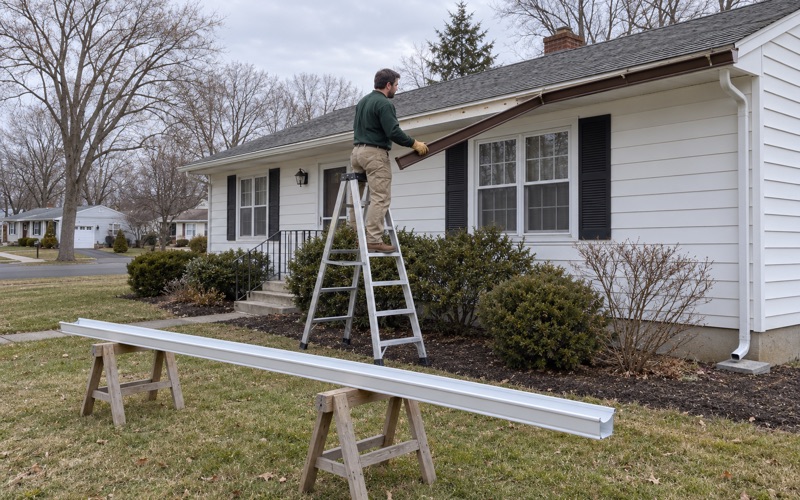
We form the gutters on site from .032 aluminum coil, cut to the full length of each run so there are no seams to open up. Hidden hangers hold the profile and pitch better over time than old spike and ferrule fastening, which tends to loosen and let a section sag.
The Fascia Behind the Gutter
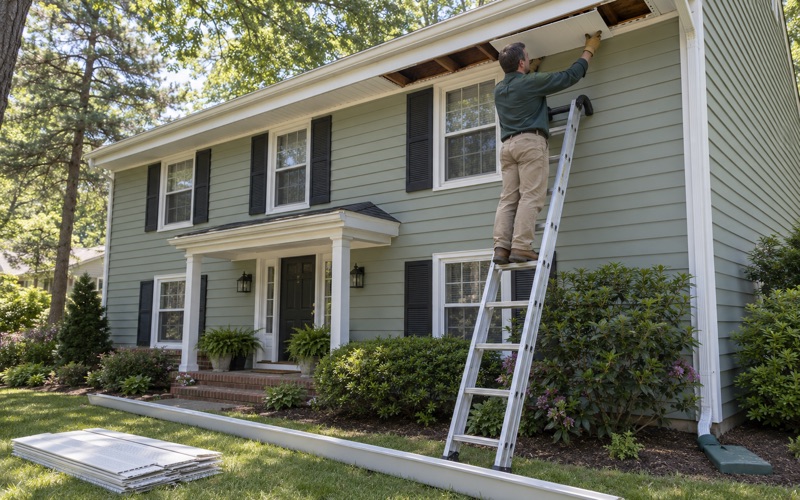
A gutter that has been overflowing for years has usually been soaking the board it hangs on. Before new gutters go up we check the fascia for rot, and if we find soft wood we show it to the owner first, so the replacement is something you have seen rather than a surprise on the invoice.
On older Wall houses, the trim may carry paint from before 1978. Where we disturb painted fascia on those homes, we follow the EPA Renovation, Repair and Painting rule for lead-safe work practices. Census figures put most of Wall’s homes before 1980, so we plan for it from the first visit.
Downspouts That Move Water Off the Foundation
Everything above comes down to one habit: we follow every downspout to the spot where its water lands. A gutter system is only as good as its outlets, and on many houses we visit the outlets are the weakest part.
Following Each Downspout to Its Outlet
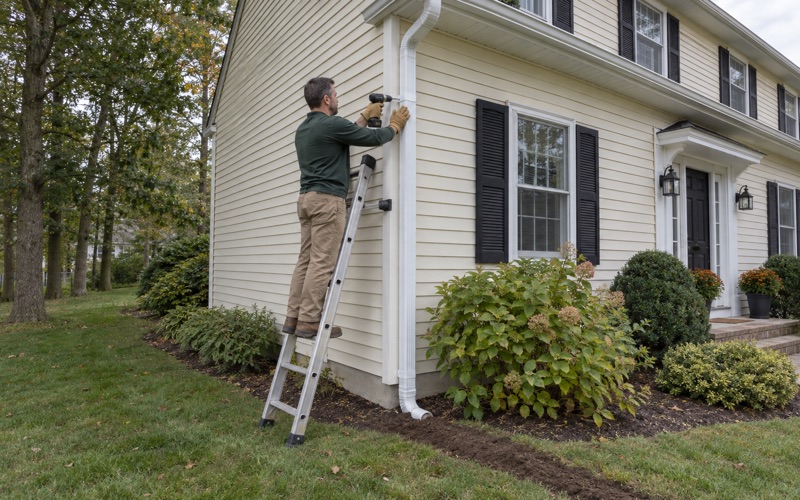
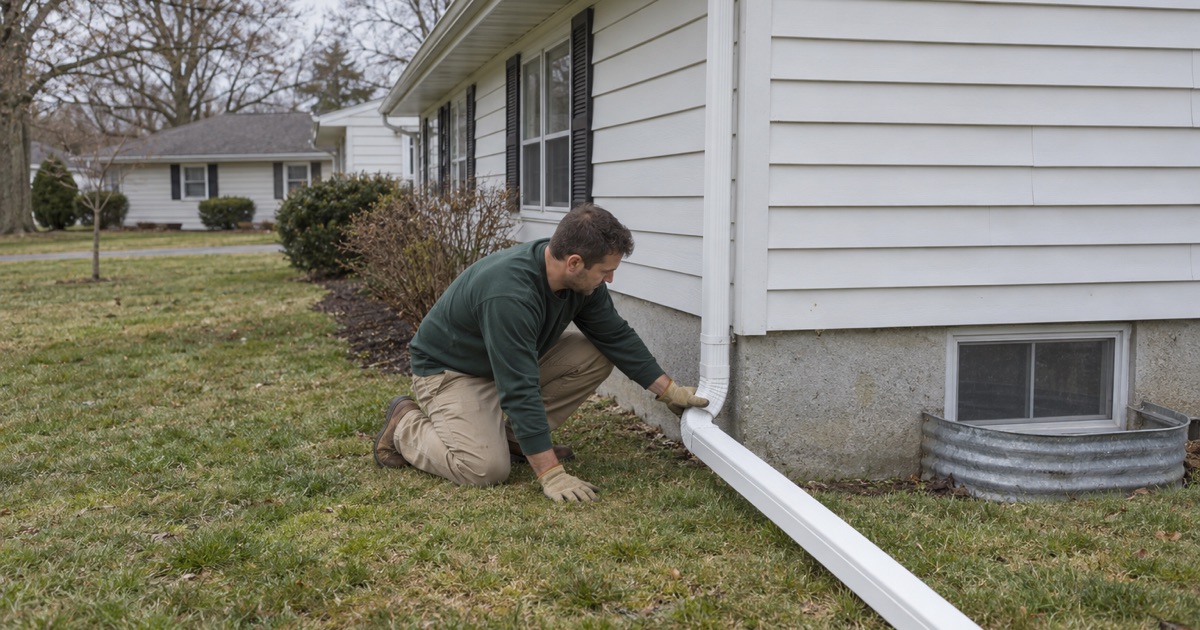
On each visit we trace the elbows, check whether a splash block is still in place, and watch where water would pool. When an outlet empties against the foundation, the estimate proposes a fix: a longer extension, an underground downspout line to a pop-up drainage emitter out in the lawn, or a drywell where the soil allows.
A drywell has its own rule. The state stormwater rule calls for dry wells to sit 2 feet above the seasonal high water table, so in wetter parts of the township an emitter or a longer surface run is often the better answer. Water that soaks into a lawn or planting bed is water that no longer heads for the street.
Wall’s sewer code, Section 222-39, bars roof leaders and downspouts, along with cellar drains, area drains and sump pumps, from the sanitary sewer. We never tie a leader outlet into the sewer, and every estimate we write states where each downspout will discharge.
That line on the estimate also helps when a home is sold. A buyer’s home inspector is required to inspect and report on the roof drainage system, and a clear record of where the outlets go answers questions before they are asked.
Gutter Checks Before Storm Season
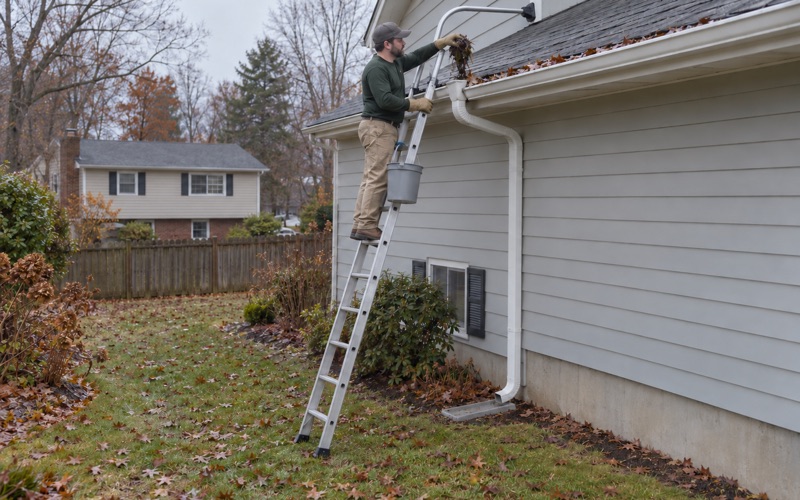
A fast-rising storm is the wrong time to learn a gutter is full. On our cleaning visits we clear every run, flush every downspout to confirm it flows, and bag the debris so nothing is left on the lawn or by the curb. You receive before-and-after photos of the work.
We also look at the trees over the roof. Oak leaves and pitch pine needles call for different guard screens, and stainless steel micro-mesh suits fine needles that slip through coarser guards. Monmouth County Mosquito Control also asks residents to keep gutters clean and properly pitched, because standing water in a sagging trough breeds mosquitoes.
How Our Estimates and Contracts Read
New gutters and gutter repairs appear on separate lines, because New Jersey treats them differently for sales tax: new gutters are an exempt capital improvement, while repairs are taxable. Our contracts follow the state’s home improvement rules, including the three-day cancellation notice.
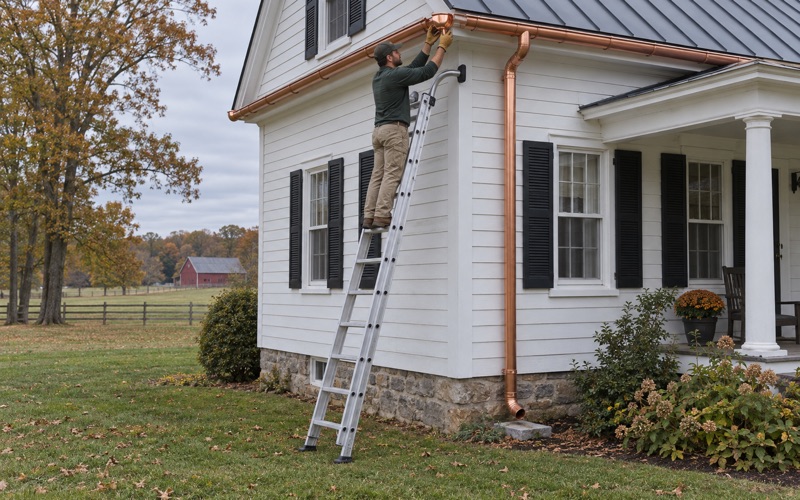
If your home is in an adult community or association, we check the master deed or ask the management office first, so you know who is responsible for the gutters before any work is scheduled. On older homes around Allaire and elsewhere in the township, we can also match copper or half-round gutters to the age and style of the house.
- 20+ Years in Business
- Seamless Gutters Formed On Site
- Before-and-After Photos