Howell Gutters has spent more than 20 years on gutters in Tinton Falls and the surrounding area, and in this borough the drainage questions often start on roofs far larger than a house. Office and flex buildings shed rain through scuppers, conductor heads and oversized leaders, and every one of those parts has to stay open for the roof to drain the way it was designed.
We work for property managers and commercial owners as well as homeowners. On a big roof the job is less about a pretty gutter line and more about capacity: how much water reaches each outlet, whether the leader below it can carry that flow, and where the discharge lands once it reaches the parking lot or the planting beds.
This page covers what changes about gutter and leader work on Tinton Falls commercial property: the big roofs along the Garden State Parkway, the drainage parts those roofs depend on, what the property maintenance code text says about keeping them clear, and how we schedule cleanouts for buildings with many tenants.
Gutters and Leaders on Tinton Falls Office and Flex Buildings
Why Large Roofs Drain Differently
A house roof sends water a short distance to an eave gutter. A low-slope office or flex roof can run hundreds of feet before the water finds an edge, so it is built to collect rain at a few chosen points instead. Those points are scuppers through the parapet, internal roof drains, or an edge gutter feeding a conductor head and a large leader.
Because the water is concentrated, a single blockage matters more. One clogged outlet on a house means an overflowing corner. On a flat roof it can mean ponding across a whole bay, water backing up under the edge metal, and a stain on a tenant’s ceiling tile before anyone on the ground notices a problem.
Sizing the Drainage to the Roof Above It
We size gutters, outlets and leaders for the roof area that actually drains to each one, not by habit or by matching what a neighboring building used. On a commercial roof that means walking the surface, noting where the crickets and tapered insulation push water, and measuring the area each scupper or edge run has to serve.
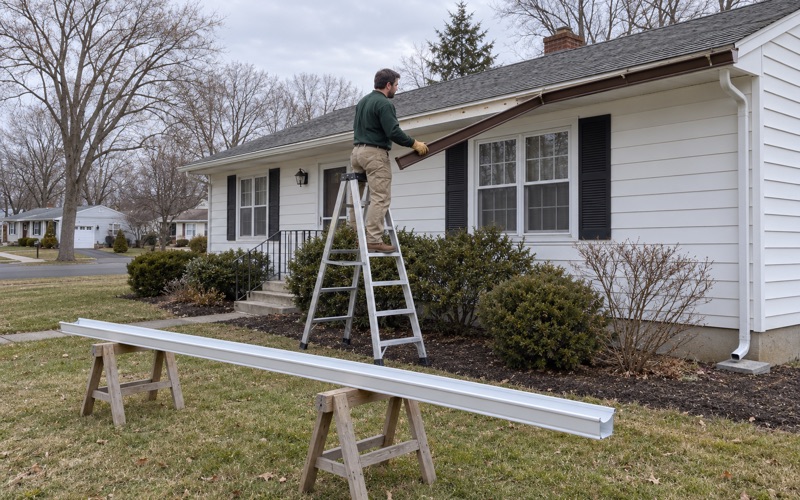
Where an edge gutter is the right answer, we form it seamless on site from coil, one piece for each run, so there are no field joints along the length to open up. Long runs on flex buildings often call for larger profiles than the 6-inch K-style seamless gutters and 3x4 downspouts common on houses, and we say so in the estimate.
Where the Water Lands at Grade
Draining the roof is only half the job. We follow every leader down to where its water ends up, and when it dumps against a foundation, across a walkway or onto pavement that ices in winter, we propose an extension, a pop-up emitter, a drywell or an underground line to carry it somewhere safer.
Leader outlets are never tied into a sanitary sewer, and every estimate we write states where each one will discharge. On a commercial site that often means tying into the storm system the site engineer laid out, or confirming that a surface outlet runs toward a swale rather than toward a tenant entrance or a loading door.
Looking for gutters closer to Shark River Hills? See Shark River Hills Gutters.
From Commvault to Bell Works: Large Roofs Near the Parkway
A 276,900-Square-Foot Campus Changes Hands
Tinton Falls carries a large office and flex stock along the Garden State Parkway, and the clearest example is the former Commvault headquarters. The building spans 276,900 square feet, was originally constructed in 2014 as a standalone development not far from the Parkway, and is being repurposed into an office and retail complex under the Bell Works brand as Bell Works Fort Monmouth.
The campus sits on a 55-acre former Army parcel that Commvault bought in 2013. Inspired by Somerset Development bought it in 2025 in a venture with H.I.G. Capital, and the campus was reported about 88% occupied, with Jersey Mike’s signing a headquarters lease and Commvault staying on as a tenant in part of the building.
We have not worked on that building, and we name it here for a different reason. A building that size, turning from a single-company headquarters into a multi-tenant complex, is exactly the kind of property where drainage maintenance moves from one facilities team to a property manager juggling many tenants and many lease terms.
Multi-Tenant Office Complexes and Flex Space
The pattern repeats on a smaller scale. In 2018 a multi-tenant office complex in Tinton Falls, two attached structures of three and two stories with 124,671 square feet of leasable area on a 10.4-acre site, sold to new owners. Buildings like that often have stepped roofs, where the upper roof drains onto the lower one before anything reaches the ground.
A stepped roof adds the upper roof’s water to the lower outlets, and a leader that discharges from the upper level onto the lower membrane wears a channel into it over time. When we look at a building of this type, we check whether those upper leaders are extended to a lower drain or simply splash onto the roof below.
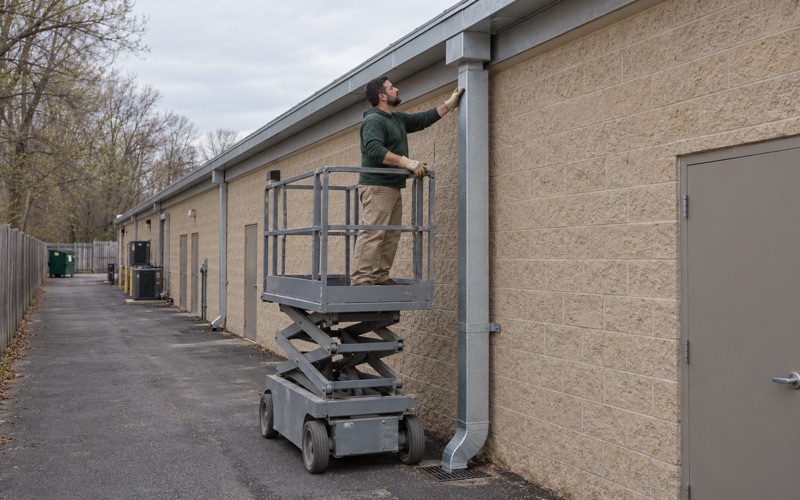
Flex and light industrial buildings near the Parkway add another wrinkle: tall walls with long edge runs and few interruptions. Those runs collect a lot of water per outlet, and a leader set behind a loading dock or a truck apron is the one most likely to be crushed, knocked off its straps or packed with windblown debris.
Scuppers, Conductor Heads and Oversized Leaders
Scuppers Through the Parapet
A scupper is an opening through the parapet wall that lets roof water leave at the edge. It is simple, which is why it fails simply: leaves, roofing granules, a lost glove or a nest of twigs gathers in the throat, and the roof behind it starts to hold water. We clear the opening and check the metal lining for open seams.
Many parapet roofs also carry overflow scuppers set slightly above the primary drains. They should stay dry in ordinary rain. When we find staining below an overflow scupper, it tells us the primary drain or scupper beside it has been backing up, and that is the outlet we open up and test with water before we leave.
Conductor Heads as the Collection Box
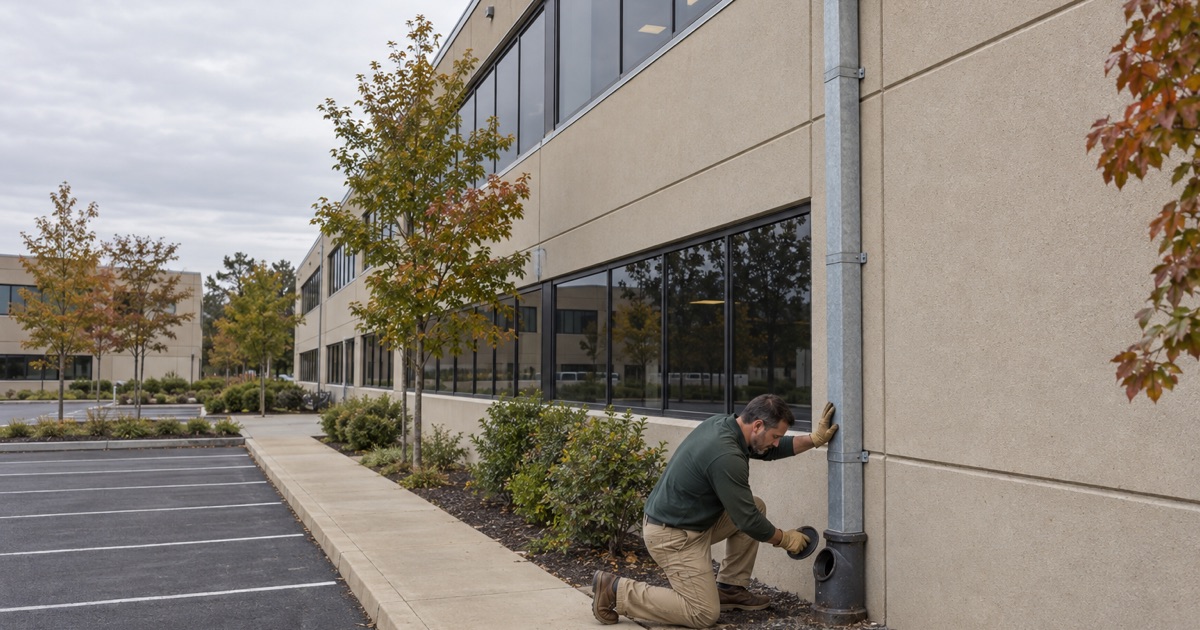
A conductor head is the box mounted just below a scupper that catches the water and funnels it into the leader. Its job is to slow and gather the flow so the leader runs full instead of spraying. Because it sits right where debris drops off the roof, it is usually the first thing to clog on a commercial building.
We empty each conductor head by hand, flush the leader below it, and confirm the outlet at the bottom runs clear. If the box has separated from the wall or rusted through at the seams, we show the property manager the photos and price a replacement head sized to the scupper above it, not a stock box that happens to fit.
Leaders, Outlets and Sealed Joints
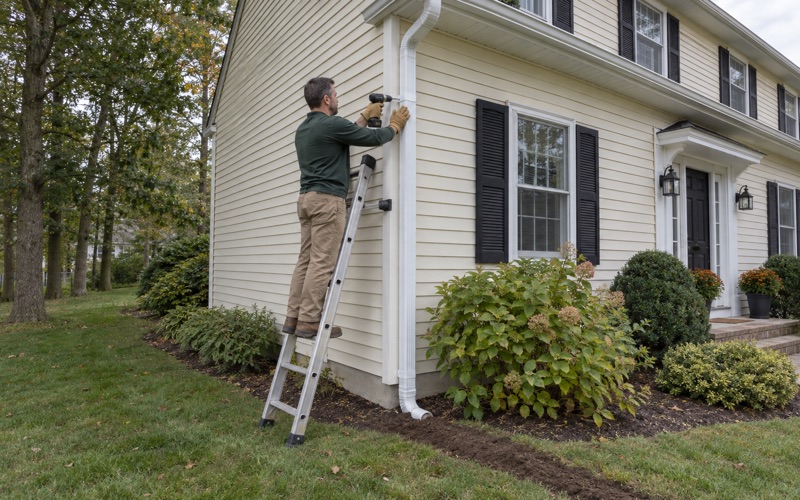
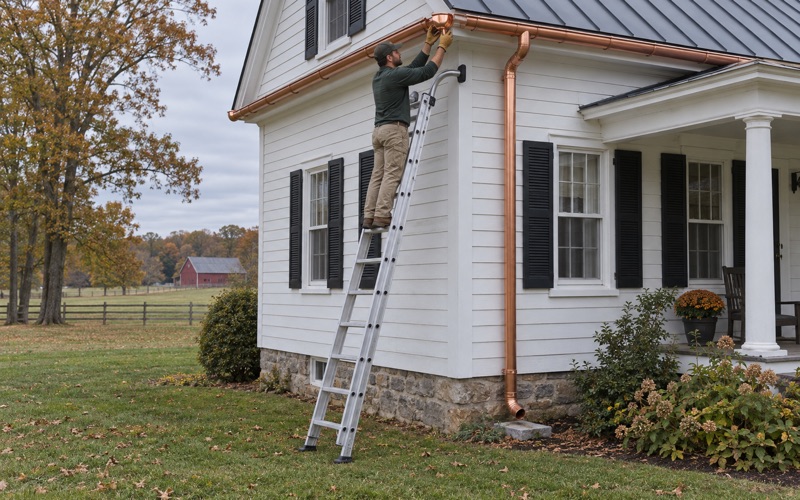
Oversized leaders carry a lot of water at speed, so their straps and joints take a beating. We check that every strap is anchored, that elbows are seated in the direction of flow, and that wide-flange outlets are sealed to the gutter or head with tripolymer gutter sealant rather than a bead of whatever caulk was in the truck.
Edge gutters on commercial roofs also depend on the wood and metal behind them. Before any new gutter goes up, we check the fascia or nailer for rot and show the owner any soft wood before replacing it, and we confirm the drip edge laps into the gutter so water cannot run down the face of the wall.
What the Maintenance Code Asks, and Scheduled Cleanouts
The Property Maintenance Code Text
The International Property Maintenance Code is written for existing buildings, nonresidential as well as residential. Its section 304.7 states that roof drains, gutters and downspouts shall be maintained in good repair and free from obstructions, and that roof water shall not be discharged in a manner that creates a public nuisance.
Excerpts of the Tinton Falls code show the borough adopting the 2018 edition of that code in its Chapter 12, though the borough’s online code index currently lists that chapter as reserved, so a property manager should confirm the current status with Borough Hall. Either way, the standard reads the same: a clogged leader on an office roof is a maintenance item, not a cosmetic one.
No Construction Permit, but a Clear Record
Repairing, replacing or installing exterior gutters and leaders counts as ordinary building maintenance under N.J.A.C. 5:23-2.7(c)1.xvi, so the work itself needs no construction permit. That does not mean it should go undocumented. Every cleaning and repair we do comes with before-and-after photos, which give a property manager a record for each outlet on the roof.
Our estimates also separate new gutters from repair work on their own lines, because New Jersey taxes the two differently: a new installation can be an exempt capital improvement, while repairing gutters is a taxable repair. For an owner tracking capital spending against maintenance, that split saves a call to the accountant later.
Scheduled Cleanouts for Multi-Tenant Buildings
One cleaning a year rarely covers a commercial roof surrounded by trees. We set a schedule with the property manager around the trees on the site, with a visit after leaves drop in late fall and another in spring, and we add a check after any storm that brings down limbs. Tropical Storm Isaias in August 2020 left uprooted trees on Tinton Falls streets.
Each visit flushes every leader and conductor head, and the debris is bagged so nothing is left on the lawn, at the curb or across the parking lot. On multi-tenant buildings we work around business hours and loading schedules where the manager asks, and the photo report goes to whoever signs off on the work.
Where a guard makes sense on an edge gutter, we match it to the trees on the lot, since pine needles and oak leaves call for different screens; stainless steel micro-mesh suits fine needles. Guards do not replace scheduled cleanouts on scuppers and conductor heads, which stay open to the roof and need a person to look at them.
- 20+ Years in Business
- Seamless Gutters Formed On Site
- Before-and-After Photos