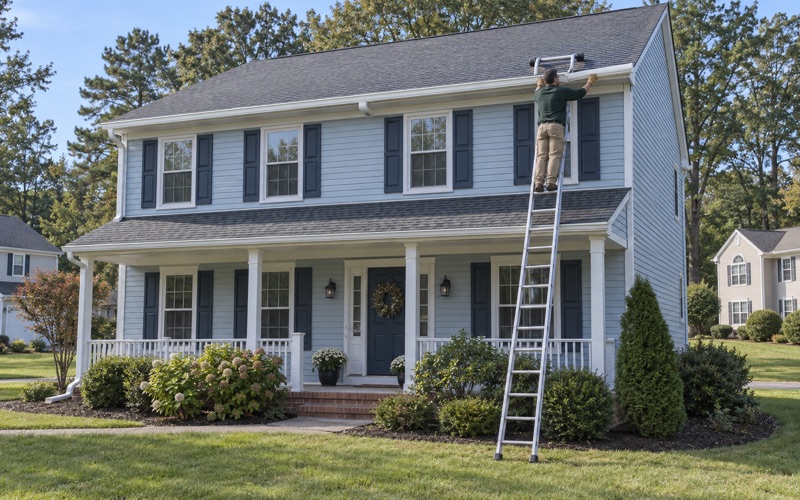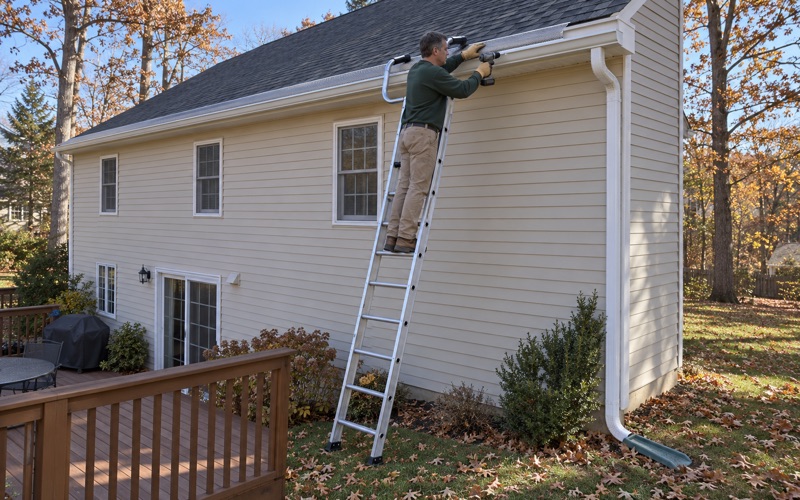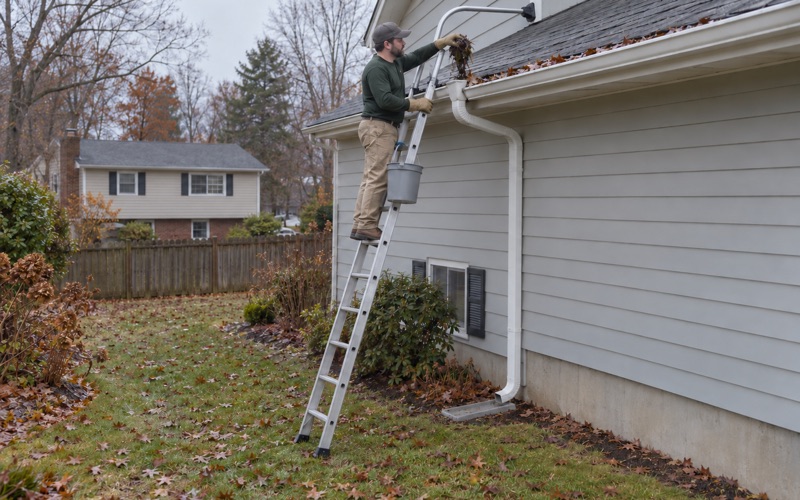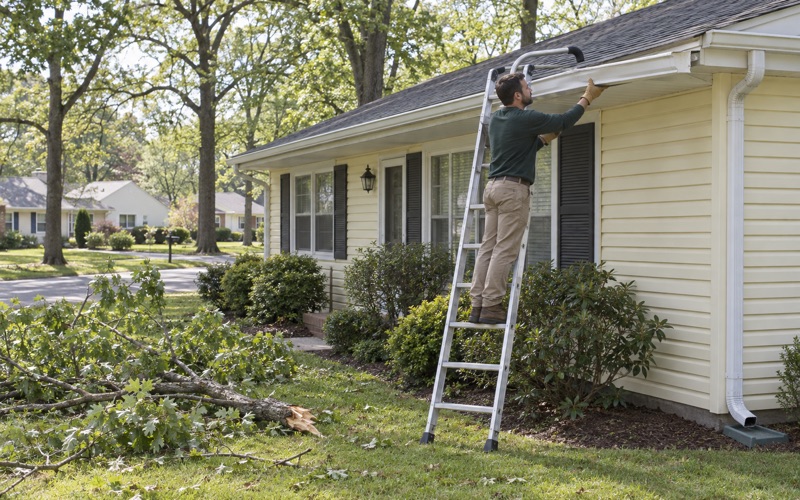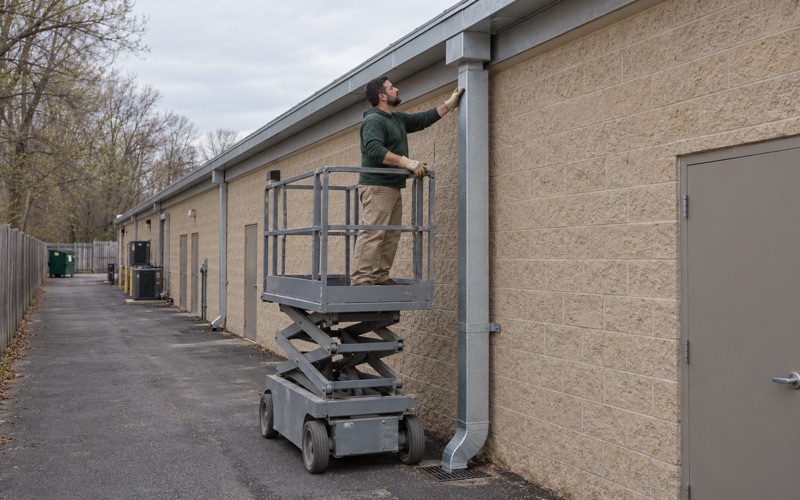
Howell Gutters has spent more than 20 years putting up and looking after gutters in Spring Lake Heights and the rest of the Monmouth County shore, and the job here always comes down to one question. Where does the water go once it leaves the roof? We size every run to the roof area draining into it, then follow each downspout to the spot where its water actually lands.
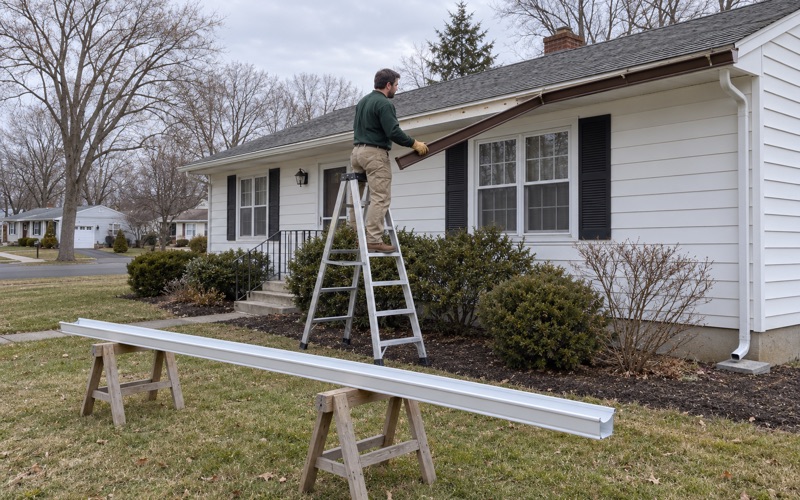
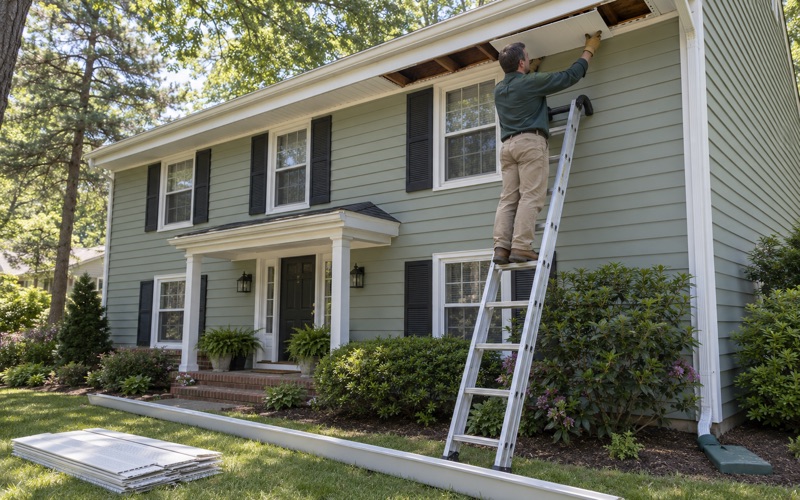
Our gutters are seamless, formed on site from coil so each side of the house gets one continuous piece with no joints along the run. Before anything is hung, we check the fascia board behind it for rot, and if the wood is soft we show it to you first and replace it only after you have seen it. A new gutter fastened to failing wood does not stay level for long.
Every estimate we write names the discharge point for each leader outlet, so you know before work starts where your roof water will end up. New gutters and repairs sit on separate lines because New Jersey taxes them differently, and our contracts follow the state’s home improvement rules, including the three-day cancellation notice.
Where Spring Lake Heights Roof Water Goes: Wreck Pond
Spring Lake Heights drains to Wreck Pond, a tidal pond the borough shares with three neighboring shore towns. The pond collects a watershed of roughly 12 square miles in eastern Monmouth County, and the borough sits along its edge. That makes a gutter here the first stage of a drainage path that ends at the ocean.
Storm Drains, Streams and the Ocean Outfall
Clean Ocean Action described the route plainly in 2014: when it rains, surface runoff picks up pollution, flows into storm drains, runs down the streams that feed the pond and then leaves through an outfall pipe in the ocean. Any roof water that reaches a street drain in the borough joins that route.
For years that outfall was watched closely. Starting in 2002, the beaches around it were shut as a precaution whenever as little as a tenth of an inch of rain fell in 24 hours, because stormwater flushing into the ocean carried elevated bacteria. In 2014 the state announced it would lift those precautionary closings.
None of this means a roof caused a closing; nothing on record ties any home in the borough to those bacteria readings. The point is simpler. Water from your roof joins the same watershed, and where a downspout releases it decides whether it soaks in on your lot or heads for the pond.
The Culvert and the Watershed Today
The pond’s outlet has been expanded since then. A gated box culvert, paid for with $7.4 million in federal, state and local money, was finished in 2016 along with a berm and a living shoreline, designed to improve tidal flows between the pond and the ocean.
A bigger outlet does not change what happens upstream. Rain still runs off roofs, driveways and streets toward the same drains, and the household decisions that slow it down are made one downspout at a time. That is the part of the watershed a gutter contractor can actually help with.
Looking for gutters closer to West Belmar? See West Belmar Gutters.
Downspouts Onto the Lawn, Not the Driveway
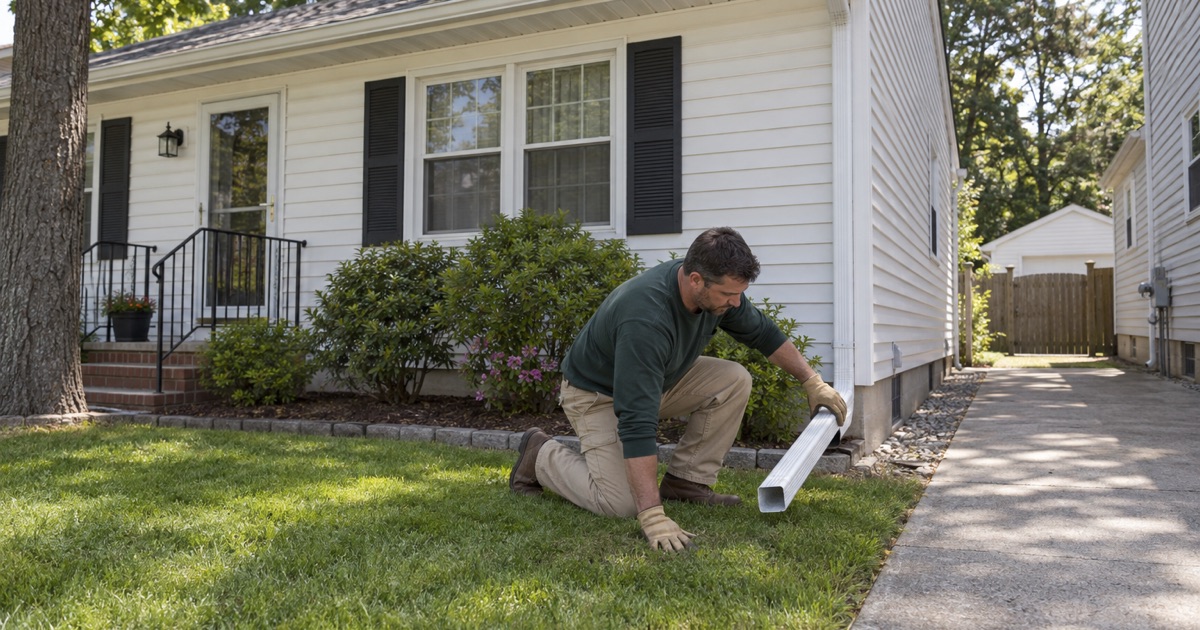
A downspout that empties onto a driveway sends roof water straight across pavement to the curb, into a storm drain and on toward the pond. The same downspout turned onto a lawn lets the water spread out and soak in first. That is general stormwater practice rather than a borough rule, and it is how we lay out discharge points on every job here.
Following Each Leader to Where It Lands
On every visit we walk the house and trace each downspout to its outlet. Many leaders were set long ago to drop onto a driveway or a walk because that was the shortest run, and few owners ever look again. With 1,822 of the borough’s homes built between 1960 and 1989, we often find layouts that date from the original construction.
Where a leader lets go matters for the house as well as the pond. Water dumped against a foundation wall works its way down along it, and the 2021 New Jersey edition of the residential code calls for grade that falls 6 inches within the first 10 feet from the foundation. A downspout should finish where that slope can carry the water away.
Extensions, Emitters and Drywells
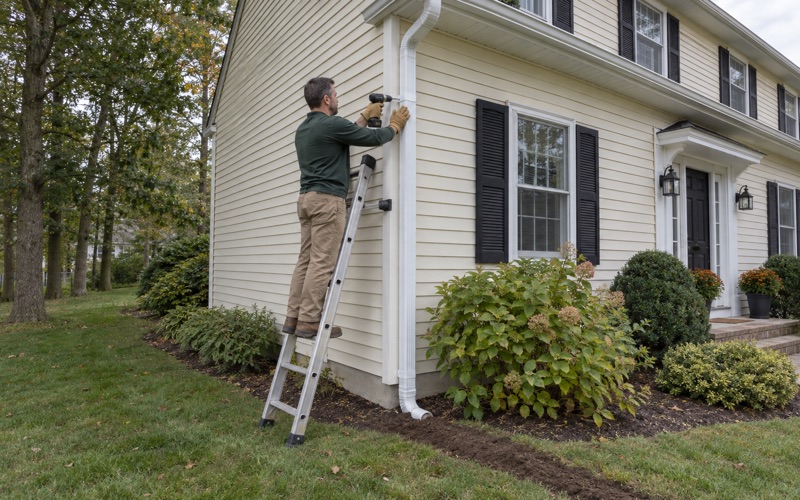
When a downspout lands in the wrong place, we propose a fix and write it into the estimate. The simplest is an extension that carries water several feet out onto the grass. Where a walk or patio is in the way, an underground line can run beneath it to a pop-up emitter that opens in the lawn and closes again when the rain stops.
A drywell is the option for a lot with no good lawn to spill onto. The state stormwater rule calls for dry wells to sit 2 feet above the seasonal high water table, so we check that before recommending one. None of these are borough requirements in Spring Lake Heights; they are choices we lay out so you can pick what suits the lot.
Keeping the Gutters Themselves Flowing
A downspout only does its job if the gutter feeding it is clear. The borough’s tree canopy covers about 26 percent of its area, enough to fill plenty of gutters with leaves each fall, and a clogged trough spills over its front edge wherever it likes. That overflow lands on whatever sits below, paved or not.
Our cleaning visits flush every downspout after the gutters are emptied, and the debris goes into bags rather than onto the lawn or the curb, where it would wash toward a storm drain. You get before-and-after photos of the work. If the trees over your roof keep refilling the gutters, we match a guard to the species, since oak leaves and pine needles need different screens.
When the Pond Rises: Irene on Shore Road and Route 71
Low ground near Wreck Pond floods in a big storm. During Tropical Storm Irene on August 28, 2011, the parking lot of the Spring Lake Heights Center was completely flooded, and Shore Road, which runs along the pond’s northwest edge, was under water on both sides of Route 71. Flood water also filled stretches of the Route 71 corridor.
What a Storm Like That Means for a Gutter System
No gutter keeps a pond from rising, and we will not pretend otherwise. What a gutter system can do is handle a heavy downpour without adding to the problem on your own lot. That starts with size: a run carrying water from a large, steep roof section needs more capacity than a short run under a small dormer.
We work out the roof area that drains to each run and choose the gutter and downspout sizes from that, rather than putting the same size on every elevation out of habit. On many houses that means 6-inch K-style seamless gutters with 3x4 downspouts on the long runs, formed from .032 aluminum coil so the trough holds its shape under a full load.
Hangers matter in a downpour too. Hidden hangers screwed into the fascia hold far better than the old spike and ferrule, which tends to work loose as the wood around it dries and swells. A gutter pulling away from the fascia dumps water behind itself, right where the trim and foundation least need it.
Flashing at the Roof Edge
Some water in a heavy storm never makes it into the gutter at all. Without a gutter apron or drip edge, water running off the shingles can curl back under the edge and soak the fascia, and where a roof meets a sidewall, a missing kickout flashing sends water down the siding. We check both when we hang new gutters.
Joints are the other weak point in a hard rain. Seamless runs remove most of them, leaving only the corners and outlets, where we use box, strip or bay miters as the roofline calls for and seal them with tripolymer sealant. Wide-flange outlets help a downspout keep up with a full gutter.
Leaders, the Sanitary Sewer and Borough Code
One destination is off the table in Spring Lake Heights. Borough code § 14-1.4, drawn from ordinances adopted in 1966 and 1992, says no person shall connect any drain or leader designed to collect ground or surface waters into a sanitary sewer in the borough. A gutter leader is exactly that kind of drain.
Why the Sewer Is Kept for Wastewater
A sanitary line is built to carry what leaves the sinks and toilets, not a roof’s worth of rain arriving all at once. Storm water dumped into it takes up capacity the system was never sized for. We treat the borough’s rule as a hard line on every job.
Older houses sometimes turn up a leader running into a pipe at grade with no clear record of where that pipe goes. When we find one, we tell you what we see and do not reconnect a new downspout to it until its destination is known. If it cannot be confirmed, the new leader discharges above ground instead.
What Our Estimate Puts in Writing
The discharge plan in our estimate is also how you can check the borough rule has been followed. Each outlet is listed with its endpoint, from a splash block on the lawn to an extension, emitter or drywell, and none of them ends at the sanitary sewer.
If your home is part of an association, we check the master deed or ask the management office before quoting, so you know whether the gutters are yours to replace or the association’s. Owners of attached homes should also know that some gutter warranties run shorter on a condominium or duplex than on a detached single-family house.
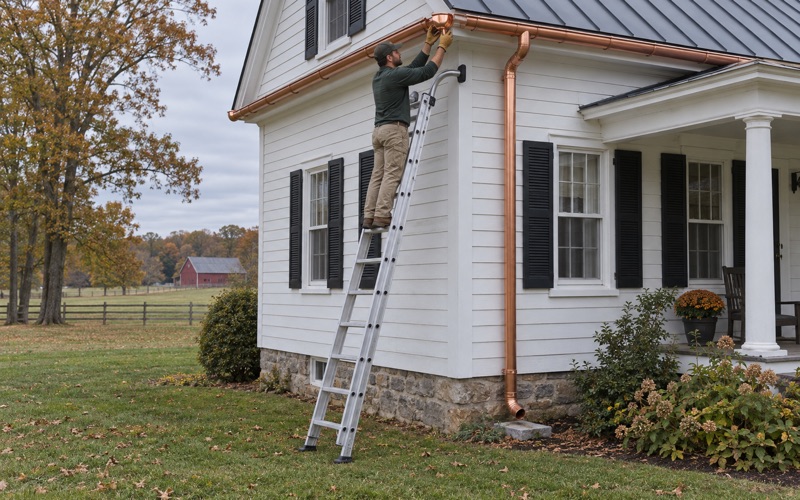
The same plan applies whatever the gutter is made of. On an older house where copper or half-round work suits the architecture, we match the profile to the age and style of the home and still route every leader to a spot where its water can soak in.
- 20+ Years in Business
- Seamless Gutters Formed On Site
- Before-and-After Photos