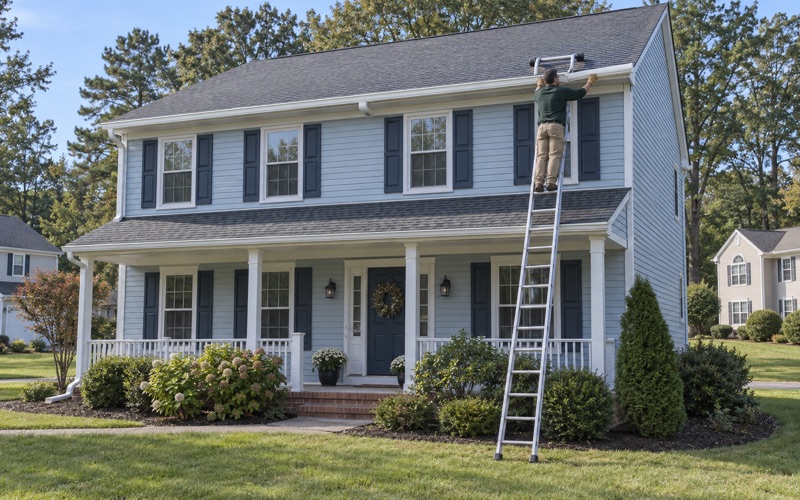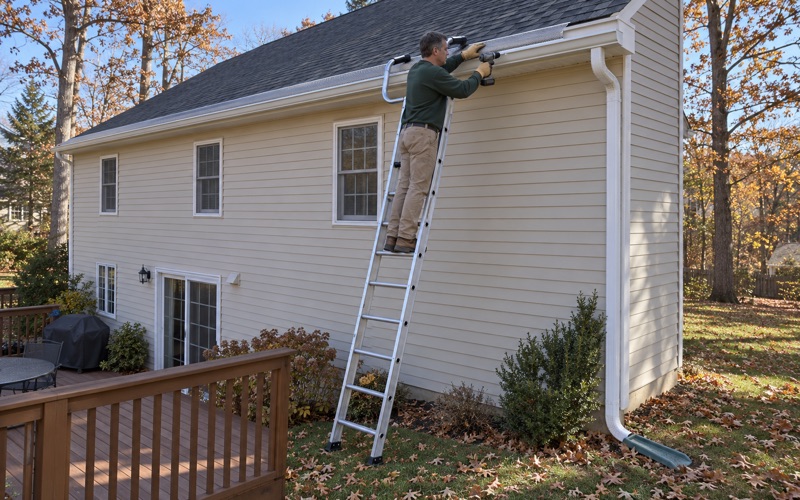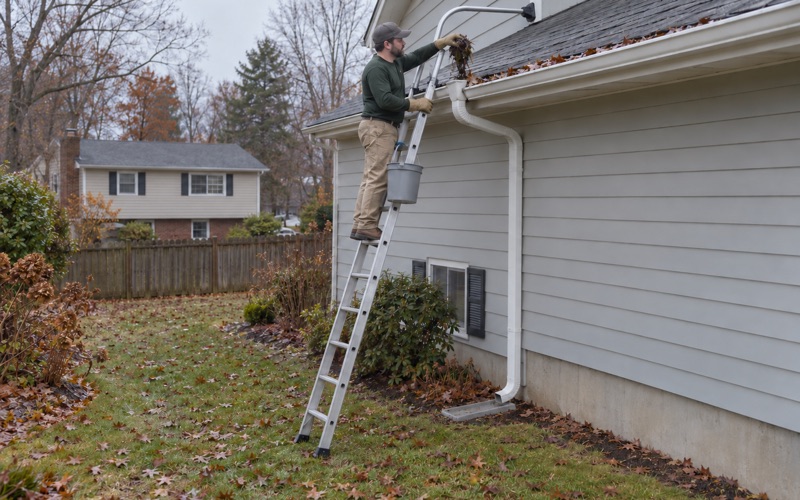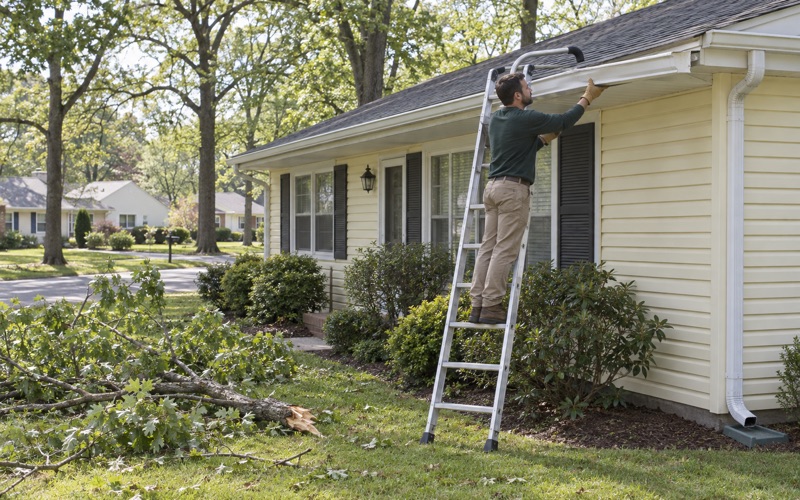
Howell Gutters installs, repairs and cleans gutters in Shark River Hills, and after more than 20 years on Monmouth County roofs we treat every job here as a question of where the water goes once it leaves the roof. A gutter that holds its pitch is only half the system. The other half is the leader, the outlet it drops into and the ground it finally reaches.
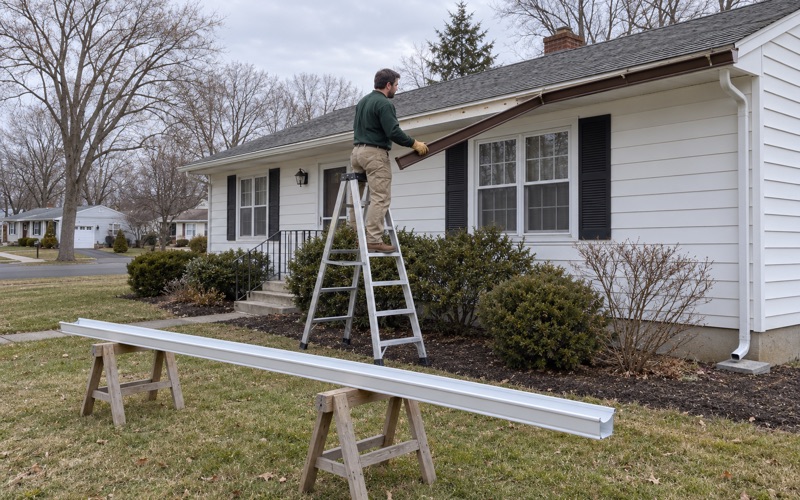
We size each gutter and downspout to the roof area that feeds it, and we form seamless runs on site from coil so every side of the house gets one continuous piece. Before anything is hung, we check the fascia board for rot and show the owner any soft wood we find. Then we walk each leader to its discharge point and write that point into the estimate.
That last step matters more on this side of Neptune Township than almost anywhere we work. The sections below explain why, and what it means for the gutters, leaders and yard drainage on a home in The Hills.
Every Downspout in Shark River Hills Drains Toward the Estuary
Shark River Hills is a census-designated place inside Neptune Township, set on a peninsula with the Shark River estuary along its east and south sides. Route 18 runs down its western edge. Of its 1.23 square miles, 0.37 is water, which tells you how much shoreline wraps around a fairly small neighborhood.
One Receiving Water for Every Roof
For a gutter contractor, that geography settles one thing early. Whatever a downspout lets go of on a lot here, whether it soaks into the lawn or runs to a street inlet, the estuary is the water body at the end of the line. We cannot trace every flow path street by street, but the peninsula leaves little doubt about where the river sits.
The river is not quiet water either. During the August 13, 2018 flash flooding, Wall Township Police relayed a warning that sharp rises along the Shark River, the Manasquan and the North Branch Metedeconk were occurring in response to the extreme runoff. When a storm drops that much rain, the roof is one of the first surfaces to shed it.
Sizing Gutters for the Water They Carry
Because so much rides on where roof water ends up, we start with how much of it each run has to move. We measure the roof planes that drain to every gutter and choose the gutter width and the number of downspouts from that area. On many homes that means 6-inch K-style seamless gutters with 3x4 downspouts, but the roof decides, not habit.
An undersized gutter overflows at its corners during a heavy burst, and that overflow lands wherever the eave happens to sit, usually right against the foundation. A properly sized run carries the water to a leader we have planned for. That is the difference between water you have chosen a place for and water that picks its own.
Decisions That Belong to the Owner
Every home in the CDP is a detached, owner-occupied house, according to the Census Bureau’s 2024 five-year estimates. There are no landlords or rental managers between you and these choices, so the decision about where each leader discharges is yours to make.
Looking for gutters closer to Neptune? See Gutters in Neptune.
What the 2016 Clam-Bed Closure Showed About Storm Pipes
The Shark River estuary supports shellfish beds, and the state watches those beds for bacteria. The closure in 2016 shows how directly the pipes under nearby streets connect to that water, and it is the clearest local example of why clean water and sewage need to stay in separate systems.
Bacteria in the River, Sewage in a Storm Pipe
In early November 2016, state Department of Environmental Protection staff detected what they called extremely elevated bacteria levels in the Shark River. Clam harvesting was suspended on 122 acres off Neptune City and 144 acres off Belmar, according to a March 2017 WHYY report.
Investigators used dye tests and cameras to find the cause: sewage leaking into a stormwater discharge pipe at West Sylvania Avenue in Neptune City. The source was two leaking municipal sewer lines, which were then repaired. Sewage had found its way into a pipe built to carry rain, and that pipe ran to the river.
What the Episode Does and Does Not Mean
We want to be precise here, because it is easy to overstate. Roof water did not cause that closure, the affected beds were off Neptune City and Belmar, and no source we know of names gutters as a pollution problem on this river.
What the episode does show is the route. A storm pipe on this river runs straight to the shellfish waters. Whatever enters that pipe is headed for the estuary, which is why keeping clean roof water and sewage in their own systems is worth the care it takes.
A local group planned to track bacteria discharged into the western portion of the river’s basin. For a homeowner, the practical lesson is narrower and simpler: know where your leaders go, and make sure none of them end up anywhere but the yard or the storm system.
Keeping Roof Water Out of Neptune’s Sewer and On the Lot
Shark River Hills is governed by Neptune Township, and the township’s sewer code draws a firm line between roof water and sewage. Section 16-3.7, in the chapter on sewers, bars connecting roof downspouts, foundation drains and areaway drains to the township sewer.
Why the Sanitary Line Is Off Limits
A sanitary sewer is sized for what drains out of the house, not for the burst of water a roof sheds in a heavy storm. Tie a leader into it and every downpour adds volume the line was never meant to carry. Neptune’s rule keeps that from happening, and it keeps the two kinds of water apart from the start.
We never tie a leader outlet into the sanitary sewer, on any job. If we find an existing leader that disappears into the ground and we cannot tell where it goes, we say so plainly and leave the decision about investigating it with you rather than guessing.
Where a Leader Should Let Go
With the sanitary sewer ruled out, roof water from a Shark River Hills house has two legitimate places to go: onto the lot, or into the storm system. Which one it reaches depends on where the leader lets go. Water released onto a lawn has a chance to soak in, while water dumped onto a driveway tends to run for the street.
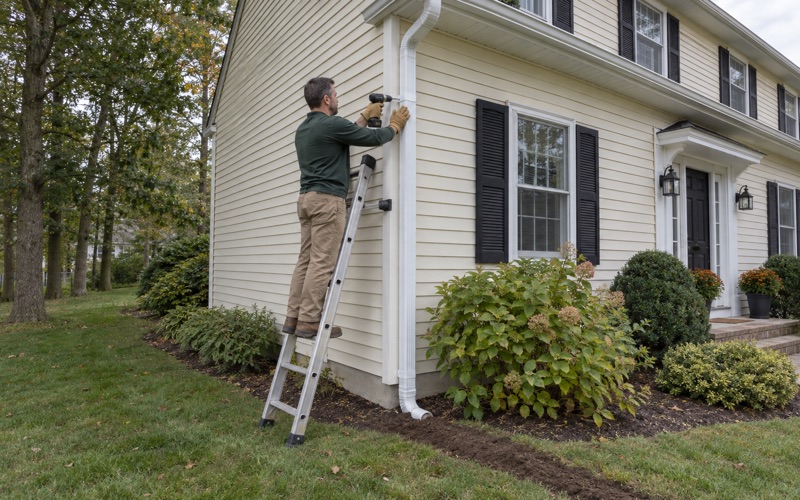
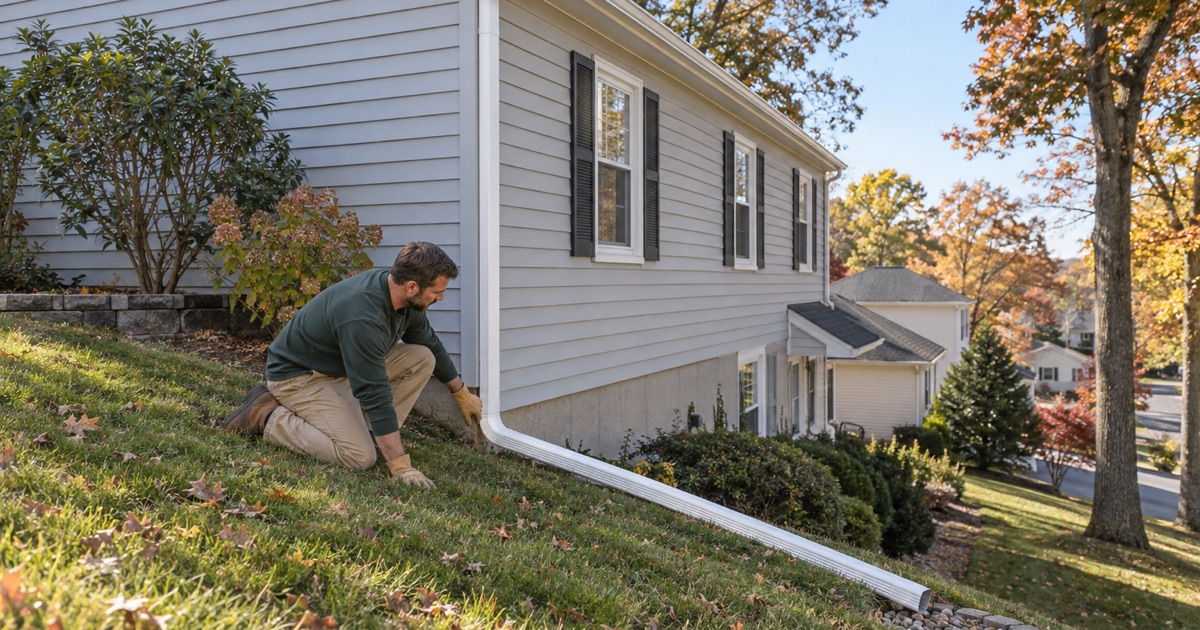
We follow every downspout to the spot where its water lands. When it lands against the foundation, we propose an extension, a pop-up drainage emitter or a drywell to move it away from the house. The goal is grade working with the water: under the IRC 2021 New Jersey edition, lot grade must fall at least 6 inches within the first 10 feet of the foundation.
On a lot this close to tidal water, a drywell needs care. New Jersey’s stormwater rule, N.J.A.C. 7:8, calls for dry wells to sit 2 feet above the seasonal high water table, so we confirm that clearance is realistic before we suggest one. When it is not, a surface emitter well out on the lawn is often the simpler answer.
Putting the Discharge Points in Writing
Every estimate we write for a Shark River Hills home lists where each leader will discharge. You see the plan before any metal goes up, and you can ask us to move a discharge point away from a patio, a walkway or a neighbor’s side yard before the work is final.
The same estimate lists new gutters and repair work on separate lines, because New Jersey treats them differently for sales tax: new gutters are an exempt capital improvement, while repairs are taxable. Our contracts follow the state’s home improvement rules, including the three-day cancellation notice.
Gutter Care for Waterfront Homes in The Hills
Neptune Township’s page on Shark River Hills describes a peninsula overlooking 3 1/2 miles of scenic waterfront, popularly known as The Hills. The area was marketed as a summer resort in 1923, and its property owners association was founded in 1929.
Older Houses and the Fascia Behind the Gutter
Census estimates show most homes in the CDP were built before 1980, with the 1950s and 1960s accounting for the largest shares and 185 homes dating to 1939 or earlier. On houses that age, the fascia board behind the gutter has often been through more than one set of gutters already.
That is why our fascia check before any new run is never skipped. Where the fascia and trim carry old paint on a pre-1978 house, we work under the EPA’s Renovation, Repair and Painting rule whenever that paint is disturbed.
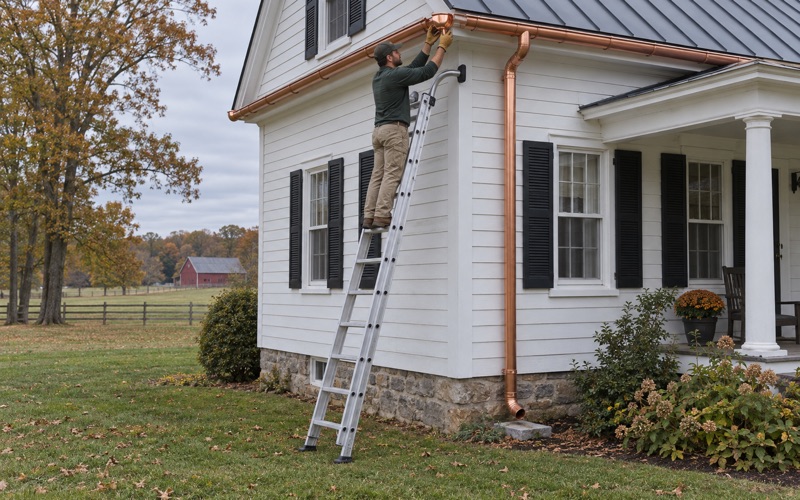
For older and more traditional homes, we can also match copper or half-round gutters to the age and style of the house. Half-round with a double-bead profile, or 16-ounce copper left to weather into its patina, can suit a house from the 1930s far better than a modern K-style profile.
Cleaning, Guards and Storm Season
Around the Shark River basin, flash flooding from heavy rain and tidal flooding from storms happens on average more than half a dozen times a year, according to a 2026 News12 report. A clogged gutter during one of those storms spills at the eave, which puts water exactly where we have worked to keep it from landing.
Our cleaning visits flush every downspout, bag all the debris and haul it away, so nothing ends up on the lawn, at the curb or in the nearest storm inlet. You get before-and-after photos of the gutters and leaders, which helps on a house where much of the roof line is hard to see from the ground.
Guards come next for many owners, and we match them to the trees on the lot. Pitch pine needles and oak leaves call for different screens, and stainless steel micro-mesh handles fine needles that slip through coarser guards. We look at what actually falls on your roof before recommending anything.
Whatever the job, the aim on a Shark River Hills house stays the same: gutters sized to the roof, leaders that keep clean water clean and out of the sewer, and discharge points you have seen and agreed to before we leave. That is the standard we hold every run to.
- 20+ Years in Business
- Seamless Gutters Formed On Site
- Before-and-After Photos