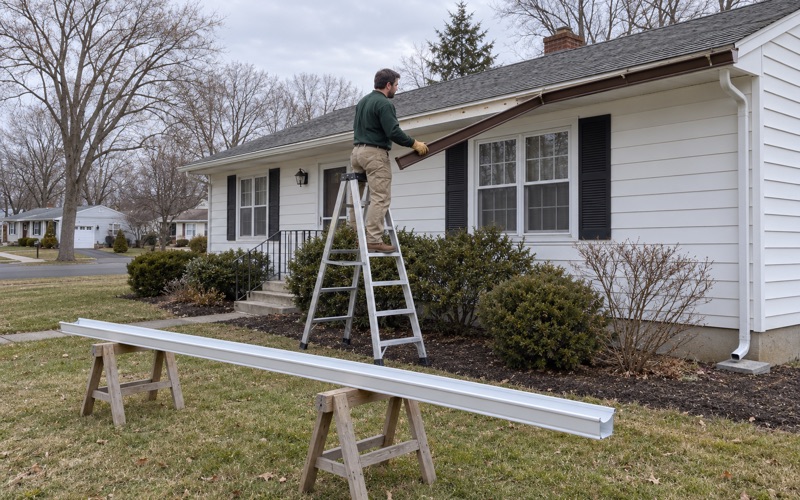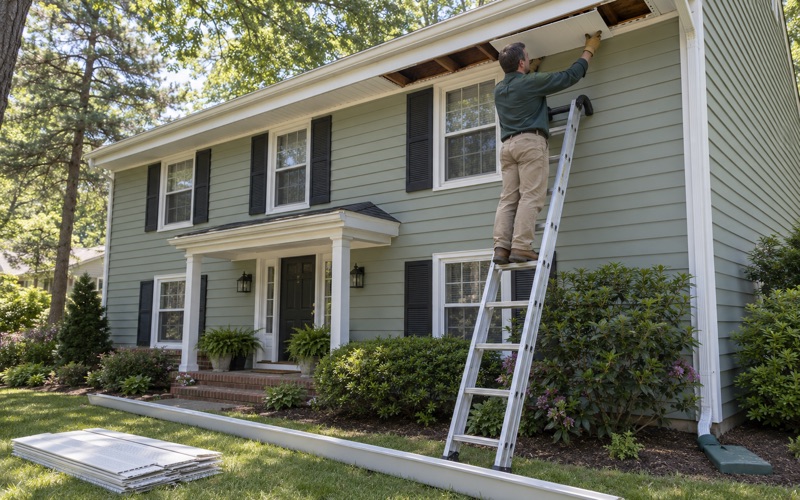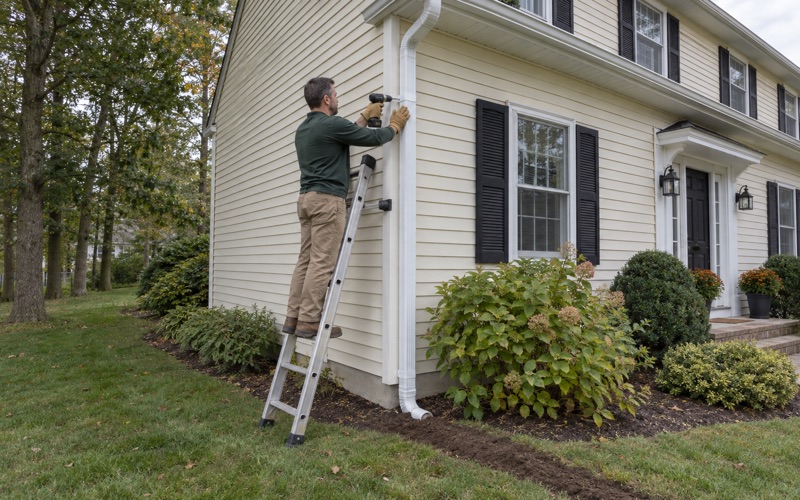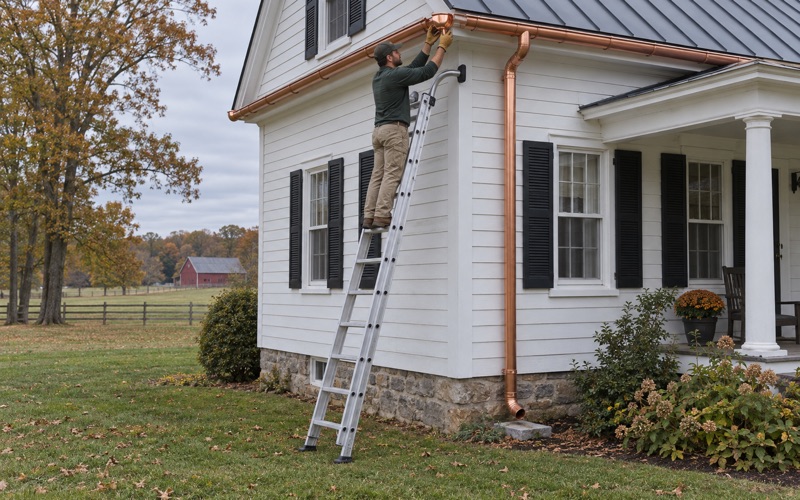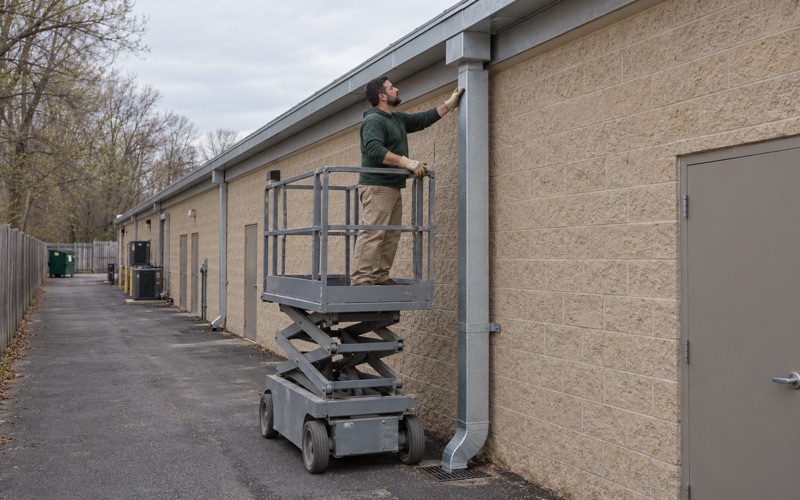
Howell Gutters has spent more than 20 years on gutters in Robbinsville and the rest of central New Jersey, and the part of the job we think about longest here is not the trough on the eave. It is the last few feet of each downspout, where roof water either leaves the property cleanly or comes back to sit against the house. A gutter that fills and empties on schedule does nothing for a basement if its leader dumps into ground that is already holding water.
That is why our estimates on a Robbinsville house start at the bottom of the downspouts and work up. We size each run for the roof area that drains into it, form seamless gutters on site from coil, and then follow every leader to its outlet. If the water lands against the foundation, we propose an extension, a pop-up emitter or a dry well, and we say which one suits that spot and why.
Where the soil cooperates, a buried line is a tidy answer. Where it does not, the better answer usually sits on the surface, and the sections below explain how we tell the difference.
Downspouts Where Robbinsville’s Water Table Runs High
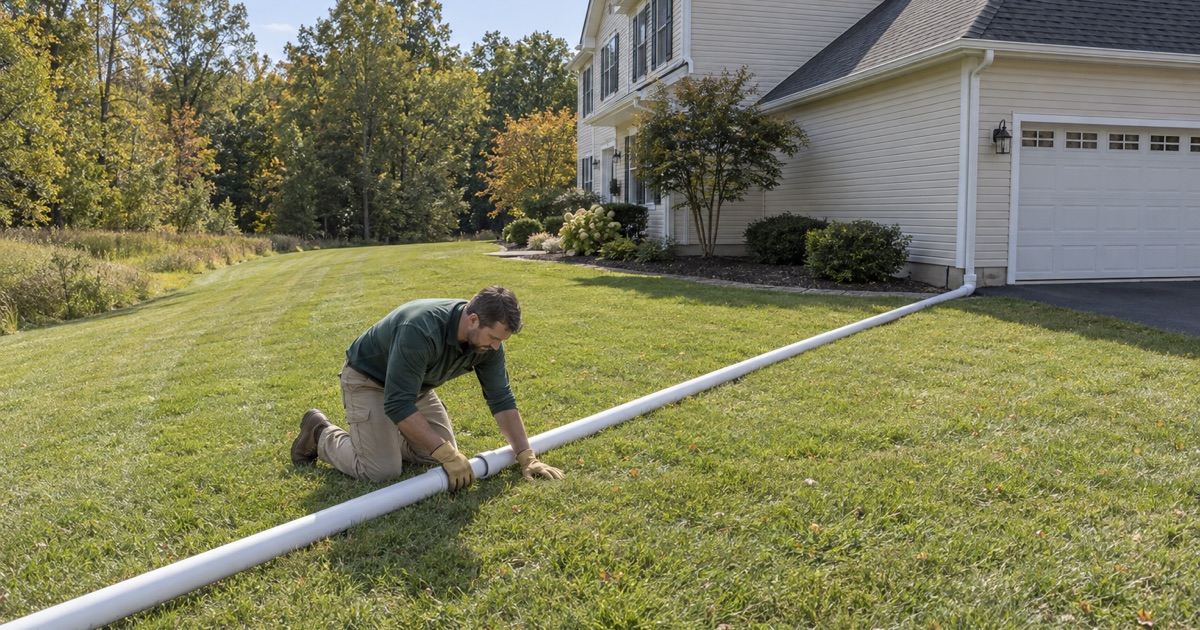
Robbinsville’s own land use ordinance says a good deal of its ground holds water. Chapter 142, Section 142-13A sets the density of the RR Rural Residential district at one unit per two acres, and the code states that this density recognizes “the septic unsuitability and seasonal high water table of many of the soil types.” That is the township describing its own soils, not a contractor’s guess.
The RR district is the open, farm-edged side of the township. A Garden State Preservation Trust table credits Robbinsville with 23 preserved farms covering 1,363 acres through fiscal year 2020, and the houses near that farmland tend to sit on large lots with long setbacks. Those are the properties where the water-table language in the code matters most to a downspout, and where a septic field is one more patch of ground a leader should stay away from.
What a seasonal high water table means for a leader
A seasonal high water table is groundwater that rises close to the surface for part of the year, usually in the wet months, and drops back later. Anything buried in that zone spends those months sitting in water. A downspout line or a dry well installed in August can look fine and still be full of groundwater by March.
When that happens, roof water has nowhere to go. It backs up the pipe, spills out of the downspout joint at grade, and ends up along the foundation, which is exactly where the system was supposed to keep it from landing.
Reading the lot before choosing a discharge
We have not read a soil map for any particular Robbinsville street, and we do not pretend to know how deep groundwater runs on a given lot before we look. What we can do on site is read the evidence: wet low spots that linger after rain, sump pumps that run in spring, existing underground lines that hold water, and how the yard grades away from the house.
The 2021 New Jersey edition of the residential code, R401.3, calls for grade to fall 6 inches within the first 10 feet from the foundation. If the ground around a house already does that, a surface outlet a few feet out often works with no digging at all, and we would rather recommend that than bury pipe in wet soil.
Looking for gutters closer to South Amboy? See Gutters Services in South Amboy.
Dry Wells and the 2-Foot Separation
A dry well is a buried chamber or pit filled with stone that takes roof water and lets it soak into the surrounding soil over time. It is a sensible tool on the right lot, and we install them where conditions support one.
The separation New Jersey’s manual asks for
The New Jersey Stormwater Best Management Practices Manual, in its chapter on dry wells, calls for a minimum of 2 feet between the bottom of the dry well and the seasonal high water table. The reasoning is simple: the soil under the well has to be able to accept water, and saturated soil cannot. Without that separation the well fills with groundwater and stops working as storage.
The same chapter limits dry wells to runoff from clean rooftops and says treating runoff from other surfaces is prohibited. That matches how we use them: a dry well takes leader water only, never a driveway drain or a patio trench.
Keeping a dry well working
A dry well that does have the separation still needs clean water to last. Leaves, shingle grit and pine needles that wash down a leader settle in the stone and slowly seal it. We put a cleanout or leaf trap at the top of the line and recommend a guard on gutters that feed a well, so the chamber takes water rather than sediment.
Why a dry well is not always our recommendation here
That manual is written for designed stormwater systems, and we use its 2-foot figure as a practical yardstick for a homeowner dry well rather than as a rule a house must meet. On a Robbinsville lot where the ground stays wet into spring, the honest advice is often that a dry well will spend part of the year underwater. In that case we will say so on the estimate.
When the ground does drain, we place the well away from the foundation and the septic field, size it for the roof area it serves, and fit an overflow so a heavy storm does not push water back up the leader. When it does not drain, we put the money into surface discharge instead.
Open Ditches, Swales and Surface Discharge on Two-Acre Lots
Outside the denser neighborhoods, Robbinsville’s code allows a different street pattern. Section 142-13F(2)(c), which covers RR district local streets built to reduced standards, says surface stormwater drainage may be carried in open ditches either inside or outside the right-of-way. On those roads there is no curb and inlet out front, and runoff moves along the shoulder instead.
Where downspout water goes on an RR lot
On a two-acre lot, the distance from house to road is usually generous, and that space is an asset. A downspout extension, a shallow lined swale, or a pipe that daylights well out into the lawn can spread roof water across open ground long before it reaches the edge of the property. Most of the time that is the working answer, because nothing has to sit below the water table to function.
Where a line would run toward a roadside ditch, we treat that as a question to settle before any digging. Robbinsville’s illicit discharge ordinance, Ord. 2006-26, prohibits putting anything other than stormwater into the township’s storm sewer system, which it defines to include streets, curbs, gutters, ditches and storm drains. We keep grass clippings, debris and anything else out of that path, and we check with the township before pointing a line at the right-of-way.
Sizing each outlet to the roof
Surface discharge only works if each outlet carries a share of roof water the ground can take. On a larger house we often split a roof plane across more downspouts rather than sending a whole side to one corner, using 6-inch K-style seamless gutters and 3x4 downspouts where the roof area calls for them. Spreading the water across several outlets keeps any one patch of lawn from turning soft.
Keeping leader water out of the sewer
On the newer streets that tie into public sewer, the same principle applies from the other side. We never connect a leader outlet to the sanitary sewer, and every estimate names where each downspout will discharge, so there is no guessing after the crew leaves.
On wooded lots we also match guards to the trees, since oak leaves and pine needles call for different screens. Less debris in the gutter means less debris washed into a swale or an emitter.
Clearing Underground Downspout Lines That Back Up
Many Robbinsville homes were built between 1980 and 2009, and a fair number of them have buried downspout lines that have been in the ground for many years. When one of those lines stops draining, the first sign is usually water spilling at the boot where the downspout meets the pipe.
Finding out why a line has stopped
A buried line can fail for a few reasons: leaves and grit packed into an elbow, a crushed section under a driveway edge, roots at a joint, or a run that sits in groundwater for part of the year. We flush the line from the top, check how it flows at the outlet, and work out which of those we are dealing with before we quote anything.
A clog is a cleaning job. A line that holds groundwater every spring is a design problem, and clearing it will not change the result.
We also look at the boot itself, especially where a downspout drops into the ground behind shrubs. A cracked adapter or a downspout that has pulled out of its fitting lets water pour into the backfill right against the foundation, which can look like a clogged line when it is really a loose joint.
Repair, reroute or bring it to the surface
If the pipe is sound and simply blocked, we clear it and fit a pop-up emitter at the outlet so the next clog shows itself. If a section is crushed, we replace that section. If the line sits too low in wet ground, we recommend rerouting it shallower or bringing the downspout above grade to an extension or swale.
We also check the fascia behind the gutter while we are on the ladder, and any soft wood is shown to the owner before it is replaced. Every cleaning visit flushes each downspout, bags the debris rather than leaving it on the lawn, and comes with before-and-after photos.
How the paperwork reads
Estimates list new gutters and repair work on separate lines, because New Jersey taxes the two differently. Contracts follow the state’s home improvement rules, including the three-day cancellation notice, so a Robbinsville owner knows exactly what was quoted, where every leader will discharge, and what they agreed to.
- 20+ Years in Business
- Seamless Gutters Formed On Site
- Before-and-After Photos