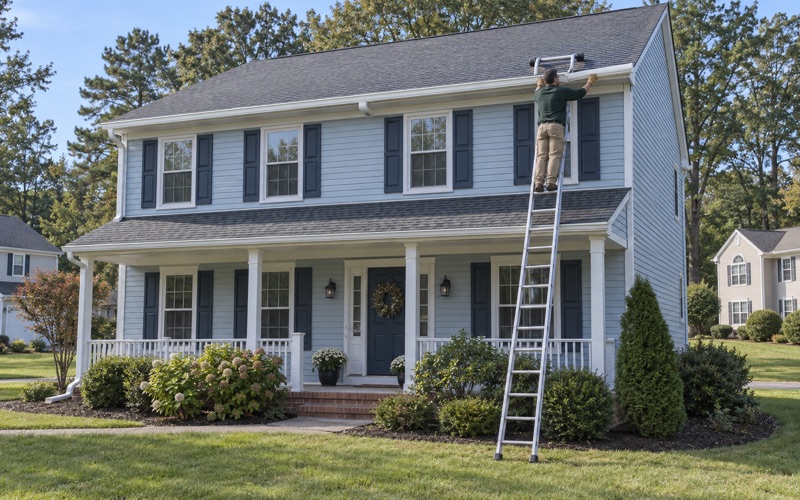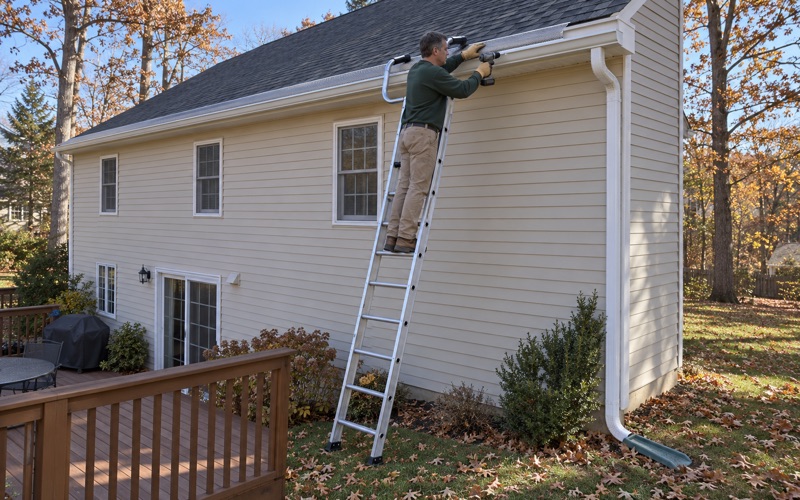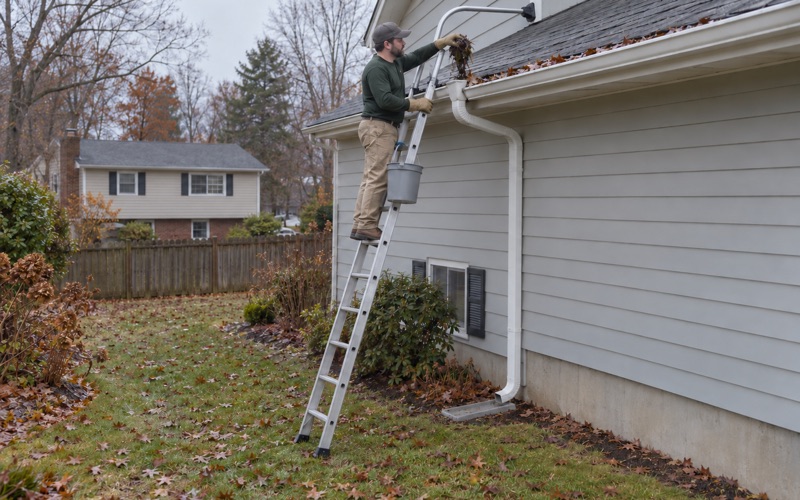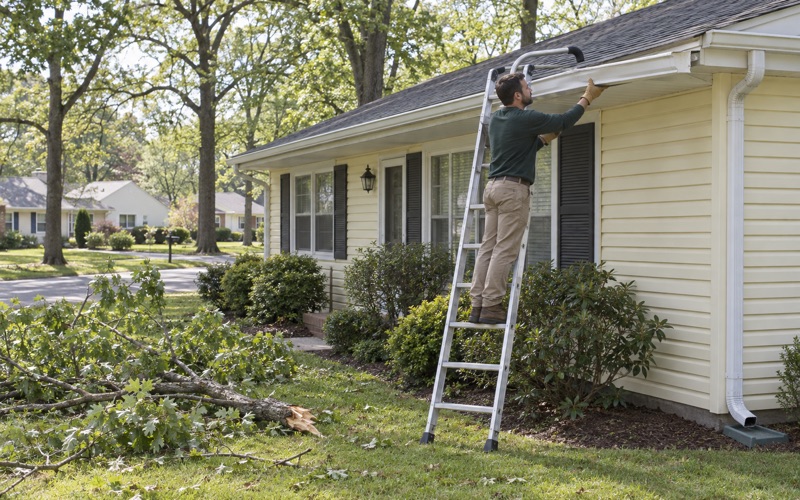
Howell Gutters has spent more than 20 years installing, repairing and cleaning gutters in Red Bank, and much of that work is for owners who do not live in the building they are maintaining. When a house holds two, three or four apartments, a clogged run or a split downspout is more than a nuisance for the tenant upstairs. It is a maintenance item the owner answers for.
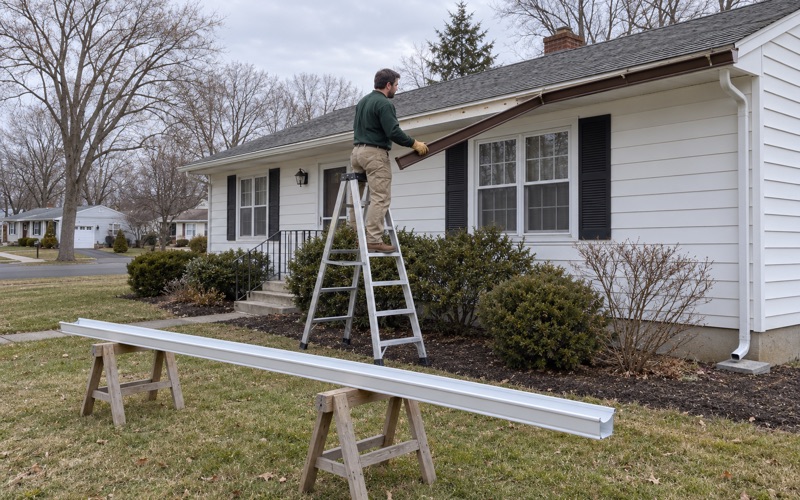
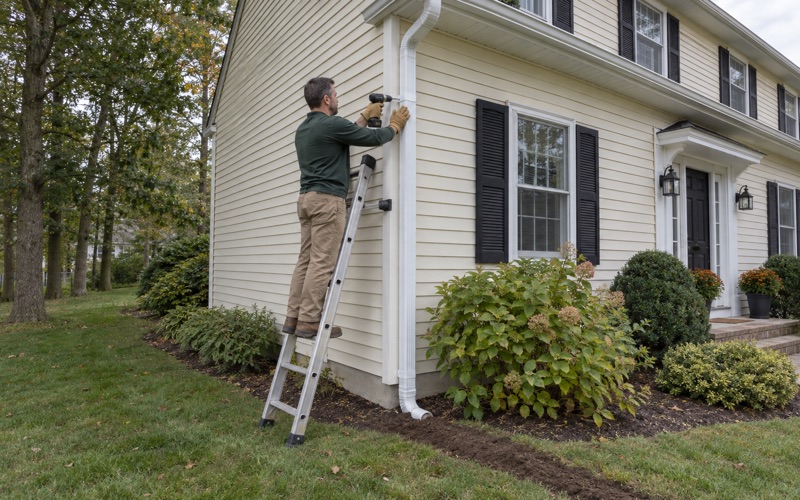
We size each gutter and downspout to the roof area that drains into it, form seamless runs on site from coil, and follow every downspout to the spot where its water lands. Before anything new goes up we check the fascia for rot and show the owner any soft wood before we replace it.
For landlords, the paperwork matters as much as the metal. Every cleaning and repair comes with before-and-after photos, our estimates put new gutters and repairs on separate lines because New Jersey taxes them differently, and our contracts follow the state’s home improvement rules, including the three-day cancellation notice.
The 60-Month Rental Clock and the Property Maintenance Code
Red Bank runs its rental housing on a schedule. Under Ordinance 2019-04, no dwelling unit may stay occupied unless it, together with its common areas, has been inspected and issued a certificate of occupancy at least once every 60 months. A unit also needs a certificate before it is rented, sold or relet, the owner gives Code Enforcement at least 14 calendar days’ notice for the compliance inspection, and the fee is $50 per rental unit. The sale of an owner-occupied single-family house is exempt.
What the borough’s maintenance code says about roof water
The standard those certificates rest on is the 2018 International Property Maintenance Code, which the borough council adopted by reference in Ordinance 2019-68 on October 23, 2019, replacing the 2006 edition. The model code’s roof drainage section, 304.7, requires roof drainage adequate to prevent dampness or deterioration in the walls or interior of the structure. It also says roof drains, gutters and downspouts shall be maintained in good repair and free from obstructions, and that roof water may not be discharged in a way that creates a public nuisance.
The 60-month cycle covers common areas as well as the units, and on a small multifamily house the common areas are often where roof water does its damage: the covered entry, the exterior stair to a second-floor apartment, the shared walkway along the side of the house. An overflowing gutter above a stair leaves standing water in summer and ice in winter, right where every tenant walks.
Why we treat the gutters as an owner’s item
We have not seen the borough’s inspection checklist, so we will not tell you what an inspector writes down. What we can say is that the adopted code puts gutters and downspouts squarely inside the property maintenance standard, and a landlord with a certificate coming due has every reason to want them clean, tight and draining before the date arrives.
How we fit the five-year cycle
Most of our rental clients book a cleaning and a repair walk well ahead of a turnover or a certificate date. We flush every downspout, bag the debris so nothing is left on the lawn or at the curb, and send dated photos of each run. A loose hanger, an open seam or a leaking miter goes on the estimate as a repair, kept separate from any section that needs replacing, so the owner can decide what to do now and what can wait.
Looking for gutters closer to Beachwood? See Gutters in Beachwood.
Two- to Four-Family Houses Near Downtown
Red Bank’s housing is older and more rented than a quick drive through suggests. The Census Bureau’s 2024 five-year survey counts 2,017 of the borough’s 6,216 housing units as built in 1939 or earlier, and 2,988 of its 5,983 occupied households as renters, almost exactly half. It also counts 501 units in two-unit buildings and 605 in buildings of three or four units, a large share of the borough’s small rental stock.
Shared roofs, divided responsibility
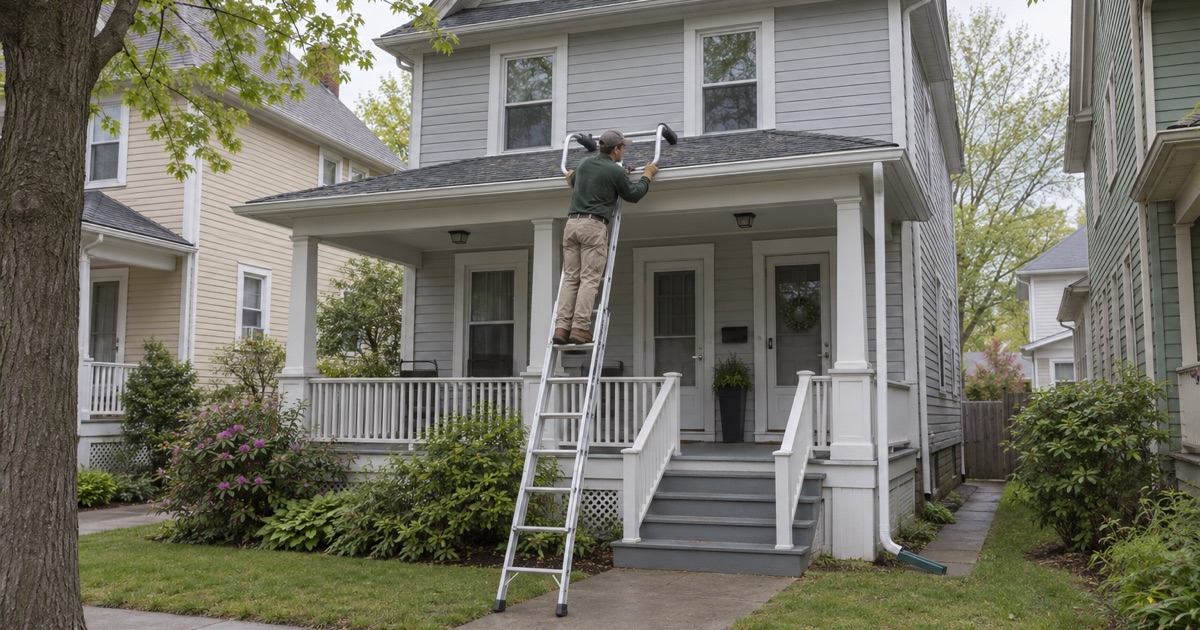
On a two- to four-family house one roof drains past several front doors. The tenant on the top floor notices the overflow, the tenant on the ground floor notices the wet foundation wall, and neither of them owns the gutter. We work with the owner or property manager, and when a building is a condominium we check the master deed or the management office first, so the owner knows whose responsibility the gutters are before any work is priced.
Sizing for roofs that were never designed for gutters
Many of these houses have cross gables, porch roofs and additions that send uneven volumes of water to each corner. We measure the roof area feeding every run and choose the gutter width and downspout size to match it, which often means a 6-inch K-style gutter with 3x4 downspouts on the main roof and a smaller run over a porch. Seamless sections formed on site remove the joints where older sectional gutters on these houses usually leak.
Fascia and painted trim on prewar houses
On a house this old the board behind the gutter is often the real problem. We probe the fascia before hanging anything, show the owner any rot we find, and replace it only after they have seen it. Painted wood trim on older houses also brings the federal Renovation, Repair and Painting rule into play; exterior work that disturbs more than 20 square feet of painted surface falls outside its minor repair and maintenance exception, so we plan fascia replacement with that limit in mind.
Copper and half-round on older facades
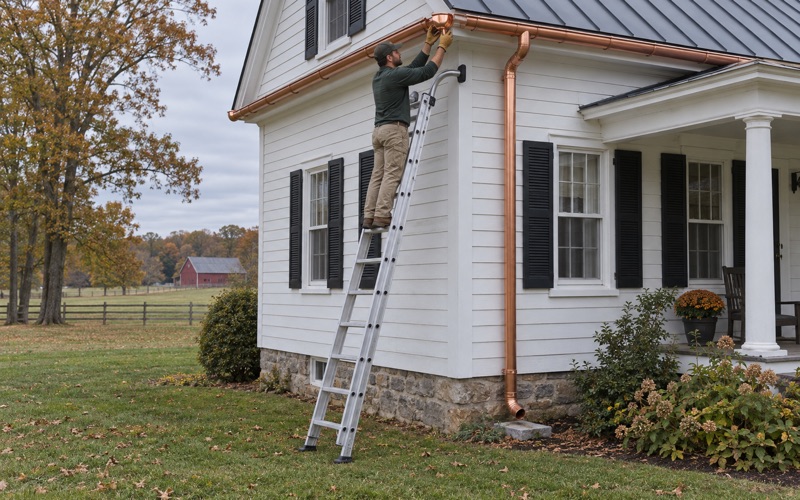
Some owners of prewar houses want the gutters to look like they belong to the building rather than to the last renovation. We match copper and half-round work to the age and style of the house, using double-bead half-round profiles and 16-ounce copper where the budget allows, and painted aluminum K-style where it does not. Either way, hangers, outlets and miters are chosen for the run they serve.
Downspouts, Leaders and the Sewer Ban
Older houses sometimes hide a downspout that disappears into the ground, and nobody remembers where it goes. In Red Bank that matters, because the borough’s sewer chapter is blunt. Section 695-40G states that no cellar drains, area drains, roof leaders, sump pumps or downspouts shall be connected to the sewage system, and section 695-40C bars roof runoff from any sanitary sewer.
Tracing every leader
When we take on a building we follow each leader from the outlet to its end point. If one runs into an old lateral, we do not reconnect it, and our estimate says where every downspout will discharge instead. Leader outlets are never tied into the sanitary sewer on any job we do. Monmouth County Mosquito Control also asks residents to keep gutters clean and properly pitched, and a sagging run behind a rental that holds water all summer is exactly what that advice is about.
Moving water away from the foundation
Where a downspout empties against a foundation wall, which is common on narrow lots with little side yard, we propose a fix sized to the site. That may be a simple extension, an underground line to a pop-up emitter at the edge of the lawn, or a drywell where the ground allows it. New Jersey’s residential code calls for grade that falls 6 inches within the first 10 feet from the foundation, and we point out low spots where discharged water would run straight back. On a rental, keeping water out of a basement apartment or a shared cellar also keeps dampness out of the walls the maintenance code asks owners to protect.
Guards for the trees on the lot
Mature street trees overhang many of these properties, and a downspout that clogs every fall undoes the work. We match guards to what actually grows over the roof, since oak leaves and fine needles call for different screens, and stainless steel micro-mesh is often the right choice where both drop onto the same run.
Parking Lots, Courtyards and the Storm Drain Rule
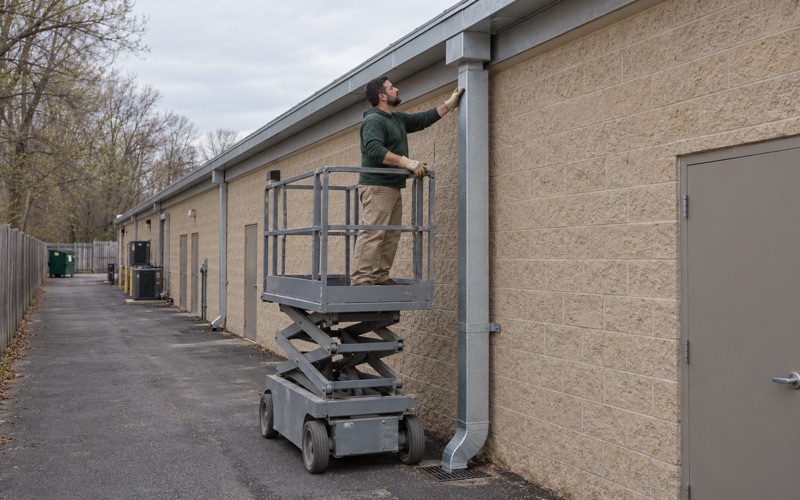
Larger rental buildings and condominium complexes in Red Bank often have paved lots or courtyards with their own storm drain inlets. Those inlets fall under a different part of the borough’s property maintenance chapter, and owners planning exterior work should know about it.
Ordinance 2025-05 and private inlets
Adopted February 27, 2025, Ordinance 2025-05 says that no one in control of private property, other than a residential lot with one single-family house, may authorize repaving, resurfacing, reconstructing or altering any surface in direct contact with an existing storm drain inlet unless that inlet meets the borough’s design standard or is retrofitted to it. The standard is an NJDOT bicycle-safe grate, or clear spaces no larger than 7.0 square inches or 0.5 inch across the smallest dimension. The Code Enforcement Officer enforces it, with fines of up to $500 for a first offense, $1,000 for a second and $2,000 for a third. The ordinance names condominium associations as an example of private inlet owners.
Where our work ends
That rule governs paved surfaces and their grates, not the roof drainage we install. Where an underground line we propose would end near a paved area, we keep the discharge point away from surfaces the owner plans to resurface and tell them about the inlet rule, so a gutter job does not turn into a paving question later.
Planning the whole building at once
For an owner with several units and a certificate date ahead, we can walk the roof edges, leaders and discharge points in one visit and hand back a single estimate with photos. That gives a landlord one clear picture of the building’s roof drainage, with repairs and replacements separated, before the next 60-month inspection comes around.
- 20+ Years in Business
- Seamless Gutters Formed On Site
- Before-and-After Photos