Howell Gutters has spent more than 20 years installing, repairing and cleaning gutters in Ramtown, and most of what we do here comes back to one question: where does the water go when rain arrives faster than a roof edge was built to handle? We size each run, pitch it, and follow every downspout to the ground before we call a job finished.
A gutter system is a short chain. The roof feeds the trough, the trough feeds the outlets, the outlets feed the downspouts, and the downspouts set the water down somewhere on your lot. When any link is undersized, clogged or aimed at the foundation, the chain fails in the first hard storm, and the damage shows up in the fascia, the siding or the basement.
Below we explain how we approach that chain for Ramtown houses: what a record cloudburst showed about rain in this corner of the township, how we size and pitch gutters for heavy downpours, where we land downspout water, and what a careful repair looks like after a storm has tested the system.
When More Than Seven Inches Fell in Under Three Hours
A Storm With a Date on It
On August 13, 2018, a cloudburst dropped more than 7 inches of rain on Howell in less than 3 hours, according to local reporting that September. The National Weather Service office in Mount Holly issued a flood warning that afternoon, with radar and automated gauges indicating 5 to 8 inches had fallen that morning and Howell named among the hardest-hit towns.
Flash flooding closed roads and damaged bridges across the township. Closest to home, Ramtown-Greenville Road stayed closed after floodwater washed out part of its bridge. Those rainfall totals describe Howell as a whole, and no report singled out gutter or roof damage here, but the storm showed what a Ramtown roof can be asked to handle on a single summer morning.
The North Branch at Ramtown’s Edge
Ramtown is an unincorporated community governed by Howell Township, and its southwest edge is the North Branch of the Metedeconk River, which forms part of the border with Lakewood Township. That August afternoon, the USGS gauge on the North Branch near Lakewood peaked at 1,560 cubic feet per second, the third-highest annual peak in its record.
Only two years in that record ran higher: August 28, 2011, at 2,500 cubic feet per second, and an estimated 1,800 on October 15, 2005. Wall Township police warned residents that day of sharp rises along the North Branch Metedeconk, Manasquan and Shark Rivers in response to extreme runoff. Water from roofs and driveways was heading toward a river that rises fast.
What That Storm Means for a Gutter
Rain at that rate is far beyond what any house gutter and downspout can carry. We say that plainly because bigger gutters are sometimes sold as if they make a home storm-proof. They do not. Every residential system overflows in a cloudburst like that one, and our job is to make sure it overflows cleanly and recovers instead of tearing loose or soaking the walls.
So we design Ramtown gutters around two goals. The system should carry ordinary heavy rain without spilling, which comes down to sizing, pitch and clean outlets. And when a storm overwhelms it, the water that does come off the roof should still move away from the foundation rather than pooling against it on the way downhill.
Looking for gutters closer to Freehold Township? See Gutters Services in Freehold Township.
Why Gutters Overflow in a Ramtown Downpour
Sized for the Roof Above Each Run
Overflow usually starts with a gutter that was never sized for the roof feeding it. We measure the roof area that drains to each run before choosing a profile. A long rear slope emptying into one corner needs more capacity than a short porch roof, so we pick gutter and downspout sizes run by run instead of putting the same size everywhere out of habit.
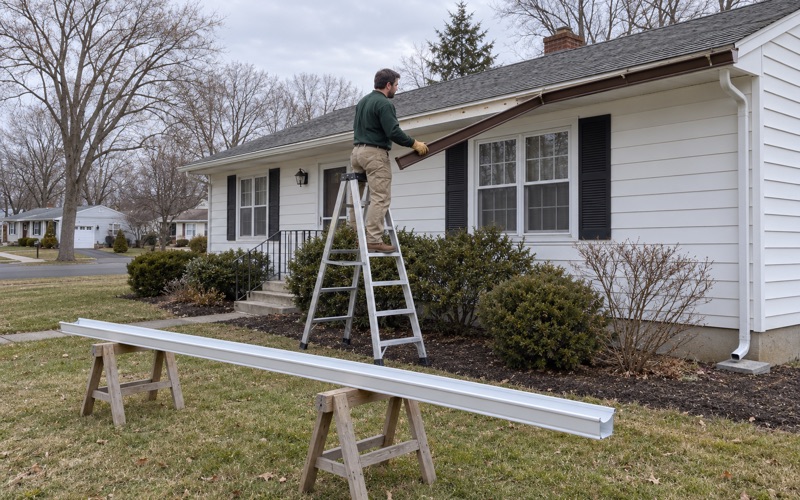
For many Ramtown houses that means 6-inch K-style seamless gutters with 3x4 downspouts, formed on site from .032 aluminum gutter coil. Each run comes off our machine as one piece cut to the length of that wall, so there are no mid-run seams to open up when a heavy load of water and debris presses on the trough.
Corners still need joints, so we build box, strip and bay miters carefully and seal them with tripolymer gutter sealant. Wide-flange outlets let water drop into the downspout faster than a narrow opening, which matters most in the first minutes of a downpour, when the roof sheds its heaviest flow and the outlet decides whether the gutter keeps up.
Pitch, Hangers and the Roof Edge
A gutter that sits dead level holds water in the middle and spills at the ends long before it reaches capacity. We set each run with a steady fall toward its outlet and check it with a level, not by eye. Standing water also breeds mosquitoes, which is why Monmouth County Mosquito Control asks homeowners to keep gutters clean and properly pitched.
We hang gutters on hidden hangers rather than the old spike and ferrule method. Spikes work loose over the years as the wood around them moves, and a gutter that sags even slightly loses its pitch. Hidden hangers screw into the fascia at close spacing and hold the trough’s shape when it fills with water and wet debris during a storm.
At the roof edge, we check the gutter apron and drip edge so water running off the shingles lands inside the gutter instead of behind it. Where a roof line ends against a sidewall, kickout flashing turns that water into the gutter. Without it, a hard rain sheets down the siding at exactly the spot where wall rot tends to start.
Clear Outlets Before the Next Storm
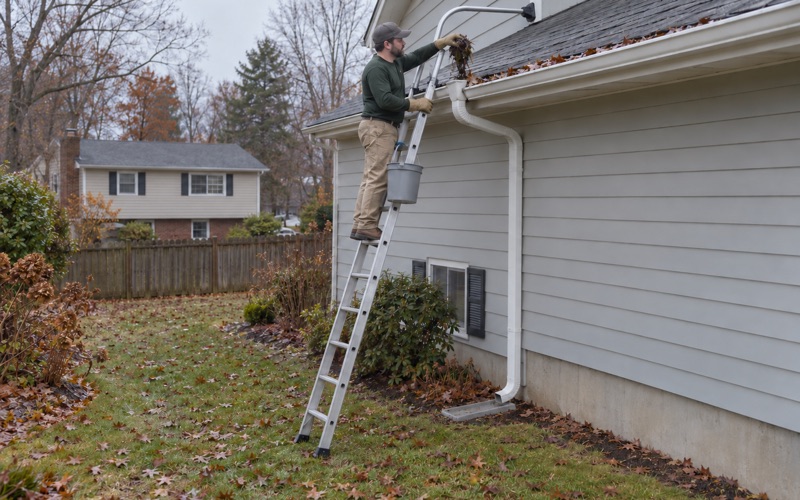
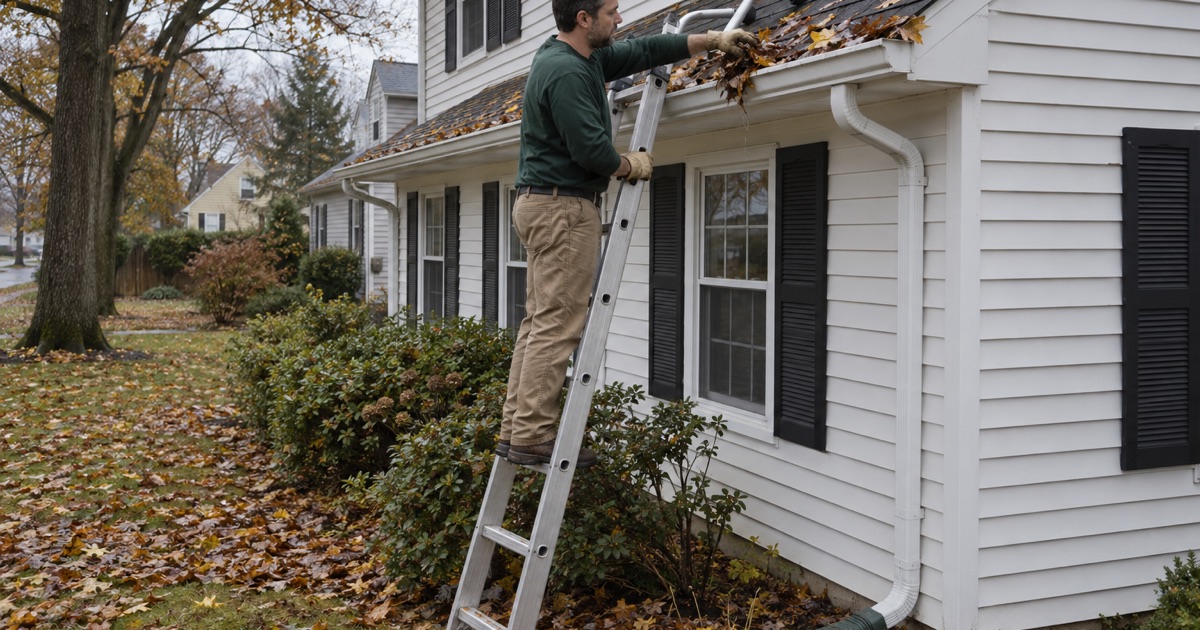
The best-sized gutter still overflows if its outlet is clogged. On every cleaning visit we clear the troughs, then flush each downspout to confirm water runs freely from the outlet to the discharge point. The debris is bagged and hauled away with us, so nothing is left on the lawn or at the curb after we leave.
Where trees overhang the roof, we talk through guards matched to what actually falls on your lot, since pine needles and broad leaves call for different screens. Stainless steel micro-mesh guards stop fine debris that coarser screens let through. A guard that suits the trees keeps outlets open longer, which is what keeps a gutter working when a storm arrives without warning.
Downspout Count and Where the Water Lands
Enough Downspouts for the Load
A single downspout at the end of a long run forces all of that water to travel the full length of the gutter before it can leave. In a heavy storm, the far end overflows while the outlet struggles to keep up. We often recommend adding a second downspout, or relocating one, so each section drains a manageable share of the roof.
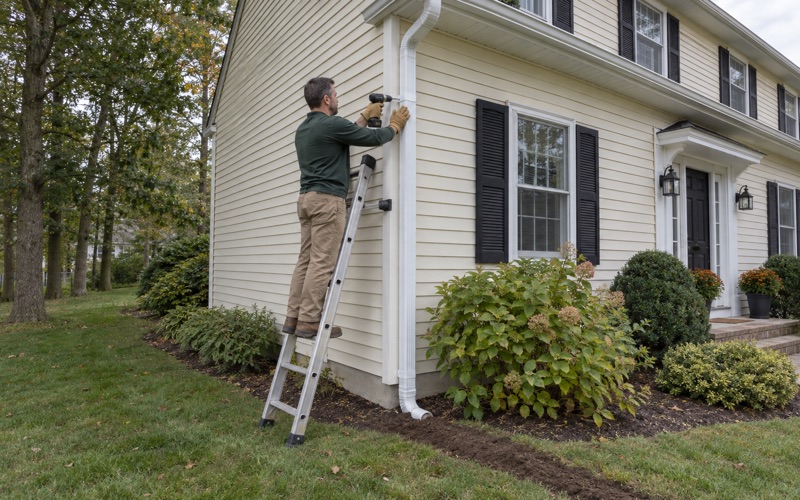
Placement matters as much as count. A downspout dropped beside a walkway, a deck stair or the driveway creates puddles and winter ice in the places people use most. We plan each location with the yard in mind, using A and B elbows to route the downspout neatly along the wall to a spot where its water can actually get away.
Following the Water to the Ground
Every downspout we install or service gets followed to where its water lands. If it empties against the foundation or into a low spot by the wall, we propose a fix: a longer extension, an underground downspout line ending at a pop-up drainage emitter, or a drywell where the yard allows. The estimate states where each one will discharge.
The IRC 2021 New Jersey edition, section R401.3, has grade falling 6 inches within the first 10 feet from the foundation. Yards change over decades of planting and settling, so we look at how the ground around your house actually slopes today before deciding how far a downspout’s water needs to be carried.
Drywells need room beneath them. Under the state stormwater rule, N.J.A.C. 7:8, a dry well sits 2 feet above the seasonal high water table, so we check that condition before recommending one. Where a drywell does not suit the spot, a pop-up emitter at a lower part of the lawn usually handles the job just as well.
Never Into the Sanitary Sewer
It can look convenient to tie a leader outlet into a sewer cleanout, and we never do it. Roof water in the sanitary sewer adds load the system was not built to carry, and a storm like the one in August 2018 is exactly when that load arrives. Our estimates name the discharge point of every leader in writing, so there is no question later.
Gutter Repair After a Heavy Storm
Fascia Checks Before New Gutters
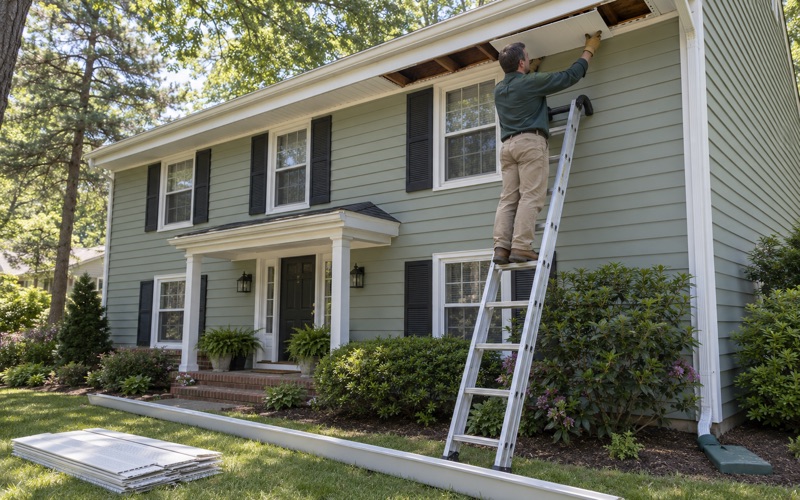
Most of Ramtown’s houses went up in the 1980s and 1990s: 1,474 of its 2,303 homes were built between 1980 and 1999, according to Census survey estimates. On houses of that age, the fascia behind the gutter has had decades of exposure, and a storm that overruns the trough soaks it again. We check the fascia for rot before any new gutter goes up.
Soft wood gets shown to you before we replace it, so you see the damage yourself instead of taking our word for it. Where fascia and trim carry old paint on a house built before 1978, we follow the EPA Renovation, Repair and Painting rule, 40 CFR 745, while we work on that section of the house.
Repair Lines and Replacement Lines
After a hard storm, a gutter may need a resealed miter, a rehung section and a cleared outlet rather than a full replacement. When we quote, new gutters and repair work appear on separate lines, because New Jersey’s Division of Taxation treats new gutters as an exempt capital improvement on Form ST-8, while repairing gutters is a taxable repair.
Separate lines let you see what each part of the job costs and how it is taxed. If repair makes more sense than replacement, the estimate says so. If a run is too far gone to hold its pitch, we explain why replacing it is the better use of your money rather than patching it again.
Photos, Paperwork and Matching the House
Every cleaning and repair visit comes with before-and-after photos, so you can see the condition of gutters you would rarely climb up to inspect yourself. Our contracts are written to New Jersey’s home improvement rules, including the three-day cancellation notice, so you know your rights before any work begins.
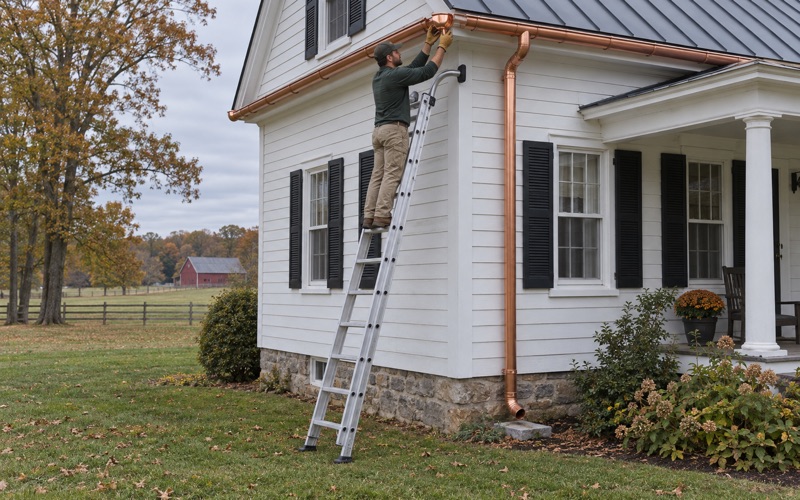
Not every house wants aluminum K-style. Where an older home calls for it, we match copper and half-round work to the age and style of the house, including half-round gutters with a double-bead profile and 16-ounce copper gutters that weather to a natural patina. Whatever the material, the same sizing, pitch and downspout planning applies.
- 20+ Years in Business
- Seamless Gutters Formed On Site
- Before-and-After Photos