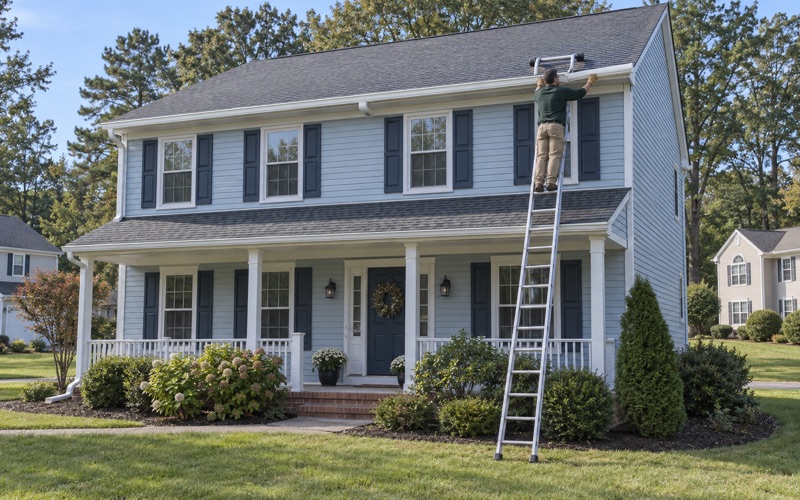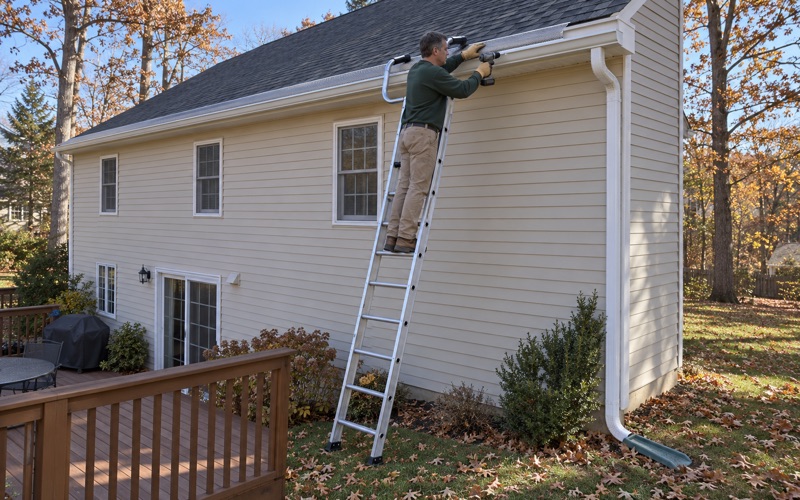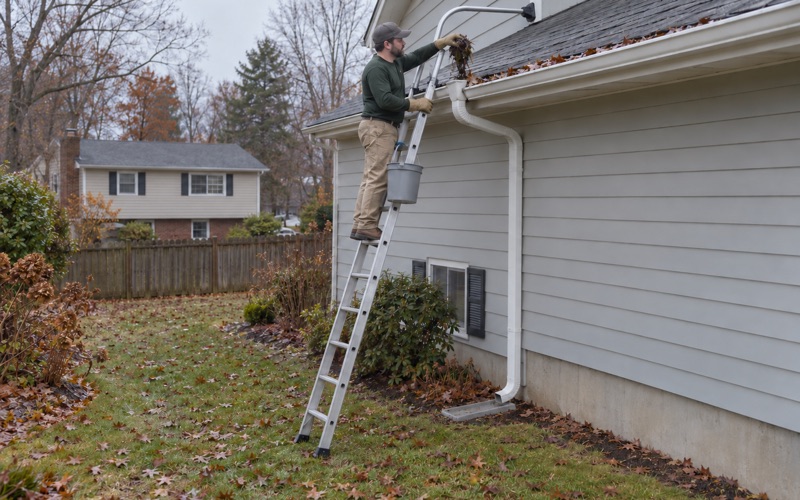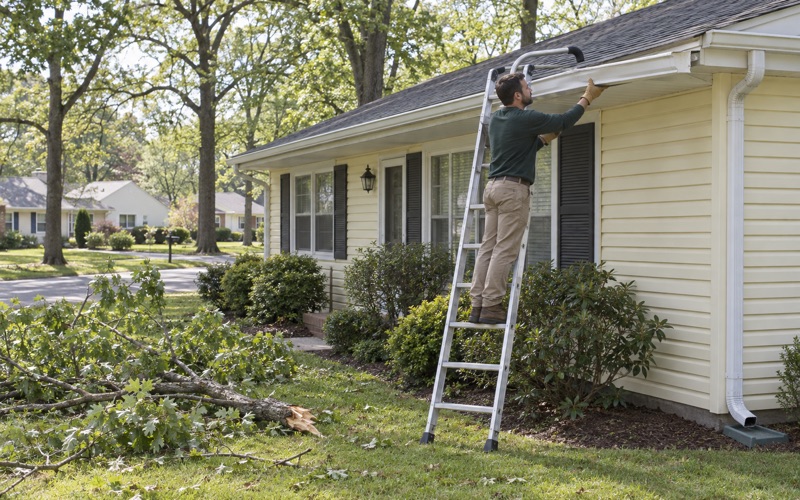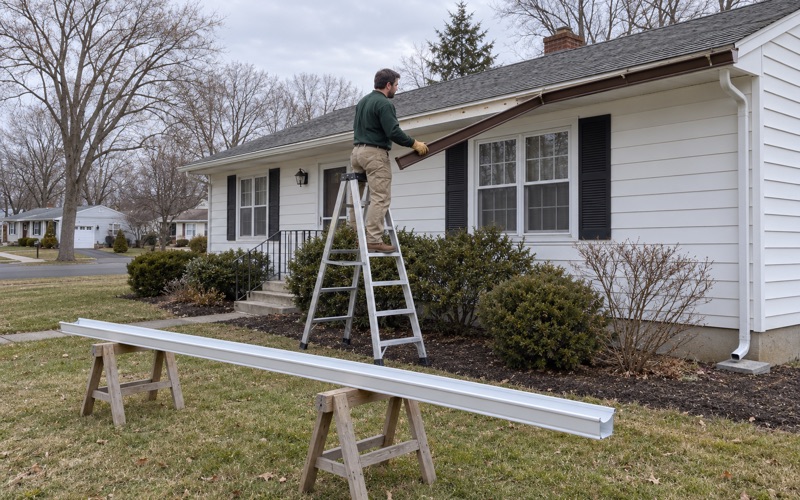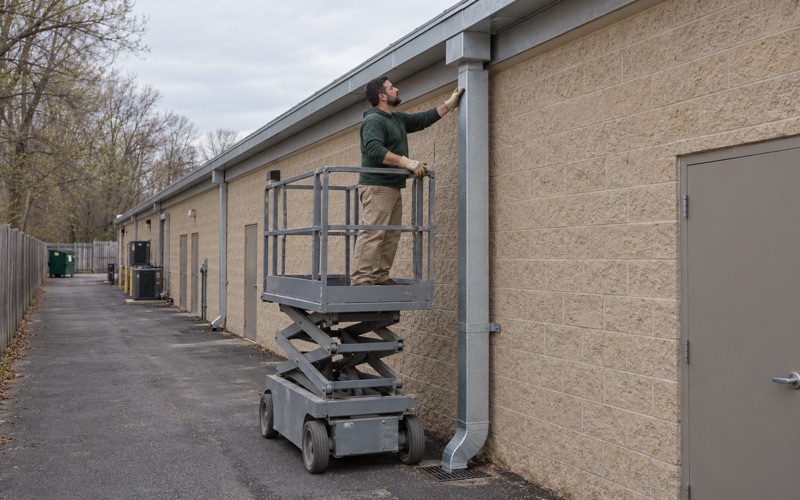
Howell Gutters brings more than 20 years of installing, repairing and cleaning to gutters in Neptune City, and every job here starts with one question: where does the water go once it leaves the roof? We form seamless gutters on site from coil, one piece per run, and we size each gutter and downspout to the roof area that actually drains into it. Then we follow every downspout to its landing point.
A gutter that catches every drop does very little good if the leader empties against the foundation. When a downspout lands too close, we propose an extension, a pop-up emitter or a drywell that carries the water somewhere it can soak in.
We also look behind the gutter before we hang a new one, and on older houses that inspection shapes most of what follows on this page. Estimates list new gutters and repair work on separate lines, because New Jersey taxes the two differently.
Gutters on the Shark River’s Tidal Edge
Neptune City is a small borough, 0.90 square miles, and its southern edge is the Shark River. The river here is not a freshwater stream. It is a tidal salt-water estuary whose bay of roughly 800 acres opens to the Atlantic through the inlet between Belmar and Avon-by-the-Sea.
The borough itself is not on the beach. Avon-by-the-Sea and Bradley Beach sit between Neptune City and the ocean, so the water that matters most to a gutter job here is the estuary to the south, not the surf.
Coastal Flooding Is Already Counted Here
Coastal flooding in the borough is not a forecast. Climate Central’s Surging Seas Risk Finder, as cited on Wikipedia, counts 39 days of coastal flooding in Neptune City from 2005 through 2014. That is more than three times the average number of coastal flooding days for 1955 through 2004.
The same source puts the chance of at least one major flood by 2050 at 68% under moderate sea level rise. We read those numbers as a reason to plan roof drainage for wet ground, not as a prediction about any single street.
Tide records give a sense of scale. The regional record Neptune Township posts for Sandy Hook Bay shows 14.1 feet above mean low water on October 29, 2012, during Sandy, and 9.8 feet for Irene in 2011. It is not a Neptune City gauge, but it shows how high the water in the region has reached.
Why the Low Ground Near the River Changes the Plan
When the tide is up, the low ground near the riverbank is already holding water. A leader that empties there is adding roof water to soil that cannot take any more, and the surplus tends to sit against the nearest wall. On the streets closest to Memorial Park, which lies along the Shark River, that is the first thing we look at.
Higher on the borough’s ground the same downspout may drain without trouble. That is why we do not apply one discharge plan to every lot in town. We walk each property, note where water pools after rain, and design around what we find.
On a lot near the river we also note how the tide was running during our visit, because a yard that looks dry at low tide can read very differently a few hours later.
Looking for gutters closer to Leisure Village? See Leisure Village Gutters.
When the Tide Is Up, Where Does Roof Water Go
A roof sheds a surprising amount of water in a hard rain, and all of it leaves through a handful of downspouts. On a house near tidal ground, the question is not whether the gutter can carry it, but where that water ends up once it reaches the bottom of the leader.
Sizing Gutters to the Roof That Feeds Them
We size gutters and downspouts by the roof area that drains to each run. A long rear slope feeding one corner may need a 6-inch K-style seamless gutter and a 3x4 downspout, while a short porch roof does not. Getting the size right keeps water from overshooting the gutter and landing in the bed below.
Each run is formed on site from .032 aluminum coil in one continuous piece. With no seams along the length, the only joints left are at the corners and the outlets, and those we seal with tripolymer gutter sealant.
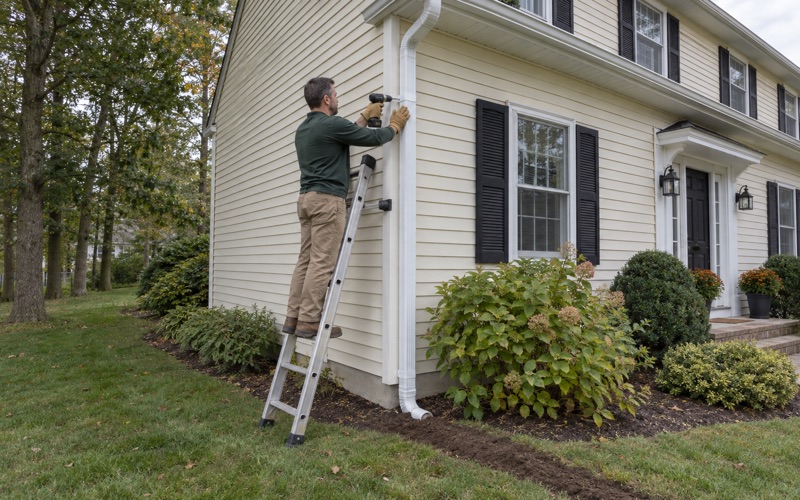
Downspout placement matters as much as size. Where a leader can drop straight to an extension on the high side of the house, we put it there, and where it has to turn, we use A and B elbows so the bend follows the wall cleanly.
Moving Water Away From the Foundation
The New Jersey edition of the 2021 International Residential Code, at R401.3, calls for grade to fall 6 inches within the first 10 feet from the foundation. On a flat lot near the river that slope can be hard to find, which puts more of the work on where the leader discharges.
We never send a leader into the sanitary sewer. Every estimate names the discharge point for each outlet, so the owner can see on paper where the water goes before any metal is hung.
Guards Matched to the Trees on the Lot
A clogged gutter spills over its front edge, and the water lands right beside the foundation. We match guards to the trees on each lot, because oak leaves and pitch pine needles call for different screens, and stainless steel micro-mesh guards are usually our choice where fine needles are the problem.
Monmouth County Mosquito Control asks homeowners to keep gutters clean and properly pitched, since standing water in a sagging trough is a breeding spot. A guard that keeps debris out helps the pitch do its job.
Leader Outlets and Extensions on Low Ground
Where a downspout empties is a choice, and on low riverside ground it is the choice that most affects whether a basement or crawlspace stays dry. We look at three options, and the lot usually tells us which one fits.
Extensions and Pop-Up Emitters
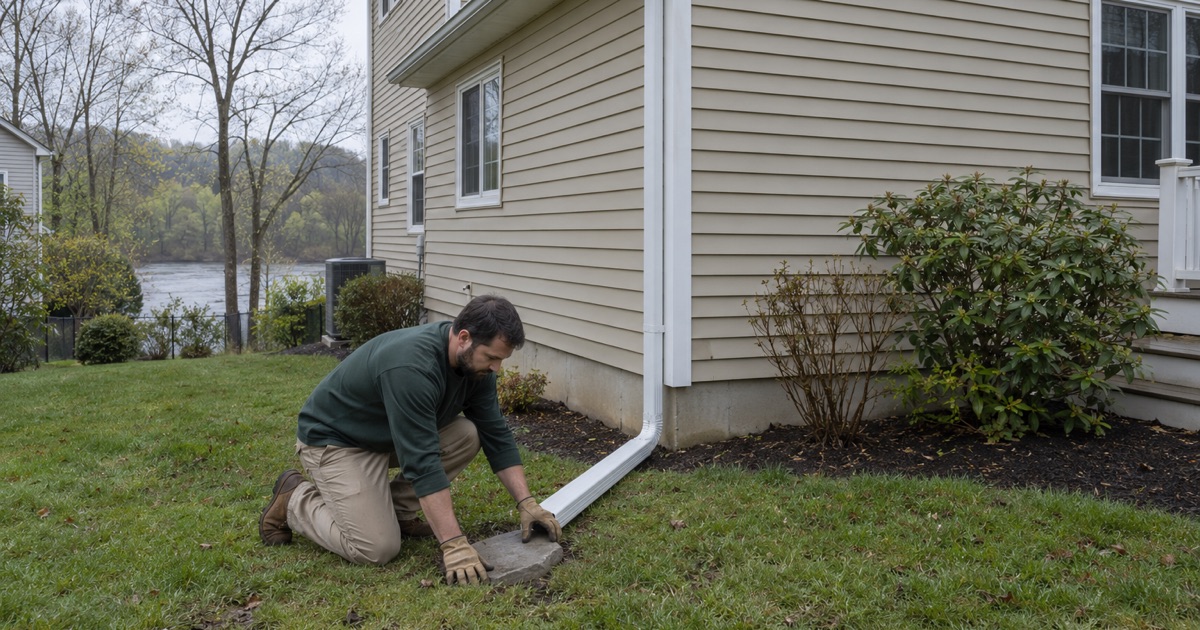
The simplest fix is an extension that carries water past the foundation plantings and onto ground that slopes away. On a small lot, a buried underground downspout line ending in a pop-up drainage emitter does the same job without a pipe lying across the lawn.
An emitter only works if the ground where it surfaces can drain. Near the river, when the tide is high and the yard is already saturated, we may move the emitter farther toward the street or to the highest corner of the lot rather than the lowest.
Where a Drywell Does and Does Not Belong
A drywell stores roof water underground and lets it seep out slowly. New Jersey’s stormwater rule, N.J.A.C. 7:8, calls for dry wells to sit 2 feet above the seasonal high water table, and on tidal low ground that separation may simply not exist.
So we do not propose a drywell by default here. We propose one only where the lot sits high enough to meet that rule, and otherwise we rely on surface discharge.
Grading helps too. Where a bed has settled toward the house, we point that out, because no discharge plan works if the last few feet of soil send the water back toward the wall.
After a Coastal Flood: Checking Gutters and Leaders
When coastal flooding pulls back from the low streets, we check the bottom of the system first. Silt and debris can wash into an underground downspout line or an emitter and choke it, and a choked line backs water up into the downspout the next time it rains.
We also check the hangers and the gutter’s pitch, since a gutter full of wet debris after a storm can pull loose or sag. A run that holds water after the flood has passed gets re-pitched before the next rain.
We flush every downspout on these visits and bag the debris so nothing is left on the lawn or at the curb. Before-and-after photos come with the work, which gives the owner a record of what the flood left behind and what we cleared.
Fascia and Hangers on Neptune City’s Prewar Houses
Neptune City’s housing is old for a shore town. The 2024 American Community Survey counts 525 of the borough’s 2,228 housing units as built in 1939 or earlier, and 884, about 40%, were built before 1950. Of those 2,228 units, 1,468 are detached houses.
What Decades of Wear Do Behind a Gutter
On a house that old, the fascia board behind the gutter has carried hangers, nails and spikes for a long time, and sometimes through more than one gutter replacement. Each set of fastener holes is a place for water to get into the wood.
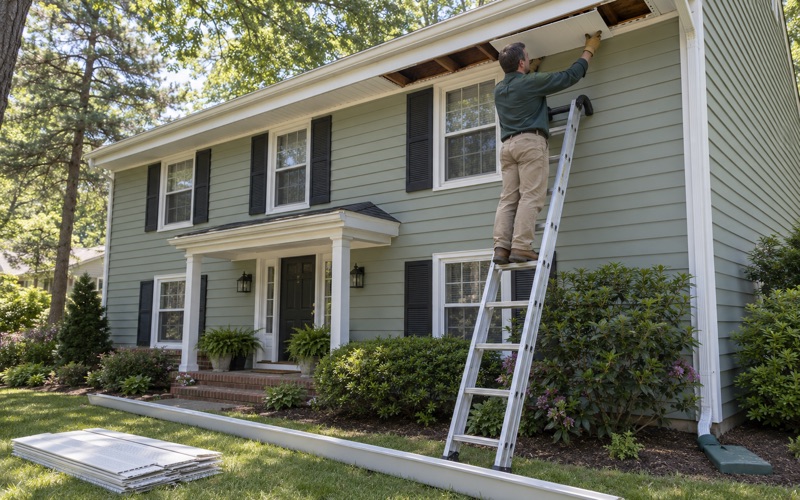
That is why the fascia comes before anything else on these jobs. We probe the board along each run, and if we find soft wood, we show it to the owner before replacing it, so the decision is made with the rot in plain view.
Fascia that does need replacing is rebuilt before the new gutter goes up, never after. A seamless gutter hung on rotten wood can pull loose however good the hanger is, so we treat the wood repair as part of planning the job.
Painted fascia and trim on a pre-1978 house also fall under the EPA Renovation, Repair and Painting rule, 40 CFR 745. Prewar houses predate that cutoff by decades, so we plan the fascia work around the rule from the start.
Hangers, Copper and Half-Round on Older Houses
Older gutters were often hung with spike and ferrule, a long nail driven through the gutter into the fascia. Over the years spikes can back out and the gutter sag. On new seamless runs we use hidden hangers fastened into sound wood, which hold the pitch without the same pull-out.
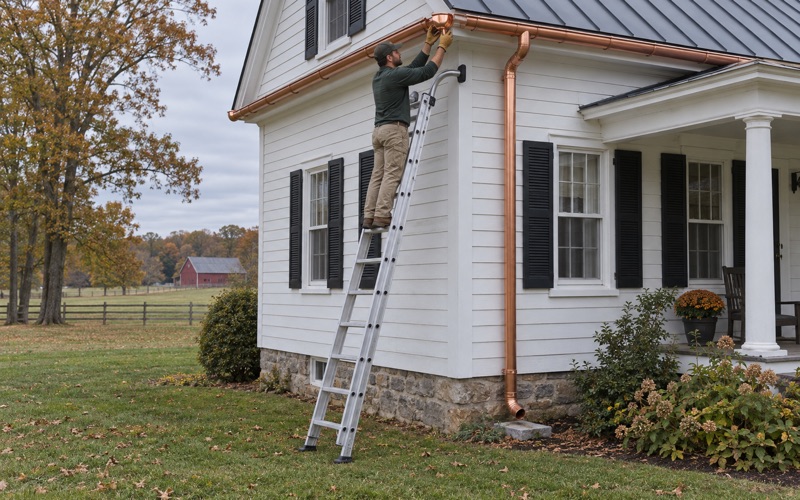
Some of the borough’s prewar houses may call for something other than K-style aluminum. Where the age and style of a house suit it, we match half-round gutters with a double-bead profile or 16-ounce copper gutters that weather to a patina over time.
When a buyer of an older house brings us a home inspection report, we work from it directly. New Jersey’s rule for home inspectors, N.J.A.C. 13:40-15.16, requires them to inspect and report roof drainage system deficiencies, so the gutter items are already spelled out.
Our contracts follow New Jersey’s home improvement rules, including the three-day cancellation notice. That gives the owner of an older house time to weigh the fascia findings before any work begins.
- 20+ Years in Business
- Seamless Gutters Formed On Site
- Before-and-After Photos