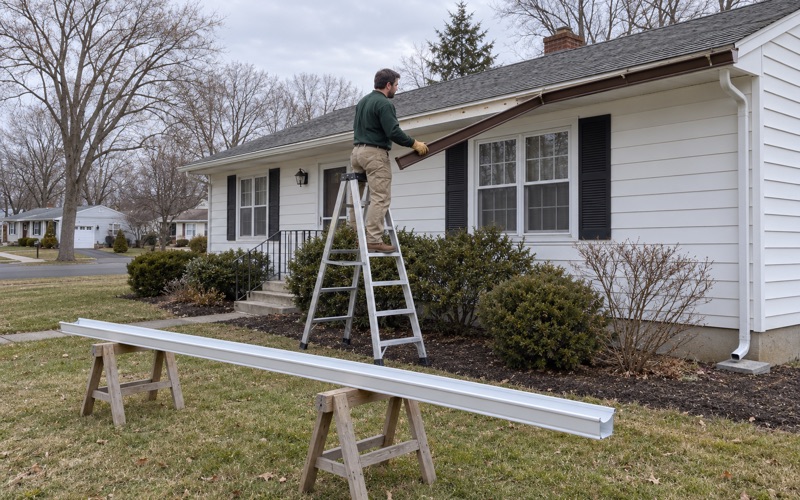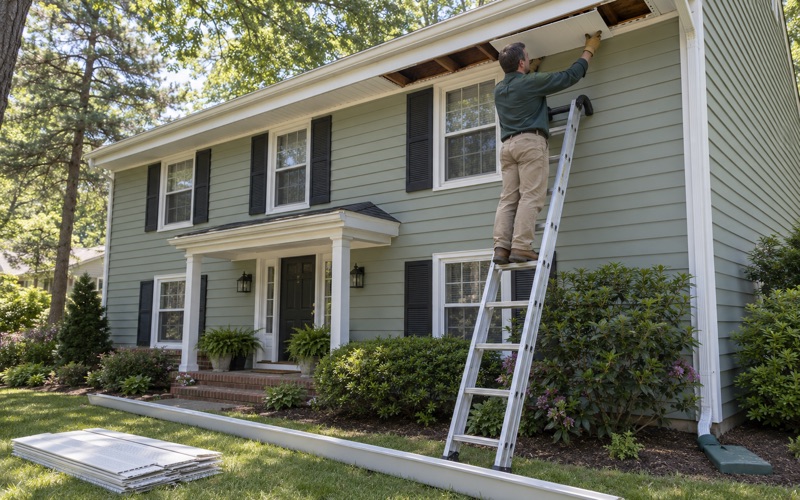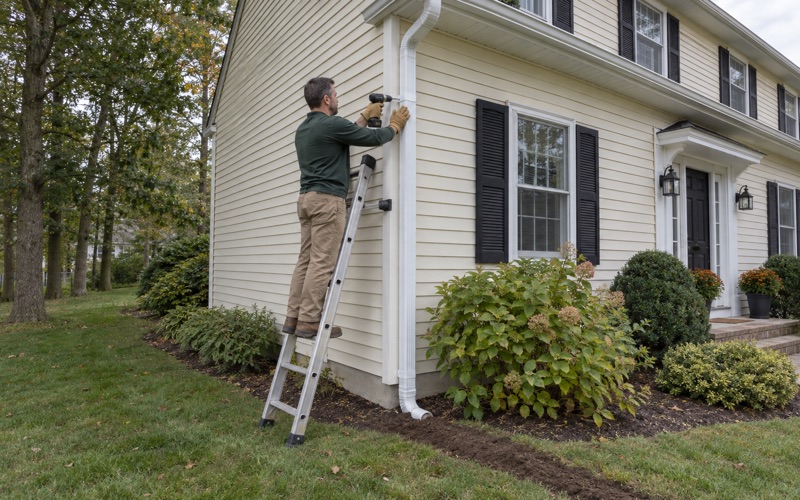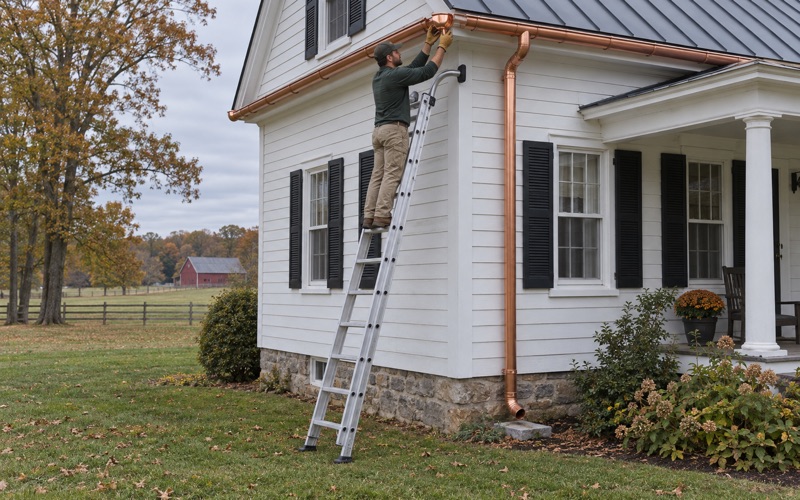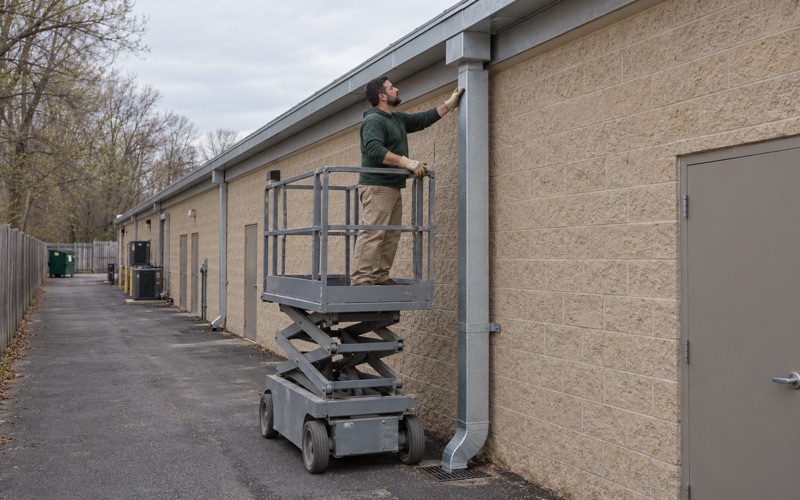
Howell Gutters has spent more than 20 years installing and maintaining gutters in Millstone Township, and many of the properties we work on carry more than one roof. A house, a detached garage, a run-in shed and a stall barn can share one parcel, and every eave sends its water somewhere. We size each run for the roof area that drains into it, form seamless gutters on site from coil, and follow every downspout to the spot where its water lands.
That last habit matters more on a farm than almost anywhere else. A barn roof sheds a large volume of relatively clean rainwater, and where the leaders let it out decides whether that water soaks away quietly or runs across a paddock and turns it to mud. We settle the discharge point before the first section of gutter goes up, and the estimate states in writing where each outlet will empty.
What follows is how we approach barns and stables, what a well-built downspout trench beside a barn looks like, how roof water relates to manure handling, and how we take care of the house and its outbuildings in a single visit.
Gutters for Millstone Barns, Stables and Run-In Sheds
Millstone is horse country as much as it is a township of large-lot houses. Its 2020 Comprehensive Farmland Preservation Plan counts more than 7,800 acres of assessed farmland and names equine farms among its farm types, alongside crop production and nursery operations. The township’s list of preserved properties includes a 127-acre equine clinic property preserved in 1997, and the plan puts preserved land at 1,446 acres. When we drive out toward Clarksburg or Perrineville for a job, there is a fair chance a barn is part of the conversation.
Long eaves and big roof areas
A stable or equipment barn usually has a longer, simpler roof plane than the house beside it, and that plane can push a lot of water to one edge in a heavy storm. We measure the roof area feeding each run and pick the gutter and downspout size from that figure rather than defaulting to whatever went on the house. On a long barn eave that often means 6-inch K-style seamless gutters with 3x4 downspouts, and sometimes an extra outlet partway along so no single leader carries the whole slope.
Seamless matters on a barn for the same reason it matters on a house, only more so. A long run formed in one piece from .032 aluminum coil has no mid-run seams to open up, and the only joints left are the corners and outlets, where we seal with tripolymer sealant and use proper box or strip miters.
Hangers and outlets for a working building
Barns take knocks that houses do not. Ladders lean on them, equipment brushes the eaves, and horses in a run-in shed will rub on anything within reach. We favor hidden hangers over spike and ferrule because they hold the gutter to the fascia without the spikes working loose over time, and we use wide-flange outlets so the downspout connection stays tight when it gets bumped. Downspouts on the animal side of a building are kept close to the wall and strapped well, so a curious horse cannot pull one free.
Guards matched to the hedgerows
Many Millstone barns sit beside a tree line or a woodlot, and what drops off those trees decides what guard makes sense. Oak leaves and pine needles behave very differently on a screen, so we look at the trees overhanging the barn before recommending anything. Where the debris load is fine and heavy, stainless steel micro-mesh guards usually hold up best; where only a few broadleaf trees overhang the eave, a coarser screen or simple seasonal cleaning may be enough.
Looking for gutters closer to Holmdel? See Gutters Services in Holmdel.
Where Barn Downspouts Should Send Clean Roof Water
Rain coming off a barn roof starts out clean. The question is whether it stays that way. If barn downspouts empty straight onto the ground where horses stand, that clean water picks up manure on its way across the paddock and carries it wherever the ground slopes.
What the Rutgers demonstration horse farm found
The Rutgers Equine Science Center documented exactly this problem at its Best Management Practice Demonstration Horse Farm on Rutgers’ Cook Campus. Its own description is plain: the gutter and downspout system on the barn captured relatively clean stormwater from the roof, but the downspouts discharged that runoff onto the paddock where manure was present. Clean water ran through the paddock, mixed with the manure and carried pollutants off site. The same arrangement also left a muddy paddock, which Rutgers notes can have negative health implications for the horses.
The gutters themselves were doing their job. The failure was entirely at the bottom of the downspout, which is why we treat the discharge point as part of the gutter installation rather than an afterthought.
The stone trench, the overflow tee and the clean-out
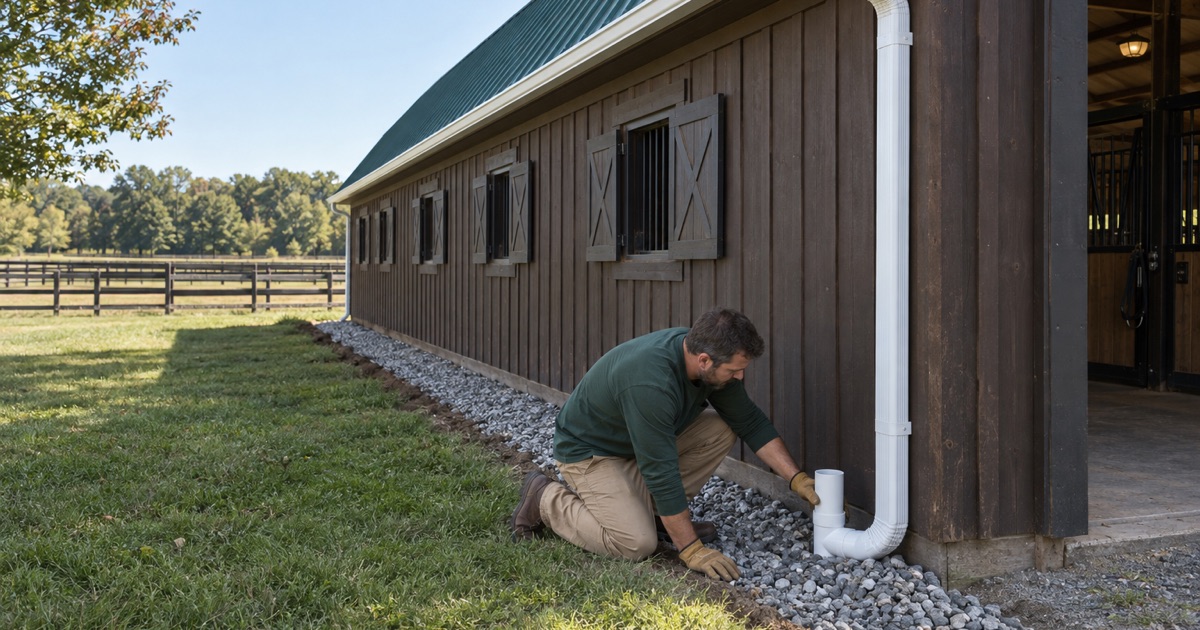
The Rutgers Cooperative Extension Water Resources Program designed the fix. Crews dug a trench three feet wide and two feet deep next to the barn, laid six inches of clean 3/4-inch stone, set four-inch perforated PVC pipe on it, and covered the pipe with another six inches of stone. The downspouts were connected to the pipe in the trench, so small storms soak into the ground beside the barn instead of crossing the paddock.
Each downspout joins the trench piping through a PVC tee, and the open leg of that tee serves as an emergency overflow when the trench is full. A clean-out was also installed so the line can be inspected and flushed. Larger storms were conveyed around the paddock and discharged to a drainage swale. Rutgers reported that rain water no longer flows through the paddock on its way to the waterways and no longer ponds there.
Adapting the idea to a Millstone barn
Every barn site is different, so we do not copy the Rutgers trench inch for inch. We look at where the paddock and any manure pile sit, which way the ground falls, and where clean water can go without crossing either one. Depending on what we find, that might be an underground downspout line run to a swale, a drywell sized for the roof it serves, or a trench with an overflow tee and clean-out along the lines Rutgers built.
Whatever the answer, it goes on the estimate by name. You will see which downspout feeds which line, where the overflow lets out, and where the clean-out sits, so anyone who maintains the barn later knows how the system is meant to behave.
Paddock Mud and Manure Storage Rules
Owners sometimes ask whether the state’s manure rules require barn gutters. They do not, and it helps to be clear about what those rules cover.
What N.J.A.C. 2:91 says
New Jersey’s animal waste management rules reach horse farms down to a single animal unit, defined as 1,000 pounds of live body weight on an annual average, and they count horses and ponies as livestock. Under N.J.A.C. 2:91-3.1, manure storage areas must sit at least 100 linear feet from surface waters of the State, measured from the top of the bank, and must avoid slopes of five percent or greater. Livestock in confined areas cannot have uncontrolled access to waters of the State.
Those rules say nothing about gutters, downspouts or roof runoff. Routing barn downspouts away from manure is a best management practice, the kind Rutgers demonstrated, not a quoted requirement. It simply makes the rules easier to live with, because a manure storage area that is not being flooded by roof water is far easier to keep where it belongs.
Keeping two kinds of water apart
The principle behind the Rutgers fix is to keep clean water and dirty water separate. Every gallon of roof water that stays out of the manure paddock is a gallon that does not need managing on the way downhill. On a farm with a sacrifice paddock or a manure pile near the barn, that usually means pointing the nearest downspouts away from both, even if the run to a safe outlet is longer.
Mud is a horse problem too
A paddock that takes a barn roof’s worth of water every storm rarely dries out. Horses stand in it, hooves stay wet, and the footing breaks down near gates and water troughs. Moving that water somewhere else is often a sensible first fix for a muddy lot, and it starts with a downspout pointed in the right direction.
Gutters on the House and the Outbuildings in One Visit
Many Millstone jobs cover more than the barn. The house, a detached garage, a pool house or a storage building often need attention at the same time, and handling them together means one measurement visit, one estimate and one crew schedule.
Matching outbuildings to the house
Millstone’s accessory structures guide, under Section 35-4-9.11d, requires a detached garage, storage building or other accessory building with a footprint over 200 square feet to be architecturally consistent with the house, including matching siding and roofing materials and color. Pool houses must match regardless of size, and farm buildings are exempt from these consistency rules. The rule names siding and roofing rather than gutters, so any question about trim goes to the Zoning Officer; either way, we bring color samples so the outbuilding gutters can tie in with the house.
On older houses we match the style, too. Half-round gutters with a double-bead profile, or 16-ounce copper that will weather to a patina, suit some homes better than K-style, and we choose based on the age and look of the building.
Fascia first, then the water’s path
Before any new gutter goes up, we check the fascia board behind it for rot. If the wood is soft, we show you the spot before replacing it, because a new gutter screwed into failing fascia will not hold. We also check the gutter apron and drip edge along each eave, and add kickout flashing where a roof edge dies into a wall, so water lands in the gutter rather than behind it.
On the house, as on the barn, every downspout is followed to where it discharges. If one empties against the foundation, we propose an extension, a pop-up drainage emitter or a drywell.
Clear estimates and contracts
New Jersey taxes new gutters and gutter repairs differently, so our estimates list new installation and repair work on separate lines. Contracts follow the state’s home improvement rules, including the three-day cancellation notice. On cleaning visits we flush every downspout, bag the debris rather than leaving it on the lawn, and send before-and-after photos, whether the roof belongs to the house or the barn.
- 20+ Years in Business
- Seamless Gutters Formed On Site
- Before-and-After Photos