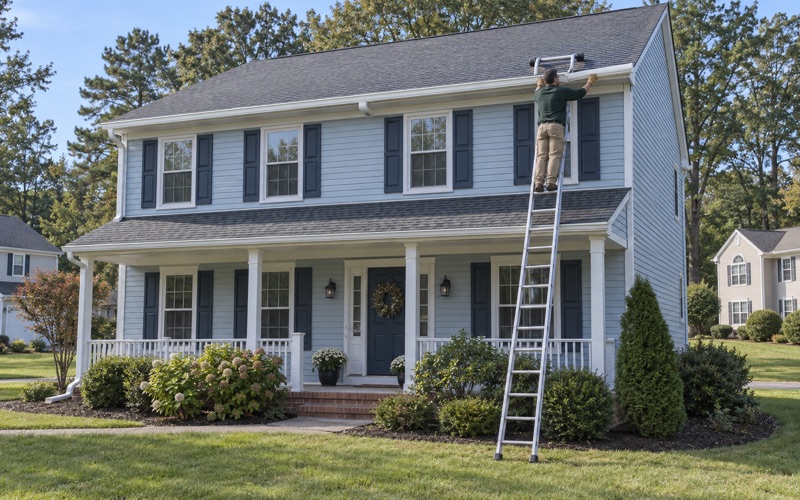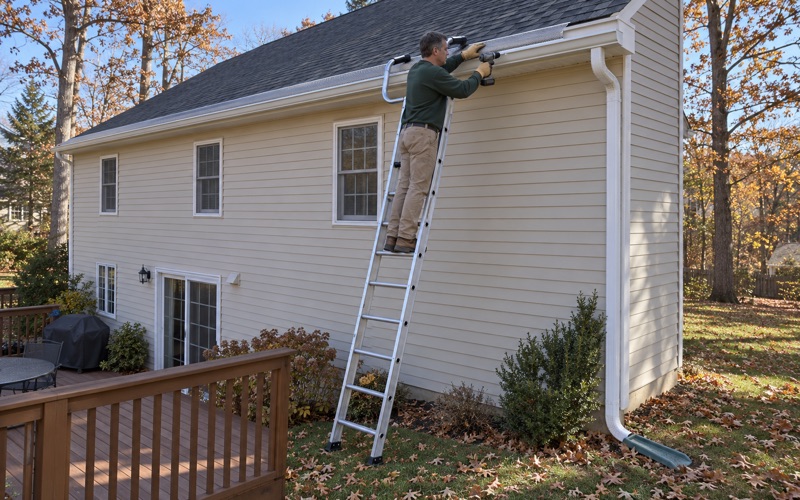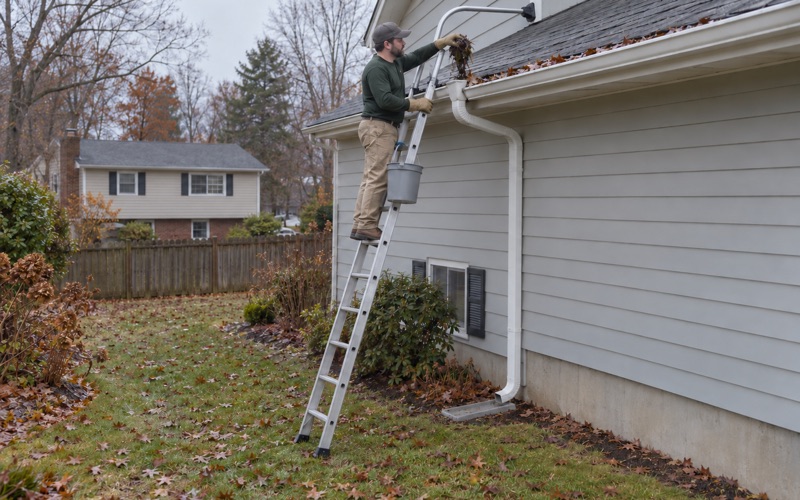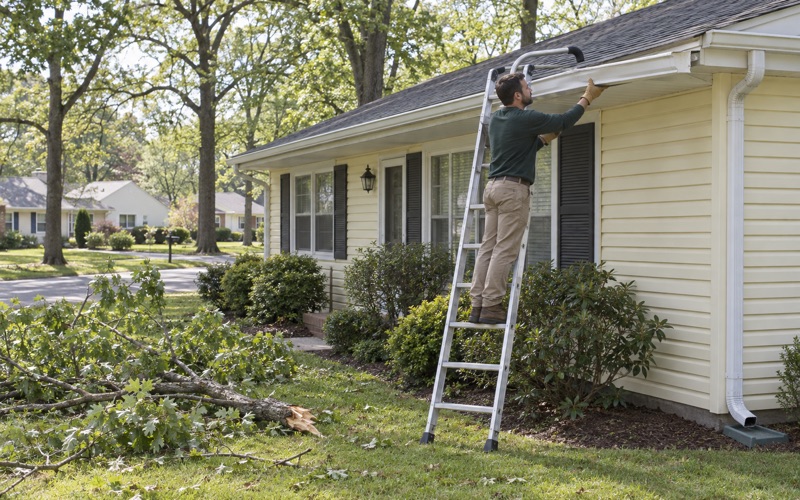
Howell Gutters has spent more than 20 years cleaning, repairing and installing gutters in Lakewood, and a large share of that work here comes from owners who rent their properties out. A landlord between tenants needs leaders that are fastened, flowing and finished before a set date, so we plan visits around that deadline instead of asking the property to wait on our calendar.
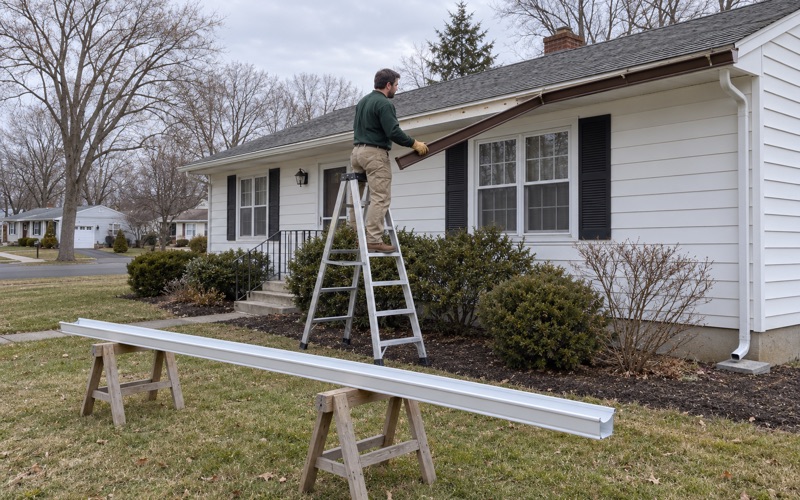
Our crews handle the full range of gutter work on a rental: clearing clogged runs, resealing leaking seams and end caps, refastening loose hangers, replacing crushed elbows and installing new seamless gutters formed on site from coil. Each job ends with before-and-after photos, which give an owner who lives elsewhere a clear record of what was done without driving over to look.
The same care goes into owner-occupied houses, but this page is written for the landlord, the property manager and the building owner. It covers how gutter work fits the township’s turnover process, what the state asks of larger apartment buildings, and how we schedule cleaning when someone already lives in the unit.
Gutter Work on Lakewood’s Rental Turnover Clock
Every New Tenant Brings an Inspection
Lakewood Township inspects a rental unit each time the tenant changes. The owner files a Rental Certificate of Occupancy application with a copy of the signed lease, names the incoming tenant and the number of occupants, and pays the fee, which was $65 on the township’s 2022 form. The landlord’s registration certificate must also be on file with the Township Clerk.
That process repeats across a large rental market. Census figures count 15,248 renter households in Lakewood, nearly as many as the 16,159 households who own their homes. Every one of those leases ends eventually, and each turnover puts a unit back on the township’s inspection calendar with a date to get it ready.
For an owner, the practical effect is that every vacancy has two clocks running: the days until the new lease starts and the inspection date. Gutter work that waits until the last week competes with painting, cleaning and repairs inside the unit, which is why we suggest booking it as soon as the old tenant gives notice.
The 9:00 a.m. Deadline
The application warns that the rental unit must be ready for inspection by 9:00 a.m. on inspection day, or a failure notice will be issued. A failed unit then needs a re-inspection, and the form carries a separate line for the re-inspection fee. Missing the morning deadline costs an owner time and money while the new tenant waits.
To be clear about what we know, the township form does not list gutters or any other exterior item, and we have not seen the inspector’s exterior checklist. We do not promise that clean gutters decide a result. What we offer is simpler: gutter and leader work finished before your inspection morning, so it is one less open item on a unit you are trying to turn over.
When you book a turnover visit, tell us the inspection date. We schedule the work for the days before it, not the morning of, and send the photos the same day so you can confirm the job is done while you handle the lead-safe certification, the lease copy and the rest of the application.
Looking for gutters closer to Colts Neck? See Gutters in Colts Neck.
Before the Inspection: Gutters and Leaders a Landlord Can Fix Fast
Loose Hangers, Leaking Seams and Crushed Elbows
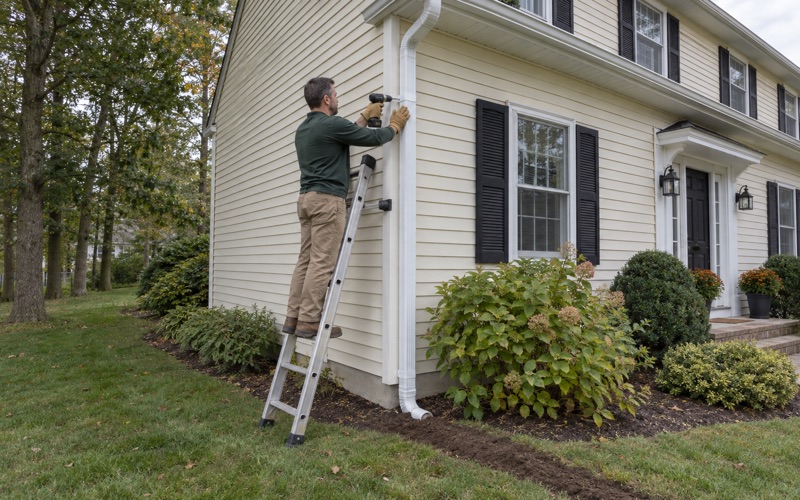
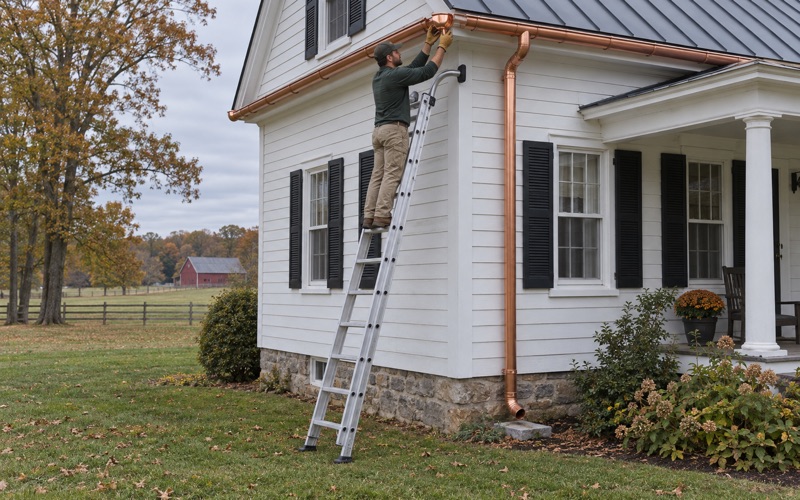
Most turnover gutter problems are small and quick to correct. Hangers back out of the fascia, end caps and corner miters start to drip as old sealant cracks, and elbows get flattened by lawn equipment or a tenant’s trash cans. We refasten runs with hidden hangers, reseal joints with tripolymer sealant and replace damaged A and B elbows, usually in a single visit.
Before any new hanger goes in, we check the fascia board behind the gutter. Rot there will not hold a fastener for long, so if the wood is soft we show it to you, in person or in photos, before replacing it. On a pre-1978 building with painted trim, fascia work follows the EPA Renovation, Repair and Painting rule.
Where a lower roof meets a side wall, we also check the kickout flashing at the base of that wall, since a missing kickout sends roof water down the siding behind the gutter end. A gutter apron or drip edge that has pulled away gets refit at the same time, so water lands in the trough instead of behind it.
Repair Lines and Replacement Lines on One Estimate
Sometimes a run is past saving: split along its length, pulling away in several spots or pitched backward so water pools in the middle. In that case we quote a new seamless section formed on site from .032 aluminum coil, sized for the roof area that drains into it, often a 6-inch K-style gutter with 3x4 downspouts.
Our estimates put new gutters and repair work on separate lines, because New Jersey taxes them differently. New gutters are a capital improvement, exempt with Form ST-8, while repairing existing gutters is a taxable repair. For an owner tracking costs across a rental portfolio, that split keeps the bookkeeping straight. Contracts follow the state’s home improvement rules, including the three-day cancellation notice.
Where the Water Goes After the Downspout
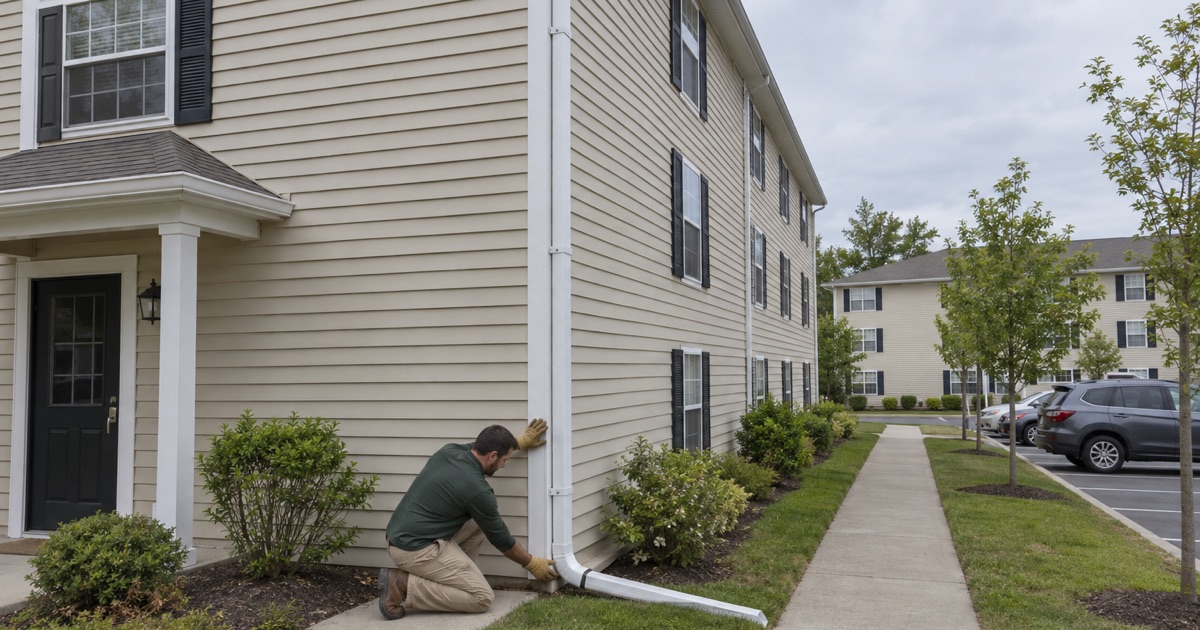
A clean gutter still causes trouble if its downspout dumps against the wall. We follow every downspout to where its water lands, and when it lands at the foundation we propose an extension, a pop-up emitter or a drywell. Leader outlets are never tied into the sanitary sewer, and the estimate states where each one will discharge.
Grade matters as much as the leader. The 2021 New Jersey edition of the residential code calls for the ground to fall 6 inches within the first 10 feet from the foundation, and on some lots that slope has settled flat or turned back toward the wall. When we see that, we note it in the photos so you can decide whether regrading belongs on the turnover list.
Apartment Buildings and New Jersey’s Leader Rule
What N.J.A.C. 5:10-7.5 Requires
Larger rental buildings carry a state maintenance standard of their own. Under N.J.A.C. 5:10-7.5, part of New Jersey’s rules for hotels and multiple dwellings, leaders and drainpipes must be securely fastened to the building, kept in good condition and free of leaks, kept clean and free of obstructions, and must direct storm water into drainage systems and away from the foundation walls.
That list reads almost like a gutter work order, and we treat it as one. On a multiple dwelling we check each leader’s straps and brackets, test the joints for leaks with running water, clear every outlet and elbow, and confirm where each discharge point sends the water before we call the job finished.
Lakewood’s Three-Plus-Unit Stock
Lakewood has a sizable share of these buildings. Census counts show 7,631 housing units in buildings of three or more units, about 22.6 percent of the township’s 33,812 units, and 5,849 of those are occupied by renters. They range from small three- and four-unit houses to buildings of 50 units or more.
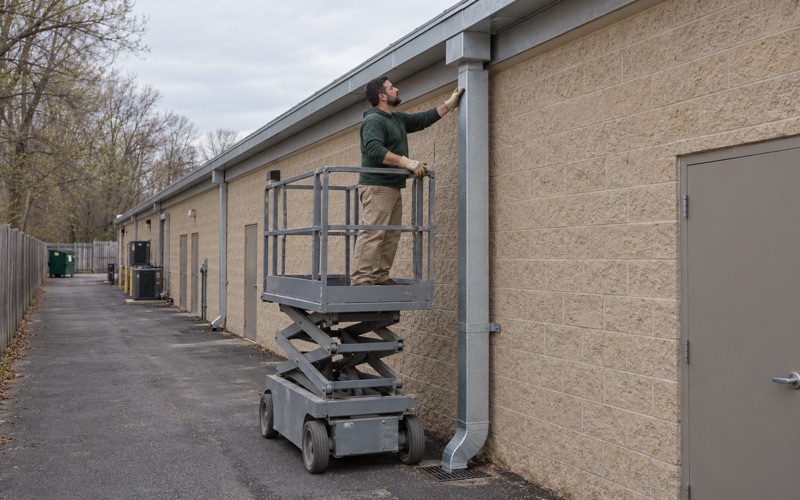
A long eave on a larger building drains a lot of roof, and an undersized gutter or a single overloaded downspout is where leaks and overflow usually begin. When we replace gutters on a multiple dwelling, we size each run and its downspouts to the roof area feeding it, and we add outlets with wide-flange fittings where one drop cannot keep up.
Where Roof Water Ends Up
Storm water leaving Lakewood’s denser neighborhoods has to go somewhere. Around Lake Carasaljo, part of the South Branch Metedeconk River, direct outfalls along North Lake Drive and South Lake Drive discharged into the lake with no water quality treatment until six of them were retrofitted with bioretention and infiltration systems in a project completed in fall 2018.
That is one more reason we keep leader outlets clean and point them where the building’s own drainage system can take the flow. Water directed into a proper drain or a drywell, rather than across a parking area or against a foundation, is what the leader rule asks for and what a building owner wants anyway.
Scheduling Cleaning Around Tenants and Several Properties
Cleaning While a Unit Is Occupied
Not every gutter visit lands between leases. Mid-tenancy cleaning is often the better plan, because it keeps a turnover from inheriting a full season of clogs. We coordinate access through the owner or manager, work from the outside usually without needing anyone home, and keep ladders and debris clear of doorways, walkways and parked cars.
Every cleaning visit flushes each downspout, and the debris is bagged and taken away, so tenants are not left with a pile on the lawn or at the curb. The before-and-after photos go to whoever booked the work, which matters when the owner, the manager and the tenant are three different people.
Guards Matched to the Trees
Guards can stretch the time between cleanings on a rental where access is awkward. We match them to what grows over the roof, because pitch pine needles slip through screens that stop oak leaves without trouble. Where needles are the problem, a stainless steel micro-mesh guard is usually the better fit than a coarse screen.
On a property where the trees are mostly oak, a sturdier screen may do the job, and on a lot with little overhead canopy we may suggest skipping guards entirely and booking cleanings instead. Either way, the guard recommendation appears on the estimate with the reason for it.
One Call for a Portfolio
If you own or manage several rentals, one call can cover all of them. We work through a list of addresses on a single schedule, move any unit with an inspection date to the front, and report each property separately so the photos and line items stay attached to the right address.
Where a building sits in an association, we check the master deed or ask the management office first, so everyone knows whether the gutters are the owner’s job or the association’s. Settling that before the ladder goes up avoids paying for work that someone else was already responsible for.
For a unit coming up on turnover, send us the address, the inspection date and what you have noticed, whether that is an overflowing corner, a loose leader or a downspout that empties beside the foundation. We will set a visit ahead of that date and send back photos of the finished work.
- 20+ Years in Business
- Seamless Gutters Formed On Site
- Before-and-After Photos