Howell Gutters has put more than 20 years into gutters in Holmdel, and most of what we do here comes down to one question: where does the roof water go once it leaves the eave? On some houses the answer is a lawn. On others it is a drainage system someone engineered before the first foundation was poured, and the gutter work has to respect that.
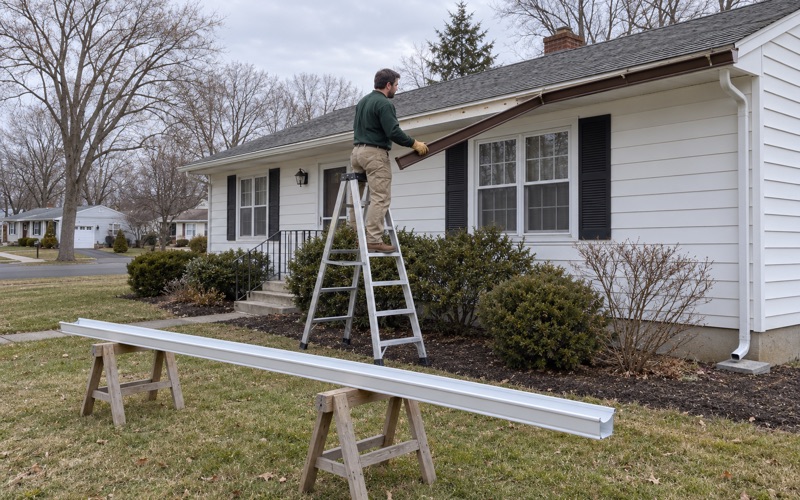
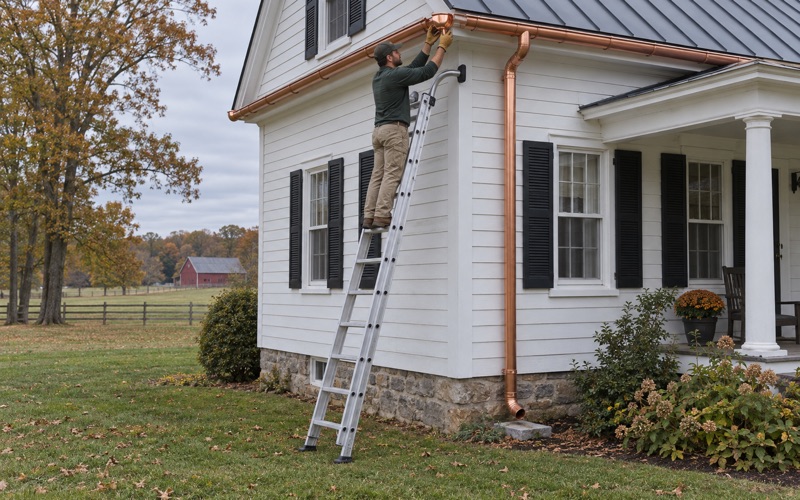
We form seamless gutters on site from coil, one piece for each run of the house, so there are no joints along the eave to open up later. Before any new run goes up we check the fascia behind it, and if the wood is soft we show it to you before we replace a single board. Repairs and new installations are priced on separate lines, because New Jersey taxes the two differently.
Cleaning visits end with every downspout flushed and the debris bagged and hauled, never piled at the curb, and you get before-and-after photos either way. The sections below cover the homes where that care matters most in this township, and the questions owners ask us before we set a ladder.
Gutters for the Homes on Holmdel’s Former Bell Labs Campus
Holmdel’s newest neighborhoods were not carved out of farmland. They were cut from a corporate campus. The Bell Laboratories complex on Crawfords Corner Road was constructed between 1959 and 1966 to a design by Eero Saarinen and Associates, and it was listed in the National Register on June 26, 2017. Somerset Development turned the 2,000,000-square-foot building into Bell Works, a mixed-use center with more than 1 million square feet of office space.
The land around the building went residential. In July 2014 the Holmdel Planning Board approved 185 age-restricted townhouses by Toll Brothers on roughly 134 acres of the 473-acre tract south of the road, under a 2012 redevelopment plan. Phase one called for 108 carriage homes with a clubhouse and recreation facilities; phase two added 77 more homes. The board also approved 40 luxury homes near Roberts Road.
What a gutter system from the 2010s needs now
Census estimates count 373 Holmdel homes built from 2010 to 2019 and another 102 since 2020, a small slice of a township that mostly went up in the 1980s and 1990s. Gutters on these houses are young, but young is not the same as maintenance-free. The things we find most often on newer installations are hangers that have loosened as the framing settled, end caps and miters whose sealant has started to lift, and runs that have lost their pitch so water sits in the trough instead of moving to the outlet.
Repair first, replacement when it earns it
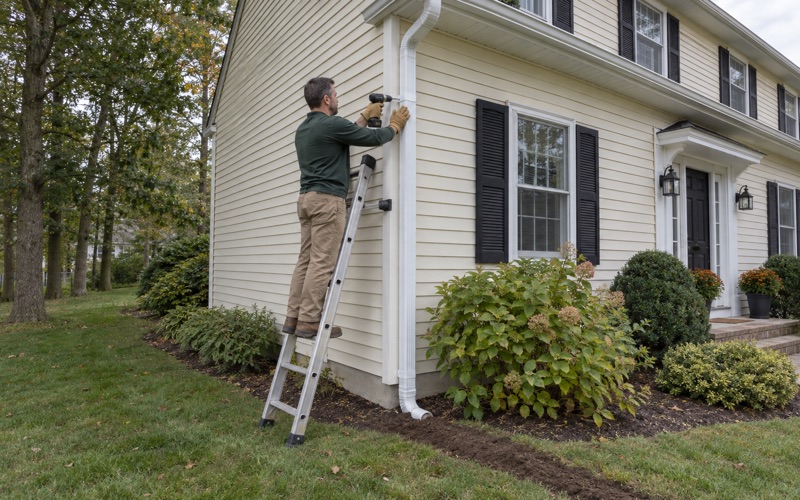
On a house of this age we usually start with repair: resealing seams with tripolymer gutter sealant, swapping spike-and-ferrule fasteners for hidden hangers, and repitching a sagging run. Full replacement makes sense when the original profile or downspout count simply can’t handle what the roof sends it, or when storm or ladder damage has kinked a run beyond straightening. Either way, the estimate tells you which line is which.
Looking for gutters closer to Red Bank? See Red Bank Gutters.
Where Roof Water Goes When the Community Has Infiltration Basins
The 2014 approval did something most subdivisions in older parts of Monmouth County never did: it built stormwater handling into the plan from the start. Phase one included an infiltration basin and a wet pond on its 65 acres, and phase two added two more infiltration basins on its 70 acres. Rain that falls on those roofs and driveways is part of a system designed for the whole community, not just water dumped onto whichever yard happens to be closest.
That changes the conversation about downspouts. In a typical Holmdel backyard, moving a leader is a homeowner’s call. In a neighborhood built around a designed stormwater system, rerouting, extending or burying a downspout may touch something the community planned, so it is a question for that plan as well as for you.
We check before we reroute
We have not read the drainage plan or governing documents for these communities, and we won’t pretend to know what they say. What we do is ask. Before quoting any change to where a downspout discharges in an adult community or association, we check the master deed or call the management office so you know who is responsible for the gutters, the leaders and the ground they empty onto. If a change needs sign-off, you hear that before work is scheduled, not after.
The ground near the foundation still matters
Whatever the community system does further downhill, the first few feet next to the house are where a leak turns into a wet basement. The New Jersey edition of the 2021 residential code calls for grade to fall 6 inches within the first 10 feet from the foundation. We follow every downspout to where its water actually lands, and when it lands against the foundation we propose an extension, a pop-up emitter or a drywell, whichever suits the lot and the rules that govern it.
Never into the sewer
One rule holds everywhere we work: leader outlets are never tied into the sanitary sewer. Our estimates state where each outlet will discharge, so there is no guessing on the day of installation and nothing a later inspector has to untangle.
Carriage Homes and Age-Restricted Townhouses: Who Calls for Gutter Work
Holmdel’s owner households skew older than most. Census estimates put 1,981 of the township’s 5,890 owner households, 33.6 percent, under a householder 65 or older. The same estimates count 990 attached homes, 842 of them owner-occupied. Put those numbers next to an age-restricted townhouse community and the pattern is clear: a lot of the gutter calls here come from owners who should not be on a ladder and who share a roofline with a neighbor.
Shared rooflines, separate questions
On an attached carriage home, one continuous eave can drain several units. A clog above one door can overflow onto the next, and a sagging section may hang across a property line. That is why we sort out responsibility before we touch anything. Some associations handle exterior gutters, some leave them to each owner, and some split the work by task. We don’t assume; the master deed or the management office tells us, and we tell you.
Paperwork that protects the owner
Replacing or installing exterior gutters and leaders is ordinary maintenance under N.J.A.C. 5:23-2.7(c)1.xvi, so a typical gutter job does not need a construction permit. The contract still matters. Ours are written to New Jersey’s home improvement rules, including the three-day cancellation notice, and we carry the home improvement contractor business registration the state requires. New gutters are an exempt capital improvement documented on Form ST-8, while gutter repair is taxable, so the two always appear as separate lines.
When an adult child is the one calling
We often hear from a son or daughter arranging work for a parent in one of these communities. That works fine. We can send the estimate, the master deed findings and the before-and-after photos to whoever is handling it, so the person paying sees exactly what the person living there sees.
Cleaning, Guards and Underground Drain Lines on Newer Holmdel Homes
A newer gutter system fails the same way an old one does: debris builds up, water backs up, and the overflow finds the fascia or the foundation. Monmouth County Mosquito Control also asks residents to keep gutters clean and properly pitched, because standing water in a clogged trough is breeding habitat.
Cleaning that finishes the job
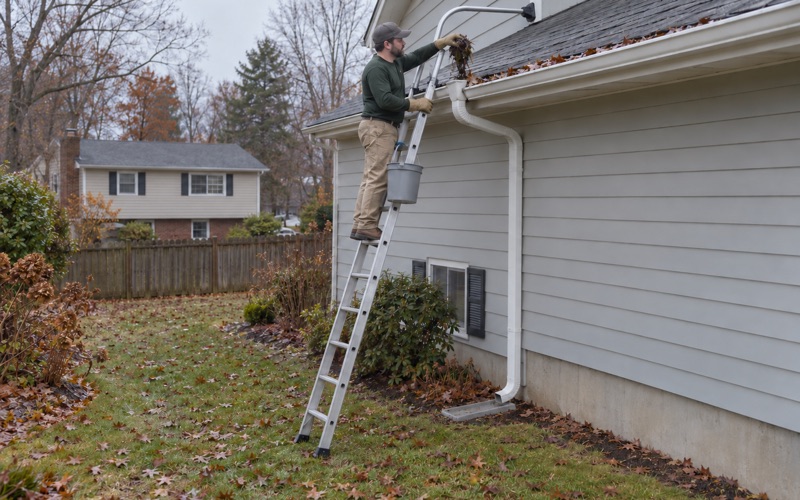
Our cleaning visits clear every trough by hand, then flush every downspout to prove water reaches the outlet. Debris goes into bags and leaves with us; nothing stays on the lawn or at the curb. You get photos of each run before and after, which is useful when you are not the one who can climb up and check, or when the association wants proof the work was done.
Guards chosen for the trees on the lot
Gutter guards only help when they match what falls on the roof. Oak leaves and pitch pine needles behave differently: broad leaves mat on top of a coarse screen, while needles slip through it and pack the trough. We look at the trees around the house before recommending anything, and on many lots that points to stainless steel micro-mesh. If a guard won’t help on your roof, we say so.
Underground roof drain lines
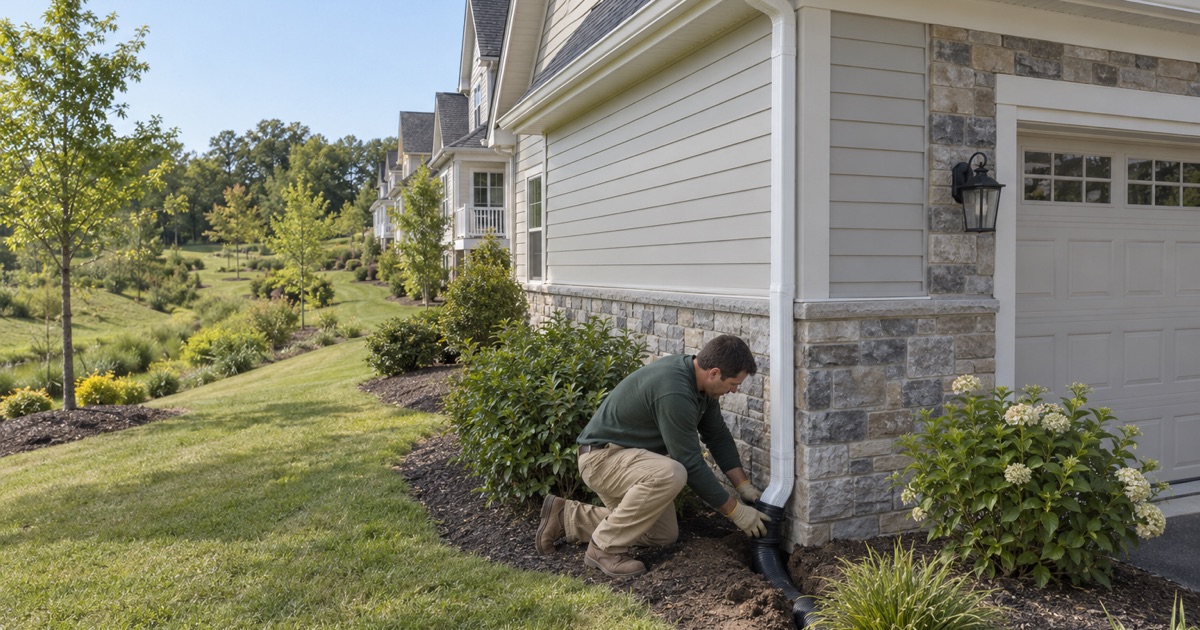
Many newer homes send downspout water into buried lines rather than splash blocks. Holmdel’s township code permits HDPE piping methods and materials for roof drain systems, which is a durable plastic pipe often used for buried leader lines. When a buried line clogs, the first sign is usually a downspout that overflows at the elbow or a gutter that spills in heavy rain even though it was just cleaned.
We flush buried lines to find the blockage, and where a line has crushed or separated we can replace it or end it at a pop-up emitter. If a drywell is the better answer, New Jersey’s stormwater rule calls for dry wells to sit 2 feet above the seasonal high water table, so we confirm the site will support one before we propose it. In a community with its own infiltration basins, any new discharge point goes through the same check with the master deed or management office as every other change.
- 20+ Years in Business
- Seamless Gutters Formed On Site
- Before-and-After Photos