Howell Gutters has spent more than 20 years cleaning, repairing and installing gutters in Freehold Township, and in the fall our calendar here bends around one thing: when the township’s leaf trucks come down your street. A cleanout done the week before a pass and a cleanout done the week after look the same from the ladder. They look very different a month later, when the pile is either gone or still sitting by the driveway.
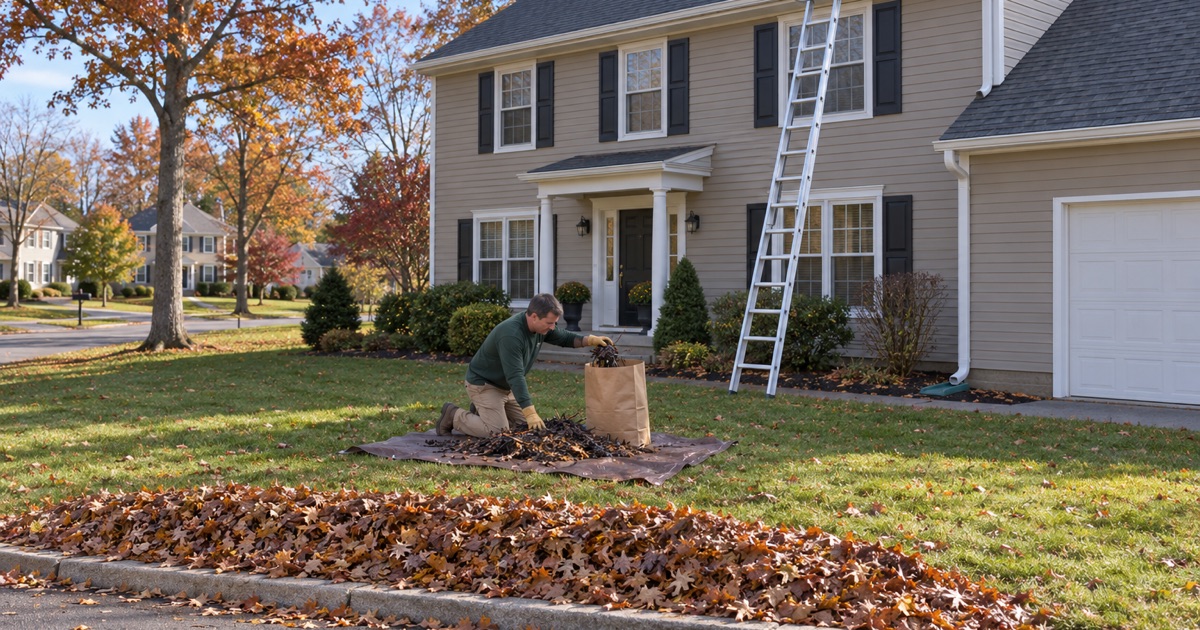
Our cleaning visits flush every downspout and bag what comes out of the troughs, so nothing is left on the lawn or pushed to the curb. That matters more here than in most towns, because gutter debris and a raked leaf pile are not the same thing to a public works crew, and the difference decides who ends up hauling it away.
Below we walk through how the fall leaf passes work, why gutter sludge does not qualify for them, what happens to limbs cut back off a roofline, and how we time cleaning and guard work so homeowners are not left holding bags of wet debris into the winter.
Three Leaf Passes per Sector, and No Call-Backs
How the Fall Schedule Works
The Freehold Township Department of Public Works collects leaves by recycling sector, lettered A through F, and each sector gets three passes in the fall, one week apiece. For 2026 the township lists Sectors A and D the weeks of October 19, November 9 and November 30; B and E the weeks of October 26, November 16 and December 7; and C and F the weeks of November 2, November 23 and December 14.
The township also notes that the schedule may change due to weather conditions or at its own discretion, so we treat those dates as this season’s plan rather than a promise. When we book a fall cleaning, we ask which sector the house sits in and check the township’s current posting before we settle on a day.
The 6:00 a.m. Monday Deadline
Leaves must be at the curb by 6:00 a.m. on the Monday of the scheduled collection week. A crew can reach any street early in that week, so a pile raked out Monday afternoon may already be too late for that pass. The rule is tied to the start of the week, not to the day a truck happens to appear on your block.
That deadline shapes our booking. If a house sits in a sector whose pass starts on a given Monday, we aim to finish the gutters by the Friday or Saturday before, which leaves the weekend to rake the yard out. A cleaning booked for the Tuesday of a collection week usually means the yard’s leaves wait for the next pass.
Once a Street Is Done, It Is Done
The township is plain about this: once a street has been completed, crews will not return, and there are no call-backs. Miss the Monday deadline and the leaves wait for the following pass. Miss the last pass of the season and they stay on the property, because no fall leaf pickup is left to take them.
For Sectors C and F in 2026, that last pass is the week of December 14. For A and D it is the week of November 30, which catches people off guard if they assume pickup runs into mid-December everywhere in town. A late-dropping oak can still be shedding leaves well after its sector’s final week has come and gone.
Looking for gutters closer to Wall? See Wall Gutters.
Why Gutter Debris Is Not a Leaf Pile
Free of Any Branches or Twigs
The township’s leaf collection criteria ask for leaves raked to the curb free of any branches or twigs. Homeowners and landscapers are also reminded not to blow or place leaves into the street. A pile is supposed to be clean leaves, at the curb, and out of the travel lane.
What comes out of a gutter in November is rarely clean leaves. It is a wet mat of leaves, twigs, seed pods, shingle grit and whatever the wind carried onto the roof. Reading the rule as it is written, our view is that a cleanout’s spoil does not meet it, so we never dump it at the curb hoping a crew will take it anyway.
Bagged, Not Dumped
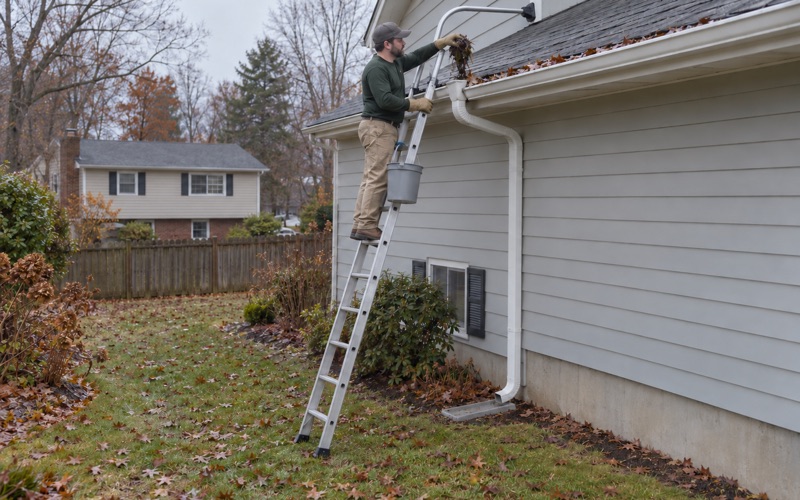
Every cleaning visit ends with the troughs empty, each downspout flushed and the debris bagged. Nothing gets raked into the homeowner’s leaf pile, and nothing is left sitting on the lawn where it can smother grass or blow back against the foundation. The bags do not end up at the curb either, so there is nothing for the township to refuse.
Keeping gutter spoil out of the leaf pile also protects the pile itself. A clean pile of raked leaves meets the township’s standard; the same pile with a few shovelfuls of twigs and grit mixed in may not. With no call-backs, that is an expensive thing to discover after the truck has already rolled past.
Downspouts Clog Before Troughs Do
In a heavy leaf year, the downspout is usually the first place water stops moving. Leaves pack into the outlet and the A and B elbows below it, and the trough fills even when the run above looks mostly clear. We flush every downspout on every visit, and before-and-after photos show what was in the system and how it looks once we finish.
Brush Waits for Spring in Freehold Township
Spring Brush Collection, Sector by Sector
Brush is not a fall service here. The 2026 brush schedule runs one sector per week, beginning with Sector A the week of March 23 and ending with Sector F the week of April 27. The township says each sector takes about a week to finish, and just like the leaf passes, there are no call-backs once a street is done.
Brush goes at the curb, not in the street, by 6:00 a.m. on the first day of the scheduled week and no more than two days early. It must be cut to a maximum length of eight feet and a maximum diameter of eight inches, and a pile should not exceed eight cubic yards. Commercial trimmings are not collected.
Limbs Cut Back Off the Roofline in Fall
Overhanging limbs feed gutters, so cutting them back is often part of solving a chronic clog. When that cutting happens in October or November, the brush has no place on the township’s schedule until spring. Grass, rocks, leaves, stumps and construction debris are not taken with brush at all, so a mixed pile will not qualify either.
That leaves two choices for fall-cut limbs: stack them neatly until the spring brush week, or take them to the township Recycling Center, open Tuesday, Thursday and Saturday from 8:00 a.m. to 3:00 p.m. When an owner mentions plans to cut back trees, we raise this early so nobody is surprised by a pile that has to sit through winter.
The One-Time Fall Bulk Collection
The township’s residents page also notes a one-time bulk collection in the fall. It is a separate program from leaves and brush, and we do not treat it as a destination for gutter debris or roofline limbs. Anyone hoping to use it for a project around the house should read the township’s own guidance before setting anything out.
Timing Your Fall Gutter Cleaning to Your Sector
Find Your Sector First
The township’s List of Sectors places streets by area. Sector A covers Colonial Acres, Dutch Lane Estates and Freehold Pointe, plus streets west of Dutch Lane Road, north of Route 33 and east of Route 9. Sector C covers streets south of Route 33 and east of Route 9, and Sector F covers streets south of and including Elton Adelphia Road, except Silvermead.
Briar Hill and Carrington Meadow fall in Sector B, Charter Oak at Stonehurst in Sector D, and Clayton Farms and College Park in Sector E. When a street sits near one of those dividing lines, the township’s own list is the only answer we rely on, and we check it before quoting a cleaning date.
Two Visits, or One Well-Timed One
Many lots are best served by a cleaning shortly before the second pass and another before the last. The first visit clears the early drop while the yard’s leaves can still go out with that week’s pile. The second catches what fell afterward, timed so the lawn can be raked to the curb before the final Monday deadline.
Homeowners who want a single visit usually choose the week before their sector’s last pass. That catches most of the season’s drop, though a late oak or a windy December can still put leaves back in the troughs after the trucks are done for the year. Because we bag gutter debris anyway, a late visit is never wasted.
Gutter Guards When the Last Pass Comes Early
In Sectors A and D, the final leaf pass of 2026 falls the week of November 30, and plenty of trees are not finished by then. Guards limit what a December drop can do. We match the screen to the trees on the lot, since pitch pine needles and oak leaves call for different designs, and stainless steel micro-mesh handles fine needles well.
Before any guard goes on, we check the fascia behind the gutter for rot and show the owner soft wood before it is replaced. Guards do not end maintenance; they reduce how often someone has to be on the roofline, which matters most once the leaf trucks are finished for the season.
Freehold Township also has more attached housing than a quick drive suggests: the 2024 ACS five-year estimates count 2,262 single-family attached homes, about 16.8 percent of all units. On those rooflines a gutter run can cross from one unit to the next, so in an association we check the master deed or management office first to learn who is responsible for the gutters.
- 20+ Years in Business
- Seamless Gutters Formed On Site
- Before-and-After Photos