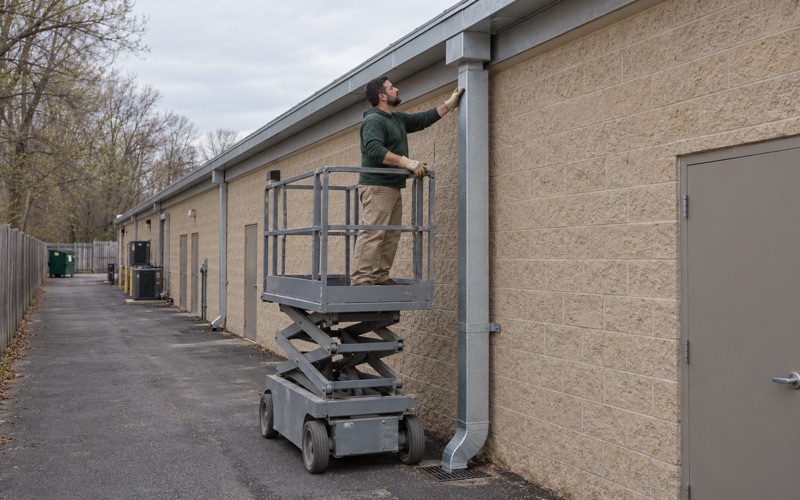
Howell Gutters has spent more than 20 years installing, repairing and cleaning gutters in East Freehold and the rest of central Monmouth County. On this part of Freehold Township, the gutter itself is rarely the hard part. The decision that matters is what happens to the water after it leaves the downspout, because most lots here are not flat.
We start every job by finding where the water ends up, then work back to the gutters that deliver it. Estimates list new gutters and repair work on separate lines, because New Jersey taxes them differently, and every contract follows the state’s home improvement rules, including the three-day cancellation notice.
This page covers what that looks like on East Freehold ground: why the soil drains well but the slope still moves water, how we handle discharge on eroded lots, and what the homes here usually need from a new or repaired system.
East Freehold Sits on Slopes, Not Flat Sand
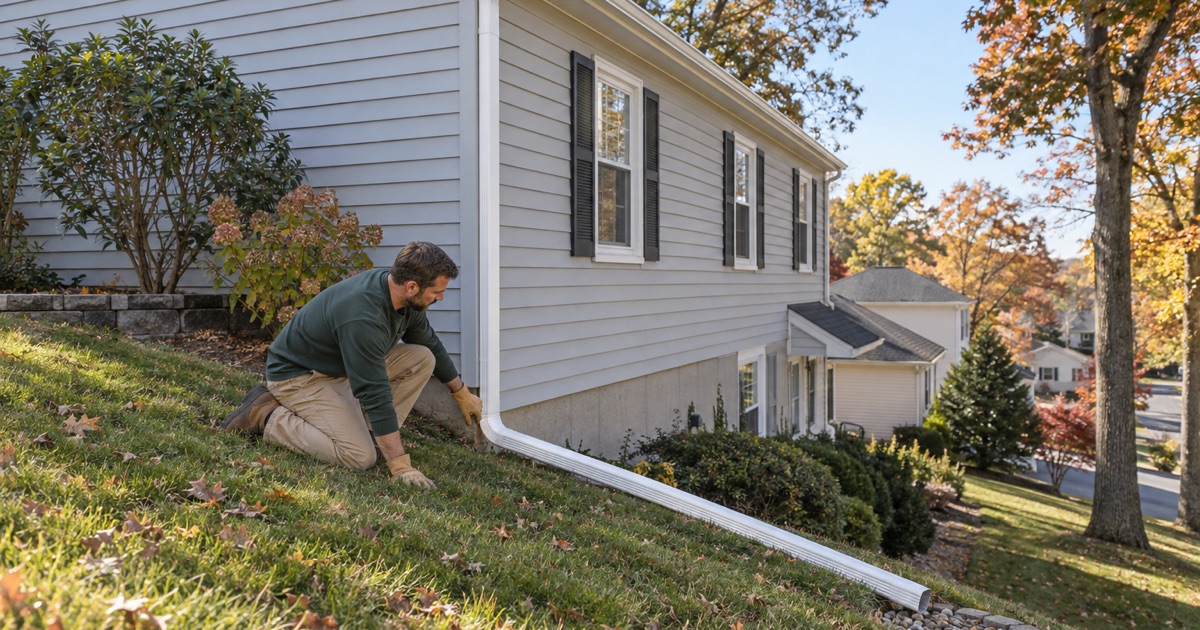
East Freehold is a census-designated place in the northeast corner of Freehold Township, governed by the township rather than as its own town. Its ground is not the level, sandy outwash many people picture when they think of this part of New Jersey. Federal soil mapping shows rolling terrain, and that shapes almost every drainage decision we make here.
Colts Neck Sandy Loam on Rolling Ground
A USDA soil survey sample across the center of East Freehold returns Colts Neck sandy loam in several slope phases: 2 to 5 percent, 5 to 10 percent, 10 to 15 percent and 15 to 25 percent. The steeper phases are mapped as eroded, meaning the slopes have already lost topsoil. Tinton loamy sand and Collington sandy loam appear in the same sample.
In practice, that means two houses on the same street can sit on very different grades. One lot may fall gently away from the foundation, while the next drops toward a back fence at a pitch you notice when you mow it. We look at the grade around each corner of the house before we decide where a single downspout should go.
Well Drained, With a Deep Water Table
The same survey rates these soils well drained, in hydrologic group B, with no flooding listed. On the Colts Neck phases, the water table sits deeper than 183 centimeters, roughly six feet down. Water soaks in readily here, and groundwater pushing up from below is not the usual concern on these lots.
That changes how we think about the job. A homeowner in East Freehold is less likely to be fighting a wet basement from the water table and more likely to be dealing with surface flow: roof water that leaves a downspout, hits the ground and runs downhill before the soil has a chance to take it.
A whole roof’s worth of rain funneled into one leader is a lot of water arriving at one point. On flat, well-drained ground it would mostly soak in. On a 10 or 20 percent grade, a good share of it can keep moving, and the gutter system is where we can control which way it goes.
Looking for gutters closer to Lakewood? See Lakewood Gutters.
Where Roof Water Goes on a Sloped Lot
Every lot has a high side and a low side, and on East Freehold’s slopes the difference can be several feet across a single backyard. Where a downspout empties decides whether roof water drains into your own lawn or crosses toward the property next door.
Mapping Every Downspout to Its Landing Spot
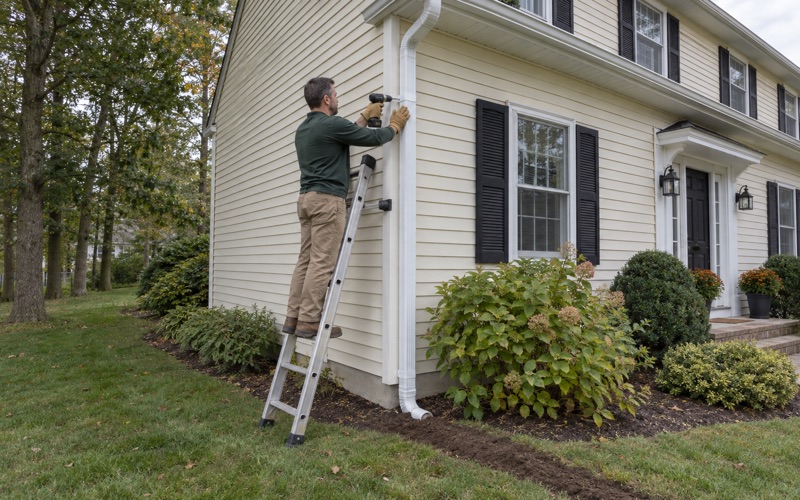
On a first visit, we follow every leader from the outlet to the ground and note where the water actually ends up. We mark which downspouts sit on the high side of the house, which discharge toward the low side, and which already empty against the foundation or onto a walkway.
Leaders on the downhill side of a house are usually the simple ones, because the grade already carries water away once it clears the foundation. Uphill leaders need more thought, since the slope can turn their discharge back toward the wall, and side leaders can push it across a lawn toward the next house.
We put that map in writing. The estimate says where each leader will discharge, and none of them is ever tied into the sanitary sewer. If a homeowner wants a different discharge point than the one we suggest, we talk through where the water would go from there.
Grading Near the Foundation
The 2021 New Jersey edition of the International Residential Code, in section R401.3, calls for grade to fall 6 inches within the first 10 feet from a foundation. On a sloped East Freehold lot, the uphill side of a house can be hard to shape that way, which puts more weight on where the downspouts deliver their water.
Reshaping a yard is landscaping work rather than gutter work. Our part is keeping roof water from adding to the problem: carrying it past the high side with an extension or an underground line, and releasing it where the ground already falls away from the house.
Downspout Extensions and Splash Blocks on Eroded Ground
The eroded slope phases in East Freehold are where downspout discharge deserves the most care. Already eroded ground has less cover to absorb a concentrated stream, and in our experience a leader that empties in one spot on a bank tends to cut a channel over time.
Splash Blocks Have Limits Here
A splash block is a fine answer on level ground. It spreads the stream a little and keeps it off the siding and foundation. On a 15 to 25 percent eroded slope, though, a splash block just moves the starting point of the runoff a foot or two downhill without slowing it much.
When we see bare soil, a small gully or a washed-out mulch bed below a leader, we treat that as the yard telling us where the water has been going. Those marks guide whether we recommend a longer extension, a different outlet location or a buried line.
Extensions, Emitters and Drywells
Above-ground extensions are the least expensive fix and work well on downhill corners, where they only need to carry water clear of the foundation and onto a stable stretch of lawn. We set them so they do not point at a neighbor’s property line or the top of an eroded bank.
Underground downspout lines with pop-up drainage emitters suit the uphill side, where water has to travel some distance before it can be released safely. Because East Freehold’s sandy loam is well drained, the emitter can usually sit on a gentler part of the yard and let the soil take the water there.
Drywells are the third option. On soils that drain this well, a drywell can take a leader’s flow below ground instead of releasing it at the surface at all. We propose one when there is no good place on the lot to let water out, and we explain the tradeoff in cost against an emitter line.
Sizing the Gutters That Feed Them
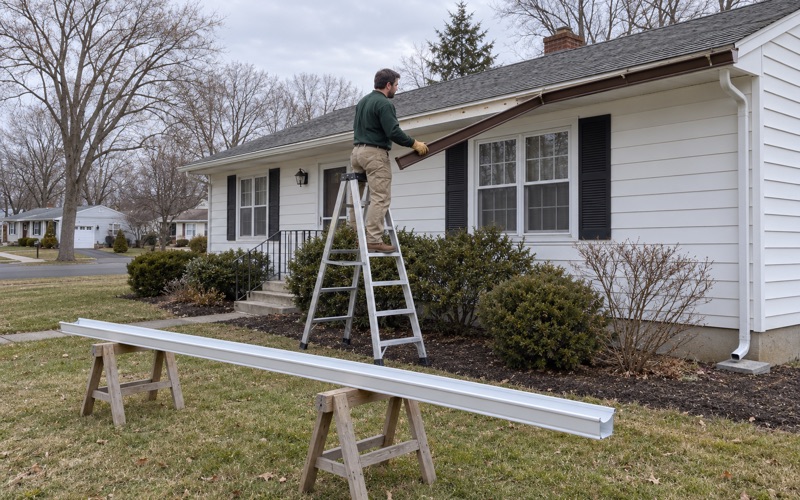
Discharge planning starts at the roof. We size each gutter and downspout for the roof area that drains into that run, so a large rear slope gets the capacity it needs instead of the same size used everywhere. On many homes that means 6-inch K-style seamless gutters with 3x4 downspouts.
Correct sizing also matters for erosion. An undersized gutter overflows along its whole length during a heavy storm, dropping water off the eave edge onto the slope in a sheet. Getting the water into the downspouts first is what lets us decide where it goes.
Yellow Brook Drainage and East Freehold’s Homes
Most of East Freehold drains east to Yellow Brook, a tributary of the Swimming River, while the southwest corner of the community drains to Debois Creek, which feeds the Manasquan River. Roof water that runs off a lot here is part of that downhill movement toward one stream or the other.
Following the Fall Toward Yellow Brook
Knowing which way a neighborhood drains helps us read a lot before we climb a ladder. On streets that fall east, the low side of many yards faces that direction, and we plan discharge points so water follows the natural fall rather than being pushed sideways across a property line.
Homes near the northeast edge, where Route 18 runs along the border, and homes in Burlington Heights each sit on their own local grade. That is why we look at each lot separately instead of assuming one street behaves like the next.
What the Housing Stock Needs
East Freehold is a place of owner-occupied detached houses. Census estimates put 93.5 percent of its housing units in detached homes, and 37.5 percent of all units were built in the 1990s, with none recorded after 2000. Most gutter work here is on single-family houses whose owners make the decision themselves.
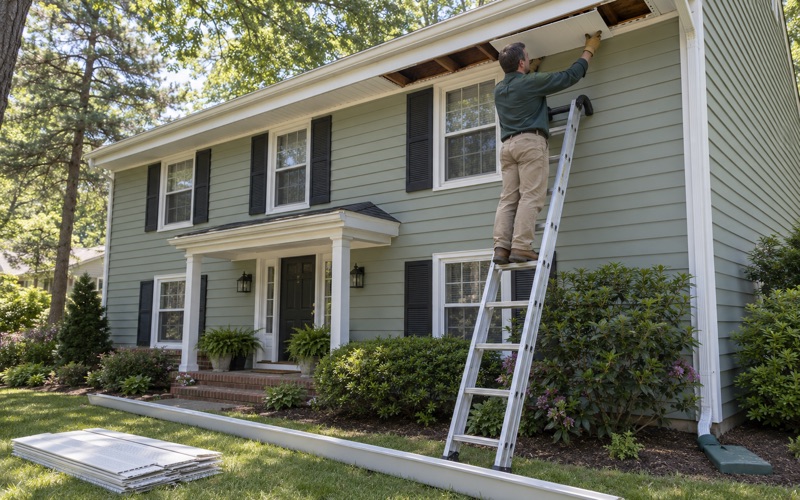
On a house of that age, original gutters and fascia have usually seen decades of weather. Before new gutters go up, we check the fascia board behind them for rot and show the owner any soft wood before we replace it, so there are no surprises on the invoice.
Our seamless runs are formed on site from .032 aluminum coil, hung with hidden hangers, and sealed at the miters with tripolymer gutter sealant. Where a roof meets a sidewall, we check for kickout flashing, since water that escapes there runs straight down the wall to the ground below.
Cleaning and Upkeep on Sloped Lots
Clogged gutters overflow in exactly the way that hurts a sloped yard, spilling water along the whole eave instead of sending it to a planned discharge point. Our cleaning visits flush every downspout and bag the debris so nothing is left on the lawn or at the curb.
Every cleaning and repair comes with before-and-after photos, which is useful when the leaders on the back slope are out of sight from the driveway. Where trees overhang the roof, we match the gutter guard to the species, from stainless steel micro-mesh for fine needles to coarser screens for broad oak leaves.
Installing or replacing gutters and leaders is classed as ordinary maintenance under the state construction code, N.J.A.C. 5:23-2.7(c)1.xvi. The harder part on an East Freehold lot is the plan: knowing where every leader’s water goes once it reaches an eroded bank.
- 20+ Years in Business
- Seamless Gutters Formed On Site
- Before-and-After Photos