
Howell Gutters installs copper gutters in Howell, NJ, bringing 20+ years of gutter work to homes where the gutters are meant to be seen, serving surrounding cities including Ramtown, Freehold Township, Wall, West Freehold and Vista Center. Copper is the material for owners who want gutters that last for generations and look like they belong on the house.
We match copper and half-round work to the age and style of the house. A copper half-round gutter suits an older colonial, a Victorian or a stone-faced home in a way that a standard aluminum K-style does not, while copper K-style can work on a newer house that wants the warmth of the metal without the period look.
As with every system we install, copper gutters are sized for the roof area that drains to each run, and every downspout is planned to discharge away from the foundation. The material changes; the attention to where the water goes does not.
Copper Gutter Weights and Profiles
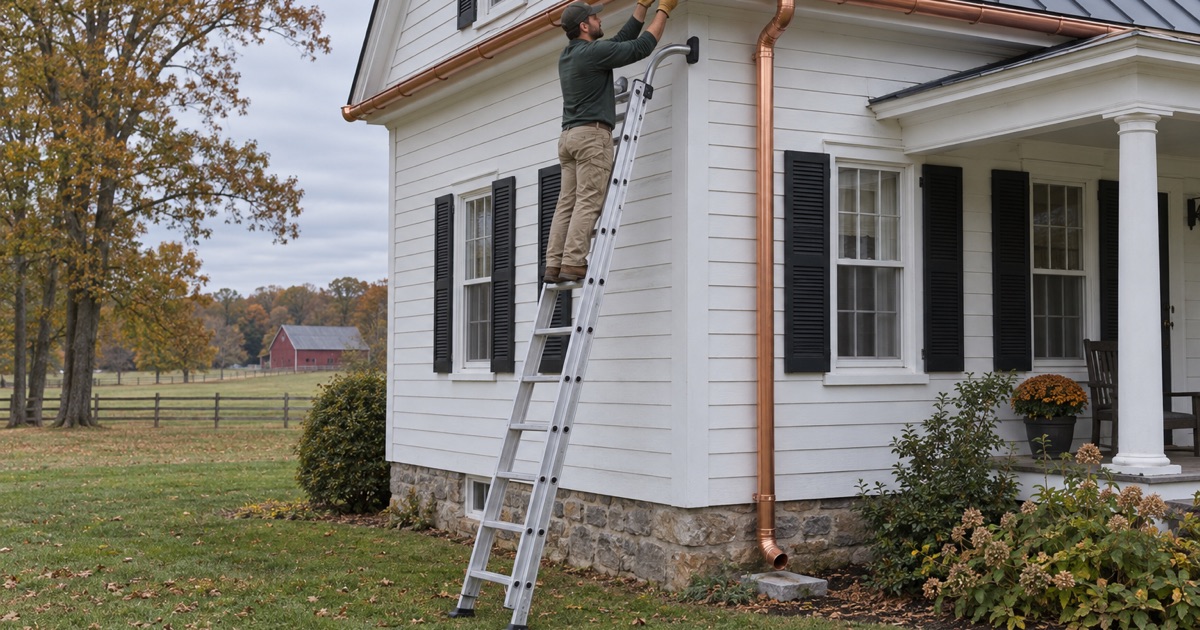
16-Ounce Copper
Copper sheet is sold by weight per square foot, and 16-ounce copper is the standard for residential gutters. It is heavy enough to hold its shape under snow and debris and to take soldered joints that stay watertight for decades. Lighter copper costs less but dents more easily and does not hold up as well along a long run.
Half-Round Gutters With a Double-Bead Profile
Half-round gutters are the traditional profile for copper, and the double-bead version has a rolled front edge on both sides that stiffens the gutter and gives it a finished look. They hang on round brackets that can fasten to the fascia or to exposed rafter tails, which suits older houses with decorative eaves. Half-round gutters are paired with round downspouts for a consistent appearance.
Because a half-round gutter carries a little less water than a K-style of the same width, we may step up to a larger size on a big roof plane, so the gutter still keeps up in a hard rain.
Copper K-Style Gutters
Copper is also available in the K-style profile, which has a flat back that sits against the fascia and a front that resembles crown molding. Copper K-style carries more water for its size than half-round and fits houses designed around that profile, giving the look of copper without changing the line of the eave.
How Copper Weathers Over Time
From Bright Metal to Patina
New copper gutters are bright and reflective. Within months they begin to darken toward a deep brown as the surface oxidizes, and over many years they can develop the blue-green patina associated with old copper roofs. That change is part of copper’s appeal, and the patina layer protects the metal beneath it.
How quickly copper changes color depends on its exposure to rain, sun and air. Gutters on a sheltered side of the house can stay brown much longer than those facing the weather.
Keeping the Original Color
Some owners prefer copper’s early bright or brown tones and do not want the green. Treatments applied to the surface can slow the oxidation, though they wear off and need to be renewed. We explain the options during the estimate so you know what to expect from each finish over the years.
Runoff and Staining
Water running off copper carries small amounts of the metal, which can leave blue-green streaks on light-colored stone, masonry, stucco and concrete. We plan downspout outlets and splash areas to keep that runoff away from light surfaces where possible, and we point out any spots where staining is likely before installation.
Installing Copper Gutters Correctly
Copper Hangers and Fasteners Only
Copper must only touch copper or compatible metals. When copper is fastened with steel screws or sits against aluminum flashing, the other metal corrodes where they meet. We hang copper gutters on copper or copper-compatible brackets and fasten them with matching hardware, so the system ages evenly without corrosion at the joints.
We also look at the roof edge flashing. If the drip edge or gutter apron is aluminum or galvanized steel, it is replaced with copper along any section where it would contact the new gutter.
Soldered Seams and Corners
Unlike aluminum, which relies on sealant at its joints, copper gutters are joined by soldering. The corners, end caps and outlets are soldered so the joint becomes part of the metal, which is why copper systems can stay watertight for decades without the resealing that sealant joints eventually need.
Round Downspouts and Fittings
Copper gutters are usually paired with round copper downspouts, connected with copper elbows and secured with copper straps. Where a downspout feeds an underground line or an extension, the connection is made so the water still discharges away from the foundation, exactly as on any other system we install.
Matching Copper to the House
Older and Historic-Style Homes
Many older houses were built with gutters as part of the architecture, and replacing worn-out originals with plain aluminum can change the character of the eave. Copper half-round with a double-bead profile and round downspouts brings back the traditional look, and we match brackets and fittings to the style of the house.
Copper Accents on Bays, Porches and Entries
Copper does not have to cover the whole house. Many owners use copper on a bay window, a front porch roof or an entry portico, with seamless aluminum on the rest of the house. We keep the two systems separate so the metals never touch, and we plan downspouts so each section still drains properly.
- 20+ Years in Business
- Seamless Gutters Formed On Site
- Before-and-After Photos