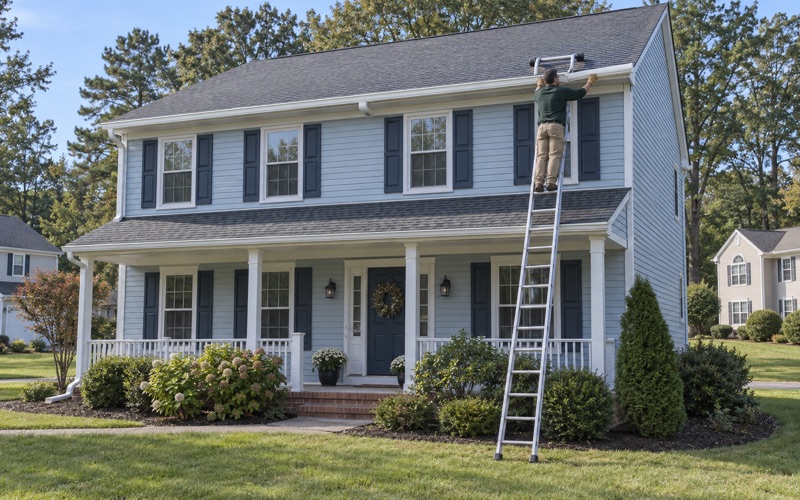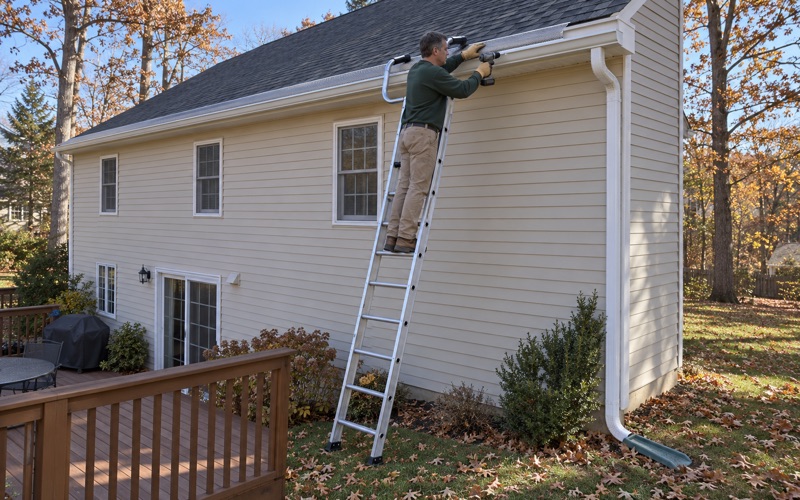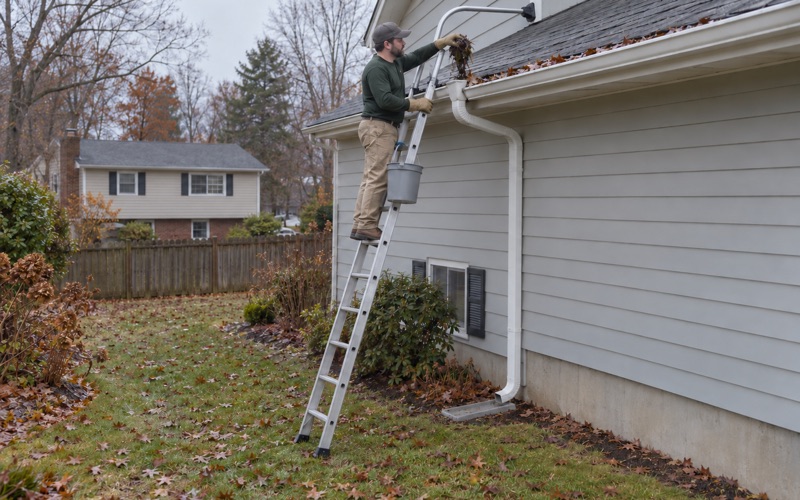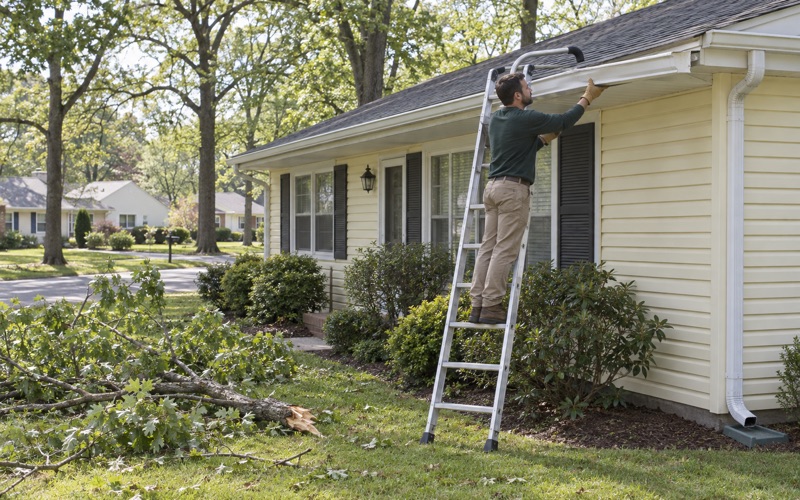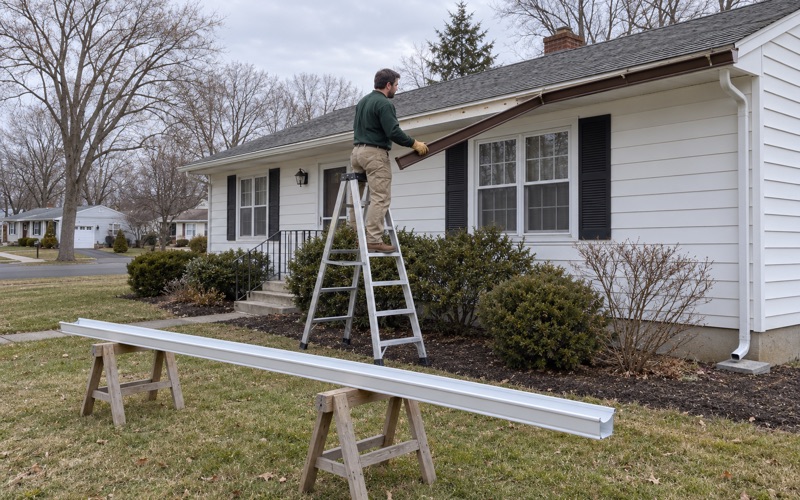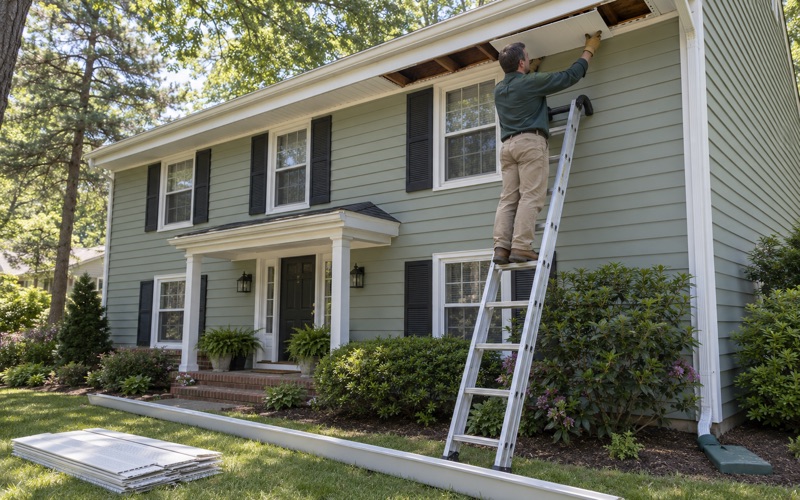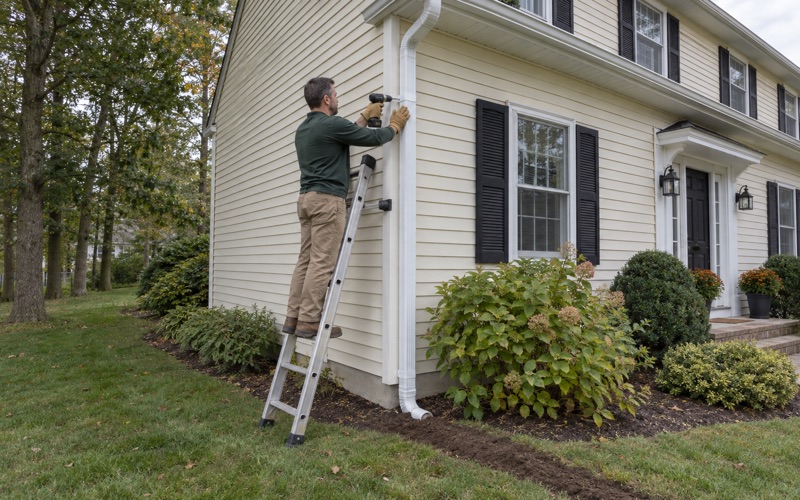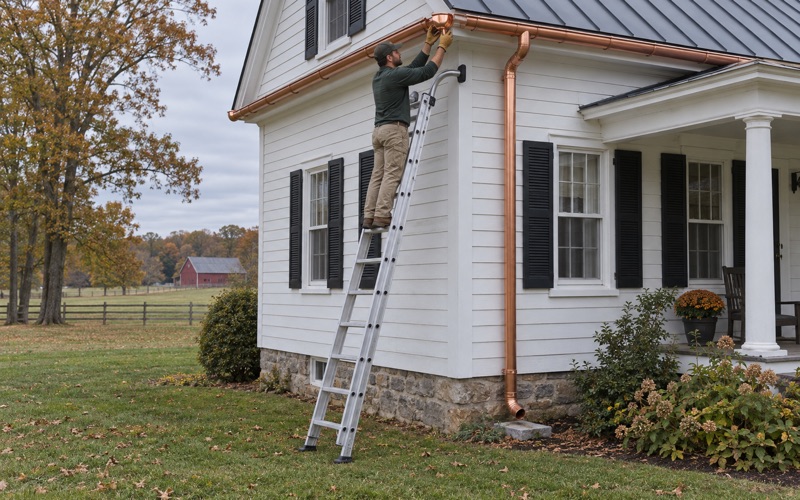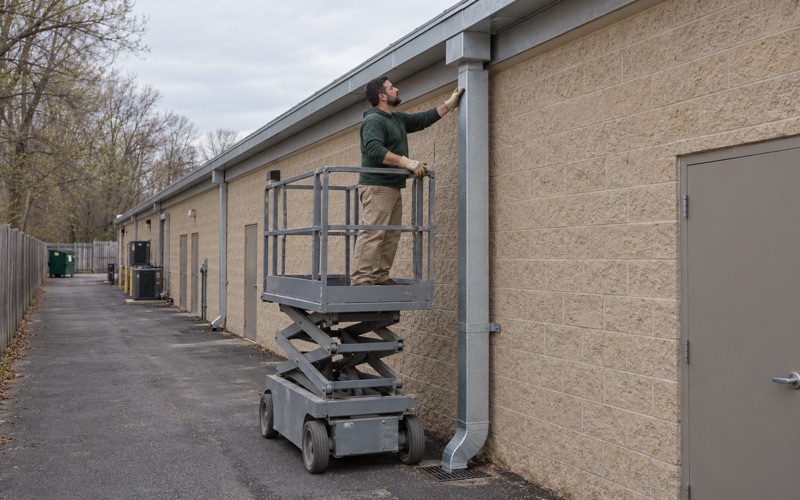
Howell Gutters brings more than 20 years of work to gutters in Colts Neck, where a gutter system has a longer job than it does in most towns. Catching rain at the eave is only half of it. The other half is deciding where that water goes on your own ground, and on a property with its own septic system and well, that decision matters.
We size each gutter and downspout to the roof area that feeds it, form seamless runs on site from coil, and follow every downspout to the spot where its water ends up. When that spot is wrong, we propose an extension, a pop-up emitter or a drywell, and the estimate names where each leader outlet will discharge before any work starts.
This page covers what changes about gutter work on a large wooded lot here: water that has no street drain to reach, long eaves under mature trees, and downspout runs that can stretch across a lawn. If you are weighing new gutters, a repair or a cleaning plan, it should help you know what to ask.
Gutters Where There Is No Public Sewer
No Street System to Hand the Water To
Colts Neck has no public water or sewage service. That single fact shapes the township, and it shapes gutter work too. In a town with curbs and storm inlets, a downspout can send water toward the street and let the municipal system carry it off. Here the roof water stays on the property it falls on, so the gutter plan has to finish on your own land.
Homes here rely on a private well for drinking water and a septic system for wastewater, and both sit on the same lot as the house. That puts three things competing for the same yard: the drain field, the wellhead and wherever the downspouts empty. We treat the discharge point as a site question on every Colts Neck job, not an afterthought.
Our own rule fits that situation well. Leader outlets are never tied into a sanitary line, and with a septic system that matters more than it would on a city sewer, because roof water sent into the tank can overload the field. The estimate spells out where every outlet will drain, so you can check it against what you know about your yard.
Lot Sizes That Make the Runs Longer
That lack of utilities is why most Colts Neck homes must sit on lots with minimums of 2, 5 and 10 acres. The zoning schedule in Chapter 102 sets a minimum of 88,000 square feet in the A-1 zone and 220,000 in A-5, and a farm in the AG zone needs 10 acres. Some zones, such as A-2, A-3 and A-7, set lower minimums of 30,000 to 40,000 square feet.
For gutters, the size of the lot is an advantage and a cost. There is usually room to carry water well away from the house and the septic area, but reaching that room can mean a long extension or a buried line. We plan the run with you on site, walking the yard rather than guessing from the driveway.
Looking for gutters closer to Tinton Falls? See Gutters Services in Tinton Falls.
Keeping Roof Water Clear of the Septic Field and the Well
Finding the Field and the Wellhead First
Before we mark a single downspout location, we ask where the septic tank, the drain field and the well are. Many owners have a property survey or septic plan that shows them; others know from the lawn, where the grass grows differently over the field. If neither is clear, we flag it on the estimate rather than assume.
We found no township rule that sets a distance between a downspout and a septic field, so we will not quote one. What we do is practical: keep concentrated roof water off the drain field, away from the tank lid and clear of the wellhead, and send it somewhere the ground can take it. A soaked drain field works harder than it should.
The wellhead gets the same care. Surface water pooling around a well casing is something no owner wants, and a downspout aimed at that corner of the house can create exactly that puddle every storm. Moving one outlet to the other end of a run, or adding an elbow and an extension, is often the whole fix.
Where the Water Lands Instead
Near the house, the target is the grade itself. The New Jersey edition of the 2021 residential code, at R401.3, has the ground fall 6 inches within the first 10 feet from the foundation, and a downspout should release water onto that slope rather than into a low pocket. We check the fall at each outlet before deciding how far to carry the water.
From there the options are an aboveground extension, an underground line to a pop-up emitter, or a drywell. On a Colts Neck lot the choice usually comes down to which direction leads away from both the septic field and the well, and how far that is. We lay the options side by side on the estimate so the tradeoff is visible.
Soils That Take Water and Spots That Don’t
Much of the ground here drains well. Soil survey data for a sample area in the township shows Colts Neck sandy loam, Tinton loamy sand, Collington and Freehold loamy sand, all rated well drained. That is good news for emitters and drywells, which depend on the soil taking water in.
Not every spot behaves that way. The same sample includes Holmdel sandy loam, only moderately well drained with a water table as shallow as 69 centimeters, and frequently flooded Humaquepts along a drainageway; marl beds also line streams such as Hop Brook. State stormwater rules keep a drywell 2 feet above the seasonal high water table, so low ground near a stream is where we point water toward an emitter instead.
Long Eaves Under Colts Neck’s Tree Lines
Why the Tree Lines Stay
From the 1950s into the 1970s, many of the township’s heavily wooded areas were developed with large colonial and ranch-style houses on acre-sized lots. The trees did not all go. The zoning purpose for the A-1 and A-2 zones asks development to protect views, wooded areas, mature isolated trees and tree lines, so a retained tree line along one side of the house is a familiar sight.
Those trees are the debris source. A long eave running parallel to a tree line collects leaves, twigs and seed pods along its full length, and a ranch house can have a lot of eave. Gutters that clog at one end overflow there, which on these lots can mean water spilling right where the downspout plan was meant to keep it away.
Gutters and Guards Sized for a Wooded Roof
A long run under trees benefits from capacity. We measure the roof area that drains to each run and size from there, which on bigger homes often points to 6-inch K-style seamless gutters with 3x4 downspouts. Forming each run in one piece on site removes the mid-run seams where leaf debris catches and where leaks start.
Guards are chosen for the trees actually standing over your roof. Oak leaves, pine needles and fine seed each defeat a different kind of screen, so we look up before recommending one; fine debris usually calls for stainless steel micro-mesh. A guard reduces cleaning on a tree-lined eave; it does not end it, and we say so up front.
We also check the fascia before anything new is hung. Shade and wet debris keep the board behind a clogged gutter damp, and on older houses the wood can be soft. If it is, we show you the soft section before replacing it, and painted trim on a pre-1978 house is handled under the EPA lead-safe renovation rule.
Cleaning Gutters on Estate Homes
On a large house with tree cover, one cleaning a year may not keep up. Each visit clears the troughs, flushes every downspout to confirm it runs, and bags the debris so nothing is left on the lawn or at the curb. You get before-and-after photos, which helps when the roofline is too long or high to inspect from the ground.
Bagging matters on a property this size. Gutter sludge is wet, packed and full of shingle grit, which is not material you want raked into a lawn or a planting bed. We carry it off the property, so there is nothing left for you or your landscaper to deal with after the visit.
Timing follows the trees. A fall visit after most of the leaves are down, and a spring visit for seed and catkins, suits most tree-lined homes here. Monmouth County Mosquito Control also asks owners to keep gutters clean and properly pitched, since standing water in a sagging trough is breeding habitat.
Downspout Runs Across a Multi-Acre Lot
Underground Lines, Emitters and Drywells
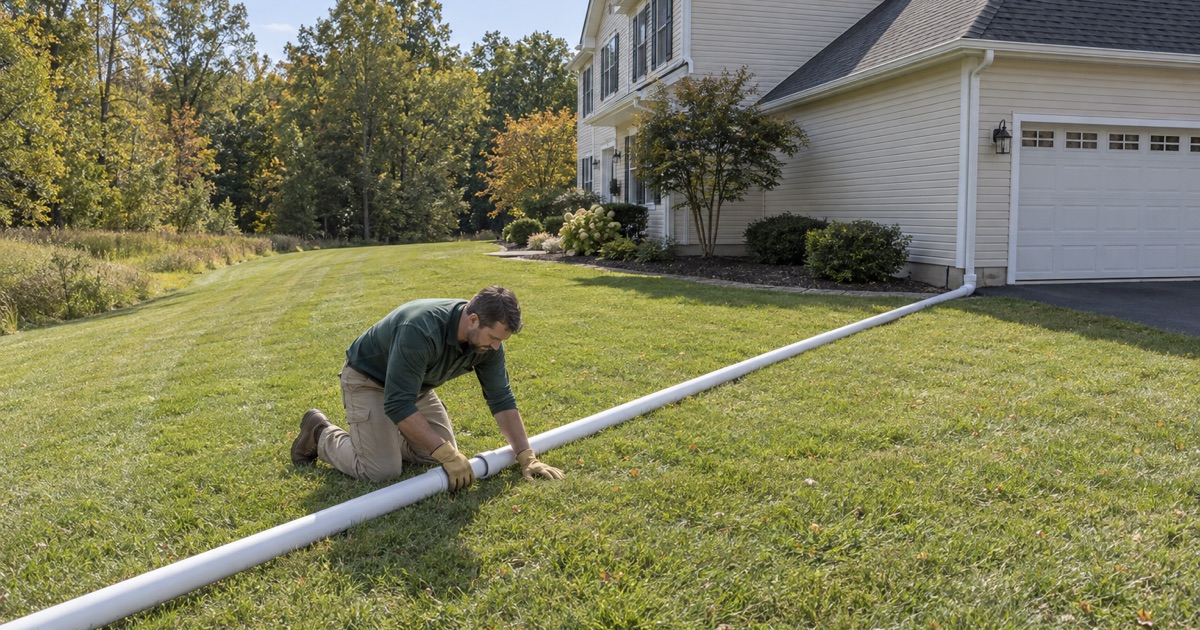
When the safe place for water is well out into the yard, an aboveground extension becomes a mower hazard. A buried line carries the water under the lawn to a pop-up emitter that opens when water arrives and closes when it stops. We set the line with steady fall the whole way, because a long run with a belly holds water and silt.
A drywell suits a spot with good drainage and no room to spread the water at the surface. On well-drained sandy loam it can work well, provided it sits clear of the septic field, the well and any low, wet ground. Where a run crosses a driveway or a patio, we plan the route before the trench is dug.
Houses From the 1960s Through the 1990s
Colts Neck’s housing is overwhelmingly detached and owner-occupied, with 94.3% of occupied homes lived in by their owners. The 1990s were the largest build decade, with 948 units, and another 1,432 went up between 1960 and 1979. On the older houses, gutters may be on a second or third set, and the downspout locations deserve a fresh look.
Style matters too. A colonial with crisp trim lines may suit 6-inch K-style aluminum in .032 coil, while some owners of older or more formal homes ask about half-round or 16-ounce copper. We match copper and half-round work to the age and style of the house, with brackets and miters chosen to suit the profile.
Paperwork, Tax Lines and the Contract
Under N.J.A.C. 5:23-2.7, repairing, replacing or installing exterior gutters and leaders is classed as ordinary maintenance. Our estimates show new gutters and repair work on separate lines, because New Jersey treats new gutters as an exempt capital improvement on Form ST-8 while a repair is taxable. Contracts follow the state’s home improvement rules, including the three-day cancellation notice.
On a Colts Neck property, a good gutter job is judged in the yard as much as at the roofline. If you want a plan that sizes the runs for your trees and sends every downspout somewhere safe for your septic system and well, we will walk the lot with you and put it all in writing.
- 20+ Years in Business
- Seamless Gutters Formed On Site
- Before-and-After Photos