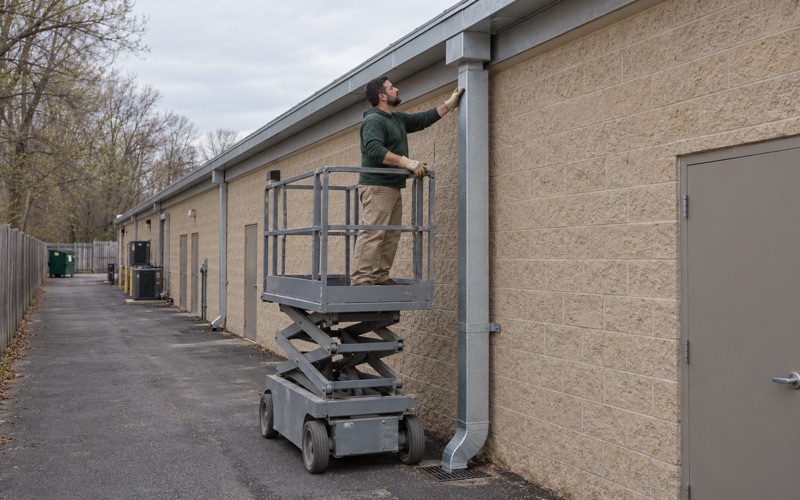
Howell Gutters installs, repairs and cleans gutters in Brielle, and for more than 20 years we have treated a gutter as a drainage system first and a trim piece second. On the borough’s waterfront commercial buildings, though, the trim side carries real weight, because the color and metal at a visible roof edge are part of how the building is judged.
That is why this page is about marina buildings, boat sheds and yacht club roofs more than houses. A long run over a boat storage bay needs the same sizing math as any roof, but the owner also has to decide between copper and a painted finish, and that choice should be made before the coil is ordered rather than after the gutters are hanging.
Our estimates put new gutters and repair work on separate lines, since New Jersey taxes the two differently, and our contracts follow the state’s home improvement rules, three-day cancellation notice included. Below we walk through what the borough’s marine commercial rules say, how we read them for gutter work, and where the roof water has to go once it leaves the downspout.
Gutters on Brielle’s Marina and Boatyard Buildings
What the C-2 Marine Commercial Zone Is For
Brielle’s land use code sets aside a C-2 Marine Commercial Zone along parts of its Manasquan River edge. Section 21-19 states its purpose plainly: to promote expanded and upgraded recreational boating and sport fishing facilities. The permitted uses follow from that, listing marinas, boat basins, marine facilities, yacht basins and yacht clubs, along with boat sales, repair, storage and fueling.
The borough itself sits on about 4.0 miles of tidal waterfront on the Manasquan River, Glimmerglass and Debbie’s Creek, so boating is not a side use here. Docking for party, charter and headboats is also allowed in the zone, and conditional uses include restaurants, hotels and multi-use marine complexes. Every one of those buildings has a roof edge that someone on the water or the street can see.
We do not keep a list of which parcels carry the C-2 designation, and the zone map is the place to confirm it. When an owner calls us about a marina office or boat shed, the first question we ask is which zone the lot sits in, because that answer shapes the color conversation that follows.
Long Eaves Over Boat Storage and Work Areas
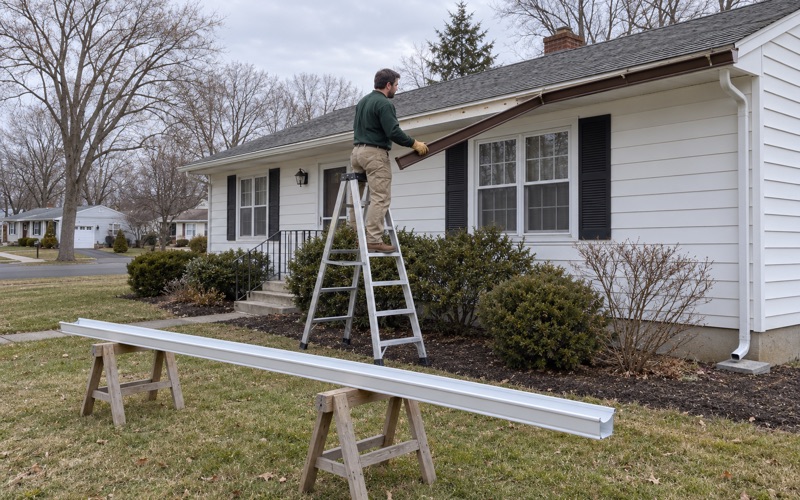
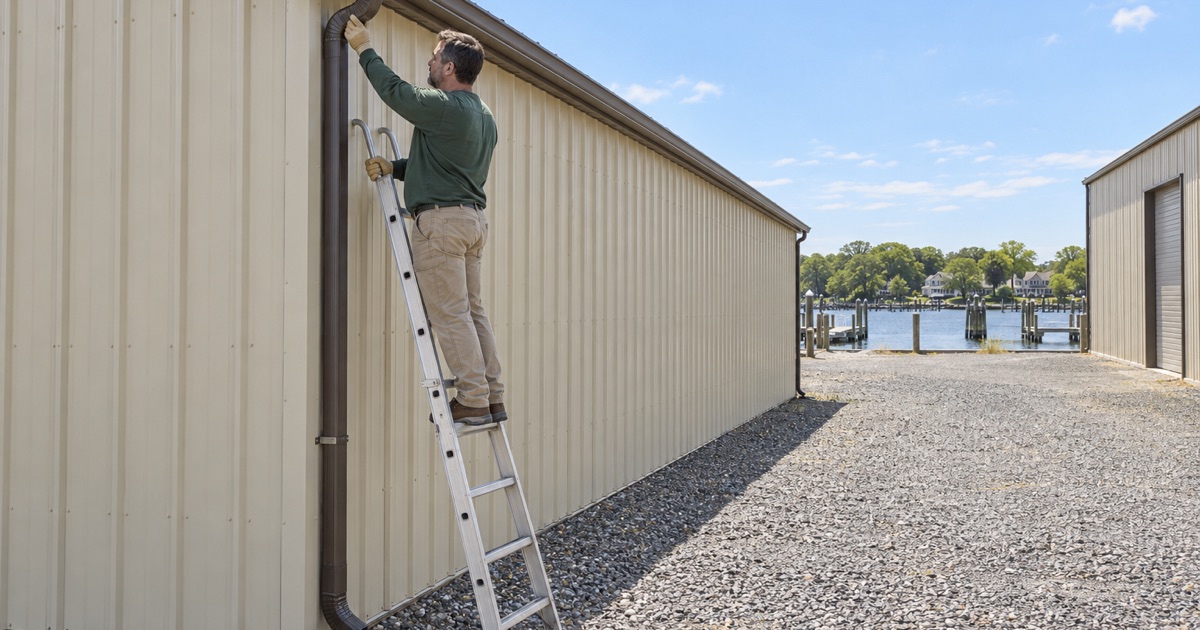
A boat shed or repair building is a different gutter job from a house. The eave runs tend to be long and unbroken, stretching over storage racks, work bays and the open ground where hulls sit on stands. A single seamless run formed on site from coil avoids the joints that would otherwise sit every few feet above people and equipment.
Where that water drops matters more on a working lot than on a lawn. A downspout that empties into a travel lane for a boat trailer, or onto a spot where someone sands a hull, creates ice in winter and a mess the rest of the year. We trace each outlet to where it lands and propose a relocation before anything is cut.
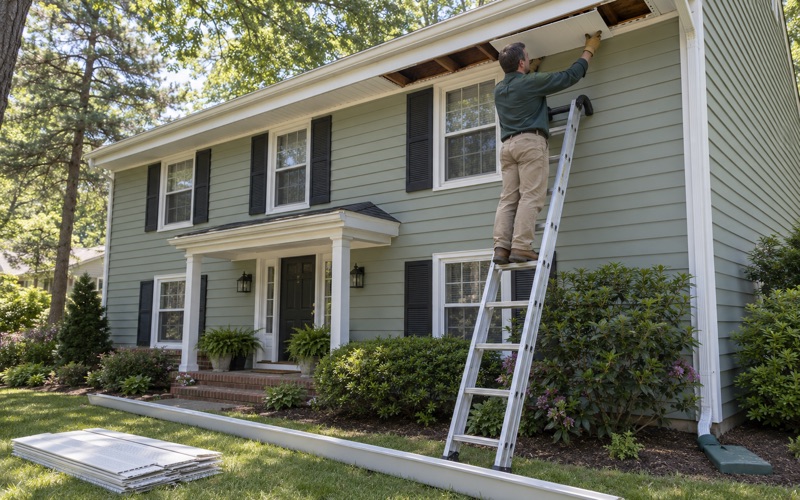
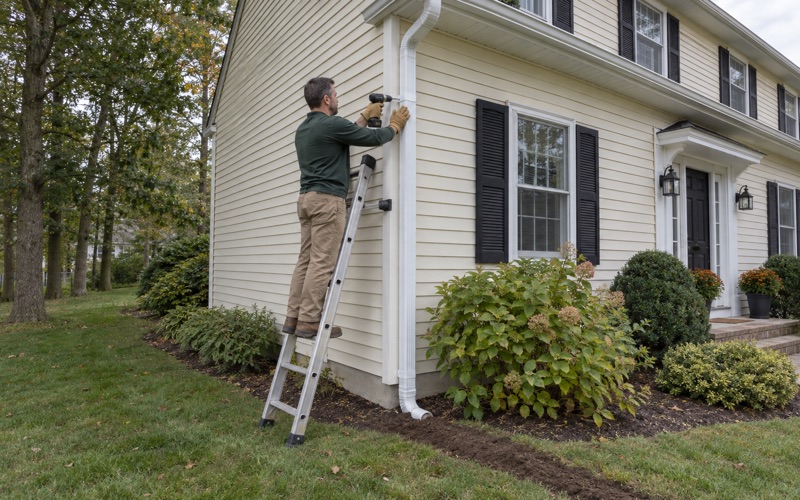
Hangers deserve attention on these spans as well. Hidden hangers screwed through the gutter into solid fascia hold far better than the old spike and ferrule, and on a long commercial eave the spacing is something we set for the load, not the default. We also check the fascia for rot first and show the owner any soft wood before replacing it.
Sizing Runs on a Commercial Roof
We size gutters and downspouts from the roof area that drains into each run. On a broad shed roof, that area can be large enough that a 6-inch K-style seamless gutter with 3x4 downspouts is the starting point, and the number of outlets matters as much as the gutter width. Fewer, overloaded downspouts are the usual reason a commercial gutter spills over its front lip.
Wide-flange outlets help a long run empty faster, and box, strip and bay miters let us turn corners on an irregular building without leaving a seam that weeps. Where a lower roof meets a wall, kickout flashing keeps water off the siding. These details are standard trade practice, but on a building that faces the water they show, so we keep them tidy.
Looking for gutters closer to Neptune City? See Gutters Services in Neptune City.
Reading the Nautical Design Rules for Roof Metal
The Earth-Tone Line and the Copper Exception
Section 21-19.5 sets building design criteria for the C-2 zone, and its stated goal is to keep the historic and nautical character of the borough’s waterfront. The line that matters most for us reads that all visible metal work on roofs, except copper, shall be painted or integrally colored in subdued earth tones.
In practice that sets up two lanes. Copper can stay bare and age the way copper does, while any other visible roof metal is expected to carry a quiet, earthy color rather than a mill finish or a bright white. The same section also addresses the roof covering itself where it is visible from a public way.
Where Gutters Fit in That Text
Here we are careful, because the section never uses the words gutter, leader or downspout. Whether a gutter counts as metal work on a roof is a reading of the code, not a stated rule, and we tell owners exactly that. We have not seen a source saying gutter work in the zone needs its own Planning Board review.
Our reading is a cautious one. A bright mill-finish or white aluminum gutter running the full length of a visible C-2 roof edge would sit awkwardly beside a rule written to quiet that metal, and copper is the one metal the text exempts. So on a marina or yacht club building we usually price copper and an earth-tone aluminum side by side and let the owner choose.
None of this carries over to houses. The design criteria are written for the marine commercial zone, and we do not read them as applying to a family home in one of the borough’s residential zones. Brielle is primarily a residential community of single homes, and those homes are sized and finished on their own terms.
Flat Roofs and the 25-Foot Setback
Two other C-2 rules shape the buildings we work on. Flat roofs are prohibited unless the Planning Board determines the design meets the nautical-character intent, so a marine building here is more likely to carry a pitched roof that sheds water to an eave. That is good news for gutters, which work best where a roof delivers water to a defined edge.
The second rule is that no building may be located within 25 feet of the water’s edge. That setback leaves a strip of ground between the downspouts and the river, and it is the space where roof water has to be handled on the lot. We plan outlets with that strip in mind rather than pointing every leader straight at the river.
Copper, or Aluminum in an Earth Tone
Copper on a Yacht Club or Marina Office
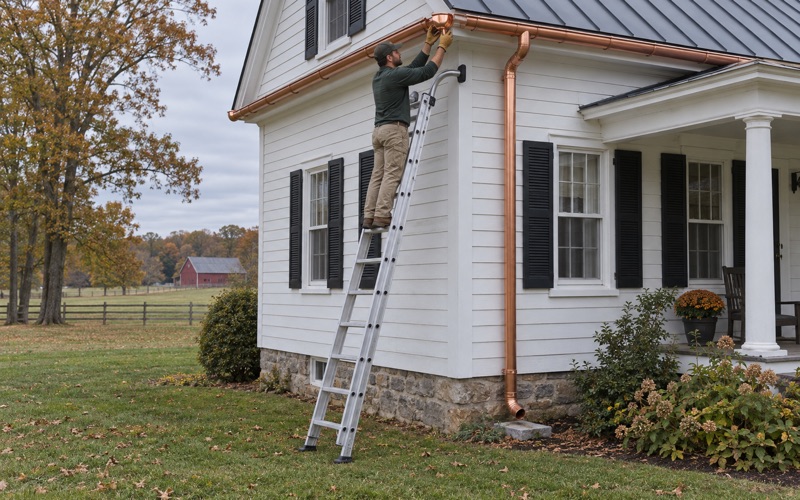
Copper is the material the code leaves alone, and on a yacht club or marina office it suits the nautical look the zone is after. We work in 16-ounce copper, in K-style or half-round with a double-bead profile, and we match the profile to the age and style of the building. Over time the bright metal browns and then develops its patina.
Copper costs more up front, and it asks for joints soldered rather than sealed, so the decision usually comes down to how long the owner plans to hold the building and how much of the roof edge faces the public. On a short run over an entry, copper can be the simple answer even where the main eaves stay aluminum.
Prepainted Aluminum in Subdued Colors
For most owners, seamless aluminum formed from .032 coil is the practical choice, and the color is where the C-2 reading comes in. Prepainted coil comes in browns, bronzes, clays and muted greens that sit comfortably in the subdued earth-tone family. Choosing from physical samples held against the trim beats judging from a screen.
Downspouts, elbows and hangers that show should match the gutter, since a white A elbow under a bronze gutter undoes the effect. Where an owner wants a color outside the stock range, we talk through whether it still reads as subdued before ordering. The choice is the owner’s; our part is to point out where a finish may draw a question.
Keeping the Two Metals Apart
Mixing copper and aluminum on one building takes planning. The Alside 20-year rainware warranty is void if the property has copper on its roof or anywhere water may be directed into the aluminum gutters. If a yacht club already has copper flashing or a copper cupola, that clause can decide the material question before color even comes up.
We read the warranty for whatever coil an owner chooses and lay out the water paths so copper runoff never feeds an aluminum run. Sometimes that means going all copper on one face of the building, and sometimes it means rerouting a downspout. Either way, the owner sees the reasoning on paper before we commit to a material.
Riverfront Roof Water and the Sewer Ban
Section 15-2.6b and Where Leaders Discharge
Brielle’s sewer code is direct about roof water. Section 15-2.6b states that no cellar drains, area drains, roof leaders, sump pumps or downspouts shall be connected to the sewer system, and Section 15-2.6d lets the superintendent discontinue sewer and water service, impose a surcharge or seek a fine when one is. On a riverfront commercial lot, every downspout discharges on the property.
We never tie a leader outlet into the sanitary sewer, and our estimate names where each one will discharge. On a boatyard that might be a splash block clear of a work bay, an underground line to a pop-up emitter in a planted strip, or a drywell where the ground allows one. The aim is water that soaks in or sheets away without pooling against a foundation.
Flood Zones, Upkeep and the Rest of the Job
Brielle’s flood code, Chapter 19, regulates Coastal A Zones and V Zones. The borough takes part in the National Flood Insurance Program with a current effective map dated September 25, 2009, and it holds no Community Rating System class. Which waterfront lots fall in which zone is a question for that map, and we check it before planning any drywell near the river.
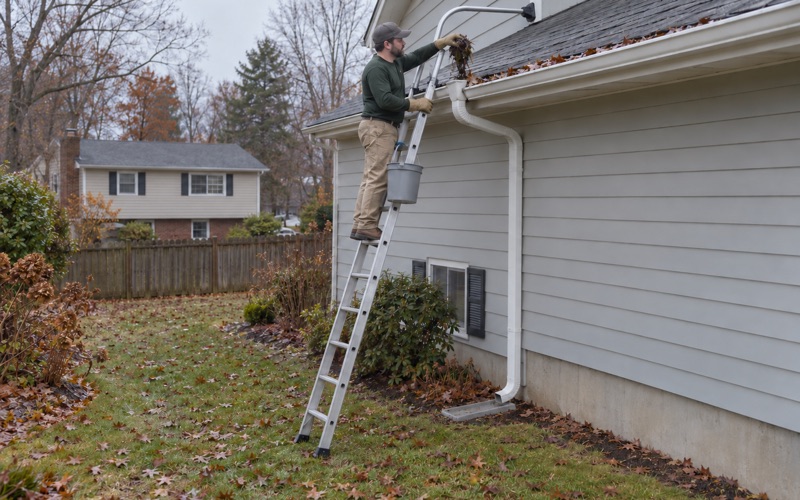
Once the gutters are up, upkeep on a marine building follows the same pattern as anywhere else. Our cleaning visits flush every downspout and bag the debris so nothing ends up on the lot, and each cleaning or repair comes with before-and-after photos. Guards, where they make sense, are matched to whatever trees overhang the roof rather than chosen from a catalog.
If you own or manage a marina, boat shed or yacht club building in Brielle, tell us the zone, the roof metals already on the building and how the lot is used. We will come back with sizes, a material and color recommendation, and a discharge plan for every downspout, all in writing before any coil is cut.
- 20+ Years in Business
- Seamless Gutters Formed On Site
- Before-and-After Photos