Howell Gutters has spent more than 20 years installing and repairing gutters in Brick, and the work we plan here starts with one question that is easy to skip: what happens when the snow on the roof lets go. A gutter that only ever carries rain can get by on tired hangers for years. A gutter that catches a slab of wet, wind-packed snow cannot.
We install seamless gutters formed on site from .032 aluminum coil, one continuous piece for each run, so there are no mid-run seams to open up under a heavy load. Each run is fastened for the weight it may have to carry in a hard winter, not only for summer rain.
We handle cleaning, repair, guards and full replacement, and we match guards to the trees on the lot, since pitch pine needles and oak leaves call for different screens. Below we explain why snow matters so much in this township, what it does to a gutter, and how we build and check a system to stand up to it.
Thirty Inches in One Storm, and Then Some
December 2010 at the Top of the List
The National Weather Service office in Mount Holly wrote in its summary of the December 26-27, 2010 blizzard that numerous locations along the New Jersey coast received 20 inches or more, with the greatest snowfall measurement of 30 inches taken in Brick Township. No other spot in that summary topped it. For a gutter contractor, that is the number to plan around.
The storm did more than pile up depth. Snow fell at 2 to 3 inches an hour, gusts passed 50 mph across much of the forecast area, and the summary notes drifts of 8 to 9 feet in some locations. Wind like that packs snow onto a roof unevenly, loading one slope far more heavily than the other.
January 2022 and Another Heavy Reading
The pattern showed up again in the January 28-29, 2022 blizzard, when a trained spotter at Brick reported 14.8 inches to the Weather Service office in Mount Holly. That is a single storm reading, not a long-term normal. Still, two heavy readings a dozen years apart make the point that a big coastal storm can land squarely on this township.
We have found no record of how many Brick gutters either storm damaged, and we will not guess at one. What we can say is that a gutter system here should be specified as if a storm of that size will come again during its service life, because the Weather Service record shows that it can.
Houses That Have Seen Many Winters
Brick is largely a township of detached houses. Census estimates count 25,886 one-unit detached homes out of 33,277, and 17,195 homes were built between 1950 and 1979. A house from that era may be on its second or third set of gutters, and the fascia board behind them may be the original wood.
That matters for snow. Older fascia that has absorbed water for decades holds a fastener less firmly than sound lumber, and a gutter is only as strong as the board it hangs from. Before any new gutter goes up, we check the fascia for rot and show the owner any soft wood before we replace it.
On houses built before 1978, fascia and trim may carry lead paint, so any work that disturbs those painted surfaces follows the EPA Renovation, Repair and Painting rule. Most of Brick’s postwar housing falls on that side of the line, and we plan containment and cleanup into the job from the start.
Looking for gutters closer to East Freehold? See Gutters Services in East Freehold.
What Sliding Snow Does to a Gutter
The Eave Takes the Load
Snow on a pitched roof does not stay put. As the sun warms the shingles or the attic warms the deck from below, the bottom layer softens and the whole blanket starts to creep downhill. When it reaches the eave, the first thing in its path is the front lip of the gutter.
A slow creep folds over the lip and fills the trough, adding weight that the hangers have to carry until it melts. A fast slide, the kind that comes when a whole slope lets go at once, can hit the front edge hard enough to roll the gutter forward, bend hangers or pull fasteners partway out of the fascia.
Wind-packed snow makes both cases worse. Drifted snow is denser than fresh powder, so the same depth weighs more, and it tends to come off in slabs rather than flakes. After a storm with the drifting the 2010 summary describes, a single eave can end up carrying far more than its share.
Ice Under the Snow
Melting snow adds a second problem. Meltwater running down under the blanket refreezes when it reaches the cold overhang, and a gutter full of ice is a solid, heavy bar hanging from the fascia. When the next slide comes down onto that bar, the hangers take both loads at once.
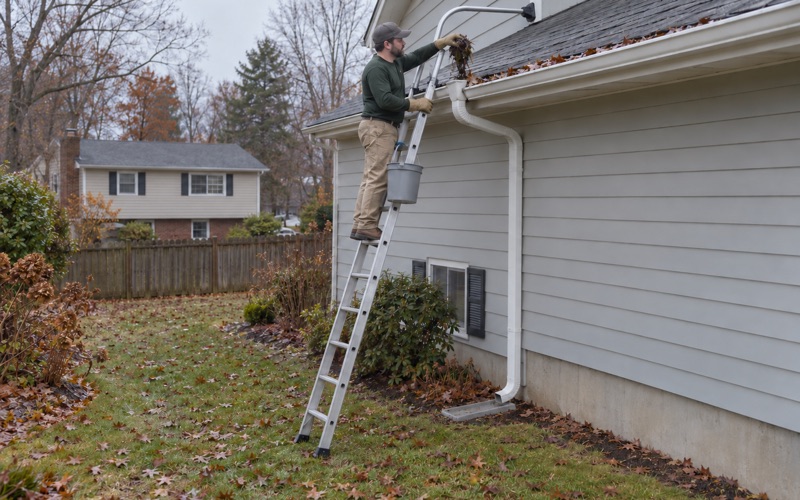
A gutter clogged with fall leaves makes the ice problem worse, because the meltwater has nowhere to drain and freezes in place. Brick’s municipal leaf collection runs from September 1 to December 31, and we recommend a late-season cleaning so the trough and every downspout are clear before the first heavy snow. Our cleaning visits flush each downspout and bag the debris.
Why Pitch Shifts After a Storm
A gutter needs a steady fall toward its outlet to drain. When snow or ice bends a few hangers in the middle of a run, that section sags, and the low spot holds standing water and debris instead of moving them to the downspout. In the next freeze, the puddle becomes another block of ice.
Sagging pitch is easy to miss from the ground in dry weather. The tell is usually water spilling over the front edge in one spot during rain, or a line of drips along the eave after a thaw. We check pitch with a level along every run on a repair call, not just at the obvious low point.
Hangers, Fasteners and Nor’easter Wind
Hidden Hangers Versus Spike and Ferrule
Older gutters often hang on spike and ferrule: a long nail driven through the front of the gutter, through a sleeve, and into the fascia. Each freeze and thaw can work the spike back out a little, and a heavy load can lever it free. Once a few spikes let go, the run drops in a section.
We hang new seamless gutters on hidden hangers, which clip inside the front lip and fasten to the fascia with a screw rather than a nail. Screws hold far better against pull-out, and the hanger braces the front edge against the kind of downward hit a sliding slab delivers. On a roof with a long, steep slope above it, we space hangers more closely.
Where an existing gutter is sound but the spikes are loosening, a repair can swap them for hidden hangers or screw-and-ferrule fasteners without replacing the trough. That is often the right call on a newer system that has simply been pulled out of line.
Sizing the Run for the Roof Above It
A gutter that is too small for its roof overflows in a downpour and fills with slush faster in a thaw. We size each run and its downspouts to the roof area that drains into it. On many houses that means 6-inch K-style seamless gutters with 3x4 downspouts, which move more water and give snowmelt a wider path out.
Flashing matters at the eave too. A gutter apron or drip edge carries water off the roof edge and into the trough instead of behind it, and kickout flashing at a wall keeps meltwater from running down the siding. We check both whenever we hang new gutters on a Brick house.
Nor’easter Wind and Loose Runs
Snow is not the only test. In the November 2009 nor’easter tied to the remnants of Ida, a Weather Service spotter report listed a 45 mph peak gust at Brick. Wind that strong gets under a loose gutter end or a downspout with failed straps and works it back and forth until something gives.
A gutter that a blizzard has already pulled slightly away from the fascia is exactly the kind wind finds. That is why we treat snow and wind damage as one problem: we re-secure loose ends, refasten every downspout strap, and seal miters and end caps with tripolymer sealant so the run moves as one piece.
Brick spans two forecast zones: the mainland falls in the Weather Service’s Ocean zone, and the barrier-island section in Coastal Ocean. Wind forecasts can differ between them, and on a house near open water we pay extra attention to gutter ends and downspout straps.
After the Storm: Checking and Repairing Brick Gutters
What to Look for From the Ground
Once the roads are clear and the snow has come off the roof, walk the house from the ground before anyone climbs a ladder. Look for gutter sections that dip in the middle, front edges rolled forward, hangers visible at odd angles, ends pulled away from the fascia, and downspouts that have separated at an elbow.
The next rain tells you the rest. Water sheeting over the front, dripping from seams, or pooling against the foundation means something moved. We follow every downspout to where its water lands, and if it now dumps against the foundation, we propose an extension, a pop-up emitter or a drywell on the estimate.
Repair or Replace
Not every storm-damaged gutter needs replacing. If the trough itself is straight and the fascia is solid, rehanging the run, resetting its pitch and resealing the joints usually restores it. If the aluminum is creased, the seams have opened or the fascia behind it has gone soft, a new seamless run formed on site is the better long-term answer.
On older houses where the original look matters, we also match copper or half-round replacements to the age and style of the home. Whatever the scope, we write contracts to New Jersey’s home improvement rules, including the three-day cancellation notice, so an owner deciding in the hectic days after a storm still has time to reconsider.
Insurance, Photos and Records
Many homeowners policies list the weight of ice, snow or sleet as a covered cause of loss, though terms and deductibles vary, so read your own policy or call your agent. If you file a claim, clear documentation helps, and every repair we do comes with before-and-after photos you can pass along.
The paperwork is straightforward. Our estimates list new gutters and repair work on separate lines because New Jersey taxes them differently: new gutters are an exempt capital improvement, while repairing gutters is a taxable repair. Leader outlets are never tied into the sanitary sewer, and the estimate states where each downspout will discharge.
If the last storm left a run sagging or a downspout hanging, call us before the next one arrives. We will walk the house with you, show you what moved and why, and lay out the repair or replacement in writing so you can decide with the facts in front of you.
- 20+ Years in Business
- Seamless Gutters Formed On Site
- Before-and-After Photos