Howell Gutters brings more than 20 years of work to gutters in Bordentown Township, and a growing share of our calls here come from owners of houses that are barely a year old. A brand-new gutter that drips at a seam or holds a puddle after rain raises a question an older house never does: is this ours to fix, or the builder’s? We would rather answer that honestly than sell a repair you may not need to pay for.
This page is written for that owner. It walks through what New Jersey’s new-home rules say about gutters, how a first-year leak or a sagging run is judged, why the order of phone calls matters in the first twelve months, and what sensible upkeep looks like once the warranty year has passed.
If your house is older, the same drainage logic applies, and we are glad to look at it. But the township’s newest streets are where most of the confusion sits, so that is where we start.
Gutters on Bordentown Township’s Newest Homes

Bordentown Township is still adding houses. Census estimates from the 2024 American Community Survey count 4,638 homes in the township, and 521 of them were built in 2010 or later, with 231 of those dating from 2020 onward. That is a meaningful slice of owners who are either inside a builder warranty or only recently out of one.
Townhomes and Single-Family Houses
Two recent communities show the range. Listings describe D.R. Horton’s Rising Sun Meadows on Marion Avenue as four-bedroom townhomes with two-car garages, most of them built in 2024. Lennar’s Reserve at Turgyan Farm, with its sales office on Ward Avenue, offers single-family homes, and listings there show a 2026 year built.
The gutter questions on those two kinds of houses are not identical. A detached Turgyan Farm house has its own runs on every side, while a row of townhomes shares long eave lines, and a downspout from one roof can carry water from more than one unit’s slope.
Who Is Responsible in Attached Housing
In attached housing, the first question is not about the gutter at all. New Jersey’s warranty rules define common elements as “those elements listed in the master deed,” so whether a townhome’s gutters belong to the owner or to the community depends on what that document lists. We have not read the master deed for Rising Sun Meadows, Turgyan Farm, or the township’s 55-and-over communities such as Village Grande at Crosswicks Creek and Greenbriar Horizons.
That is why we check the master deed or call the management office before quoting any work in an association. Knowing who holds responsibility for a run saves an owner from paying for something that may be someone else’s to handle, or from having work redone because it was never theirs to change.
Looking for gutters closer to Metuchen? See Gutters Services in Metuchen.
What New Jersey’s New-Home Warranty Says About Gutters
The New Jersey new-home warranty is administered by the Department of Community Affairs through its Bureau of Homeowner Protection, under the rules in N.J.A.C. 5:25. Most owners know the program exists. Fewer know that its performance standards name gutters and downspouts directly.
The Standard in N.J.A.C. 5:25-3.5
Under N.J.A.C. 5:25-3.5, in the section on thermal and moisture protection, the rule states that “Gutters and downspouts which leak is a deficiency.” It goes on to say that “Gutters which are improperly pitched to drain water is a deficiency.” The corrective action it assigns is to “Repair leaks and pitch gutters to drain properly to meet standard.”
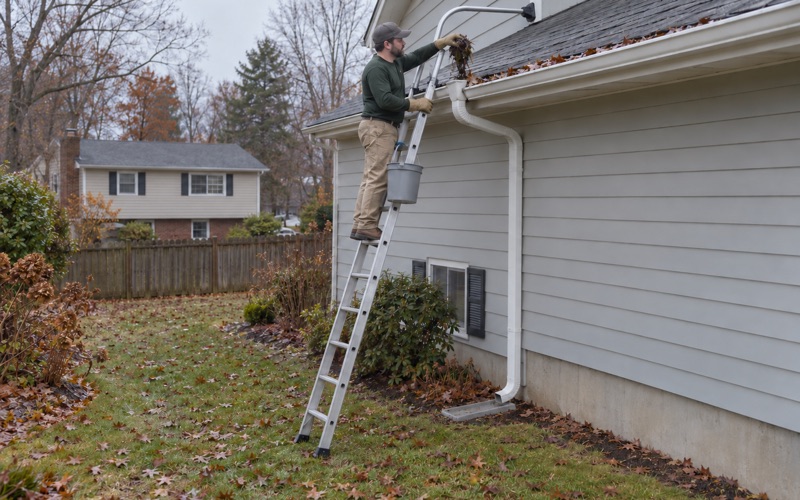
The same section also gives the owner a job. The owner is “Responsible to keep gutters and downspouts free from leaves and debris to prevent overflow.” A gutter that overflows because it is packed with leaves is a maintenance problem, not a construction defect, and the rules treat those two very differently.
How Long Coverage Runs
Performance-standard items such as gutters carry a one-year warranty, compared with two years for mechanical and electrical systems and ten years for major structural defects. The clock starts on the warranty date, which the rules define as “the date of the first occupation by the owner or settlement date, whichever is sooner.”
Written notice of a defect must reach the builder no later than seven calendar days after that item’s warranty expires. The rules also leave the remedy to the builder, who chooses between repair, replacement or payment. If you plan to report a gutter problem, put it in writing well before the anniversary of your closing.
Leaks, Pitch and the First Year: Builder Before Contractor
Most first-year gutter complaints on new houses fall into two groups: water escaping where it should not, and water sitting where it should not. The warranty standard addresses both, and it sets a clear line for the second.
Leaking Seams, Corners and Outlets
A leak shows up as a drip line at a corner miter, a stain on the fascia under an end cap, or water running down the outside of a downspout instead of inside it. On a new house, these usually trace back to a missed bead of sealant, an outlet that was not seated, or a joint that opened as the house settled through its first seasons.
Because the rule says plainly that leaking gutters and downspouts are a deficiency, a first-year leak belongs on the builder’s list. Note where it drips, photograph it during a rain, and include those details in your written notice.
Improperly Pitched Gutters and One Inch of Standing Water
Improperly pitched gutters are the other common complaint. A gutter needs a slight, steady fall toward its outlet; a run that is level, or that dips in the middle, holds water instead of moving it. The warranty treats a gutter that is not pitched to drain as a deficiency.
The rule does not demand a bone-dry trough, though. It states that “Standing water in gutters is acceptable if it does not exceed one inch in depth.” A shallow film after a storm is within the standard. Water deeper than one inch that stays put is the kind of condition worth measuring with a ruler and reporting.
Why Calling Us First Can Cost You Coverage
Here is the part that surprises people. The Department of Community Affairs exclusions form states that work performed “by the owner or any contractor hired by the owner” is excluded from coverage under the warranty. A separate rule excludes defects in, or caused by, work supplied by anyone other than the builder or the builder’s crews.
Read together, those rules mean that if work by a contractor the owner hires touches a gutter run during the first year, that run can fall outside the builder’s coverage. Re-hanging a back-pitched section on a 2024 townhome or resealing a corner on a 2026 house may feel like a quick fix, but it can trade a covered item for an uncovered one. We cannot tell you what any particular builder’s plan will do, because we have not read them, but we can tell you the order that protects your options: report it to the builder in writing first.
When We Can Still Help in Year One
None of that means a new-home owner has to wait a year to talk to us. We can look at a problem without touching it and tell you whether it reads as a leak, a pitch issue, or simply a clogged outlet. Clearing leaves is the owner’s duty under the same rule, so routine cleaning does not raise the same concern as altering the gutter itself.
We can also follow each downspout to where it discharges and tell you whether water is landing against the foundation, and we put that in writing with photos. That record can support your notice to the builder.
After the Warranty: Guards and Cleaning for 2024-2026 Gutters
Once the first year has passed, the gutters on a new house are an ordinary maintenance item, and the township expects them kept up. Bordentown Township adopted a property maintenance chapter by ordinance in June 2022, setting minimum standards for residential and nonresidential premises.
Cleaning That Leaves Nothing Behind
The warranty rule already put leaves and debris on the owner, and that responsibility does not end with the warranty. Our cleaning visits clear the troughs, flush every downspout to confirm it runs free, and bag the debris so nothing ends up on the lawn or at the curb.
Each cleaning and repair comes with before-and-after photos. For a new house, that photo set becomes a simple maintenance history, which is useful if a question ever comes up about whether a problem was neglect or workmanship.
Guards Matched to the Lot
Young plantings on a new lot do not drop much at first. That changes as street trees and landscaping grow, and the right guard depends on what grows nearby. Pine needles and oak leaves behave differently, so we match the screen, often stainless steel micro-mesh, to the trees on and around the lot.
On a townhome row, a guard installation may affect shared runs, which brings the master deed question back. We sort that out before any guard goes on.
Repairs and Replacement Down the Road
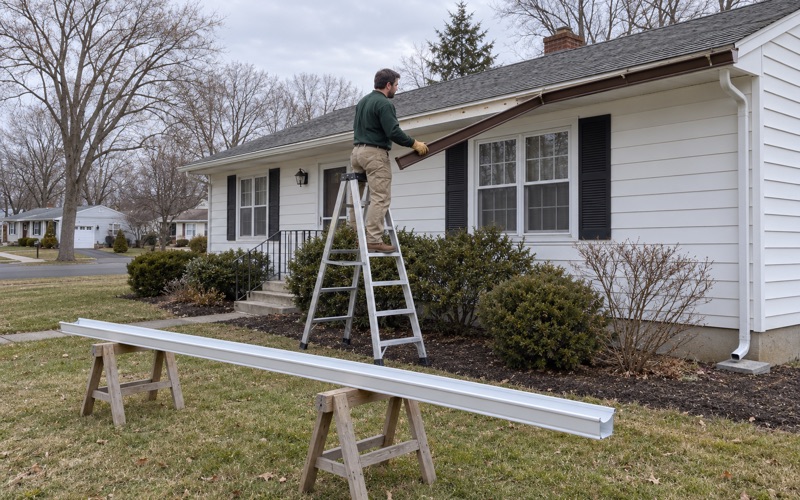
When a run does need work after the warranty, we size gutters and downspouts to the roof area each one drains rather than defaulting to one size. Replacement runs are formed on site from coil as seamless pieces, one for each run of the house, and the fascia behind them is checked for soft wood before anything is hung.
Our estimates list new gutters and repairs on separate lines, because New Jersey taxes them differently, and every leader outlet is shown with where it will discharge, never into the sanitary sewer. Contracts follow New Jersey’s home improvement rules, including the three-day cancellation notice, so an owner in Bordentown Township knows exactly what was agreed before any ladder goes up.
- 20+ Years in Business
- Seamless Gutters Formed On Site
- Before-and-After Photos