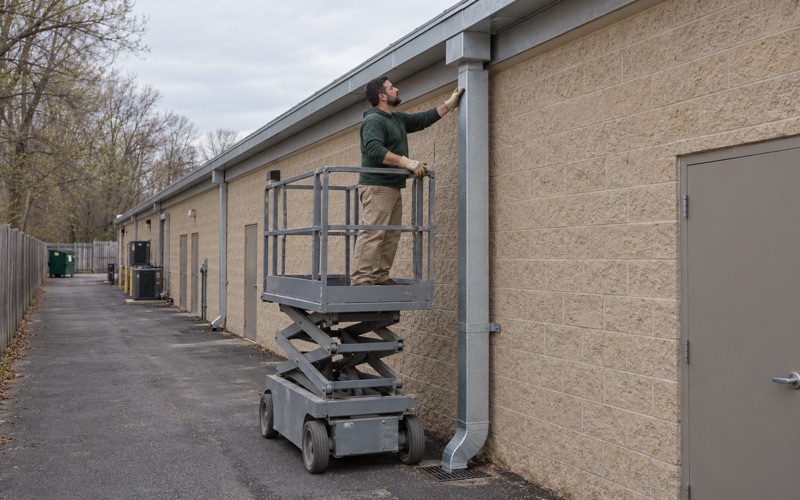
Howell Gutters has spent more than 20 years hanging, repairing and cleaning gutters in Beachwood, and on many of these houses the real job begins after the water leaves the downspout. On a wide lot that part solves itself. On a tight side yard it takes a plan, because the ground between a downspout and the property line can be shorter than a standard extension.
So we start every Beachwood visit at ground level. We walk the house, follow each downspout to the spot where its water lands, and note what sits between that spot and the neighbor’s yard. Only then do we go up the ladder and work out the gutter and downspout size each run needs, based on how much roof actually drains into it.
What you get is an estimate that reads run by run: what we would hang, where each leader would discharge, and why we picked that spot. New gutters and repair work are priced on separate lines, and the contract is written to New Jersey’s home improvement rules, three-day cancellation notice included.
Gutters on Beachwood’s Tribune-Era Lots
Beachwood did not grow the way most Ocean County towns did. In 1914 a promotion backed by the publishers of the New-York Tribune bought 1,763 acres of Berkeley Township and divided it into 20-by-100-foot plots. A buyer paid $19.60 for a plot and received a six-month subscription to the paper as a bonus. The first residents moved in during April 1915, and the borough incorporated in 1917.
What a 20-Foot Plot Means for Drainage
An original plot is 20 feet wide and 2,000 square feet in area. That is narrower than almost any house, so homes here were generally built across several plots, and the lot lines that resulted are not always generous on the sides. Where a house sits close to a side lot line, the downspout at that corner may have only a few feet of yard before the water reaches the neighbor’s grass, fence or driveway.
That is an inference from the plot dimensions, not a survey of any particular street. Lots vary widely across the borough, and plenty of them have room to spare. The point is that we never assume the side yard is wide enough until we have walked it, because on some Beachwood lots it is not.
Sizing Each Run for the House That Was Built
Nearly every home in Beachwood is a detached house, and most are owner-occupied, so each drainage decision is made one property at a time. The housing stock leans toward the 1970s and 1980s, with older and newer homes mixed in. A ranch with a long, low roof and a two-story colonial with a steep main roof send very different volumes of water to their corners.
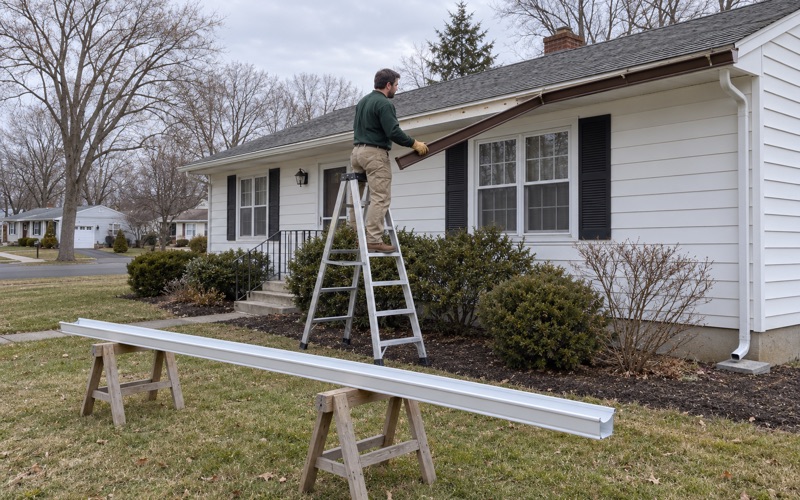
We measure the roof area that feeds each run and choose the gutter and downspout to match. On many houses that means a 6-inch K-style gutter with 3x4 downspouts; on a smaller roof a 5-inch gutter can be the right call. The gutters are formed on site from .032 aluminum coil, one seamless piece per run, so there are no joints along the length to open up later.
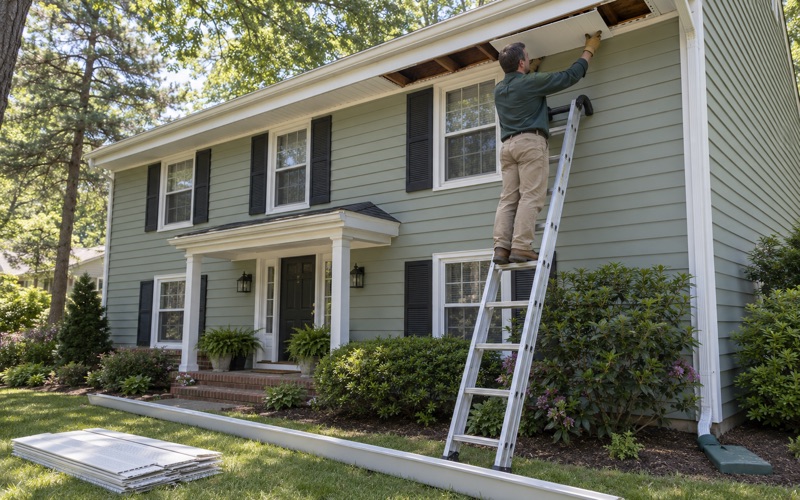
Before anything new goes up, we check the fascia board behind the old gutter. If the wood is soft, we show it to you before we replace it, so you see the rot with your own eyes rather than finding a line item you cannot verify.
Looking for gutters closer to Aberdeen? See Gutters Services in Aberdeen.
Downspouts Near the Side Line, and How to Reroute Them
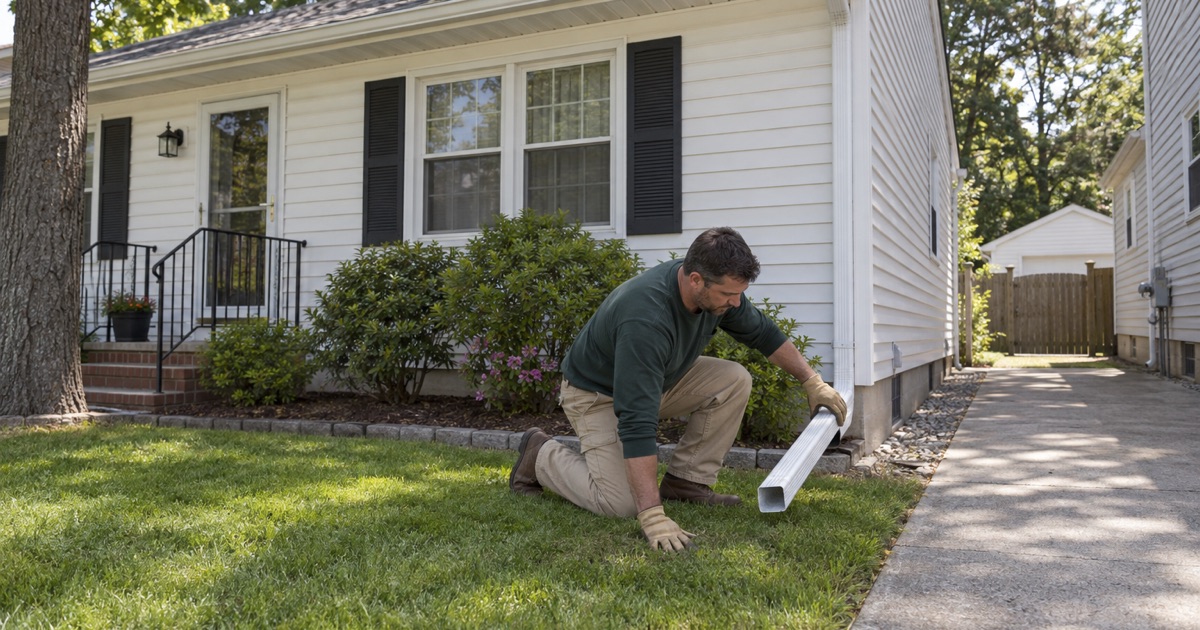
A downspout that ends a few feet from the property line leaves very little room to work with. Water has to go somewhere, and the goal is to move it away from your foundation without sending it across the line onto the house next door.
Reading the Short Run
We look at three things at each tight corner. First, how much roof drains to that downspout, because a corner fed by a large roof section needs a different answer than one fed by a small porch roof. Second, which way the ground falls. Building code for new work calls for the grade to drop 6 inches within the first 10 feet from the foundation, and on a narrow side yard that slope often runs toward the neighbor as much as away from you. Third, what the water would hit if it kept going: a driveway, a fence line, a basement window next door.
Extensions, Splash Blocks and a Different Corner
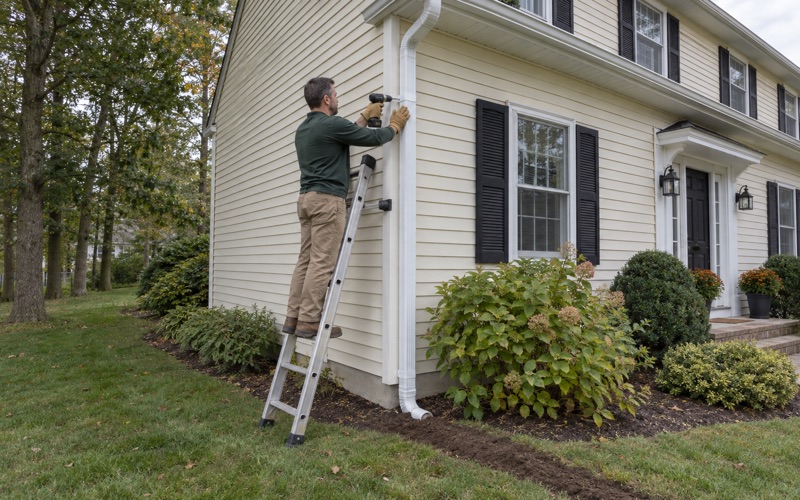
A splash block or a short extension is enough at many corners, especially where the side yard opens toward the back. Where it is not, the simplest fix is often to move the water rather than stretch the pipe. We can add an outlet farther along the run and drop the downspout at the front or back corner instead, where there is open lawn to receive it. That can mean reworking the run with new box or strip miters and a pair of elbows, which is easier to do with seamless gutters made on site than with sectional stock.
On some houses we split a long run so half the water goes to each end. That lowers the volume reaching the tight side and gives each downspout less work to do in a heavy storm.
Pop-Up Emitters, Underground Lines and Drywells
When there is no good surface route, the water can travel underground. A buried downspout line carries it to a pop-up emitter out in the yard, where it surfaces on open lawn and soaks in. A drywell is another option where the soil and groundwater allow it; New Jersey’s stormwater rule calls for the bottom of a dry well to sit 2 feet above the seasonal high water table, so we check that before proposing one.
Whatever we recommend, the estimate says where each leader will discharge. We never tie a leader outlet into the sanitary sewer, no matter how close the cleanout sits to the downspout.
What the Property Maintenance Code Says About Roof Water
Beachwood runs its Certificate of Continued Occupancy inspection under the International Property Maintenance Code of 2000, under Section 17-12.3A of the borough code. That inspection comes up when a house is sold, but the code it applies describes a standard worth meeting whether or not a sale is coming.
Good Repair and Free From Obstructions
The drainage section of the property maintenance code, Section 304.7, reads in the model text that roof drains, gutters and downspouts shall be maintained in good repair and free from obstructions. In practical terms that means gutters that hold their pitch, hangers that grip the fascia, seams that do not drip, and downspouts that run clear from top to bottom. A gutter packed with needles overflows at the front edge, and the water lands right against the house, which is exactly what the downspout was supposed to prevent.
Where the Water Lands Is the Other Half
The same section says roof water shall not be discharged in a manner that creates a public nuisance. On a wide lot that line rarely comes into play. On a narrow one it is the reason to think carefully about a side-corner downspout that empties straight toward the next house, onto a shared driveway, or across a walkway where it can freeze.
We are not the borough, and we do not decide what counts as a nuisance on your street. What we can do is lay out each discharge point so the water stays on your property and soaks in, and show you on the estimate where each one ends up. If a downspout has been dumping toward a neighbor for years, rerouting it is usually a modest job, and it heads off a conversation nobody wants to have over the fence.
Repair Versus Replacement on the Estimate
When an older system only needs work, we say so. Resealing a seam with tripolymer sealant, rehanging a sagging section with hidden hangers in place of loose spike and ferrule, or adding a missing elbow can bring a run back into good repair without replacing it. New Jersey taxes a repair differently from a new installation, which is why those two kinds of work never share a line on our estimates.
Gutter Cleaning Under Beachwood’s Pines and Oaks
Beachwood’s western side reaches into Pine Barrens creek country. Jakes Branch, a Toms River tributary named for the sawmill Jacob Jacobs built on it in 1761, runs along the northern edge of Jakes Branch County Park on Double Trouble Road. Most of that 400-acre park is land left unsold from the 1914 Tribune promotion, given to the borough in 1917 and later bought by Ocean County, which developed only 40 acres because of environmental restrictions. Its nature center is devoted to the Pinelands, and the trees that define that landscape are the same ones dropping debris into gutters across town.
Needles, Leaves and the Guard That Fits
Pitch pine needles and oak leaves clog a gutter in different ways. Oak leaves are broad and pile up on top of a coarse screen, where they mat down and shed water over the edge. Pine needles are thin enough to slip through many screens and lodge in them like straw. Because of that, we match the guard to the trees standing over each section of roof. On lots with heavy pine, a stainless steel micro-mesh guard keeps needles out without blocking the water; where oaks dominate, a sturdier screen may serve better and costs less.
A guard is not a reason to stop checking your gutters. Fine debris still collects on top of mesh, and a downspout can still pick up a clog at an elbow. Guards stretch the time between cleanings rather than ending them.
What a Cleaning Visit Includes
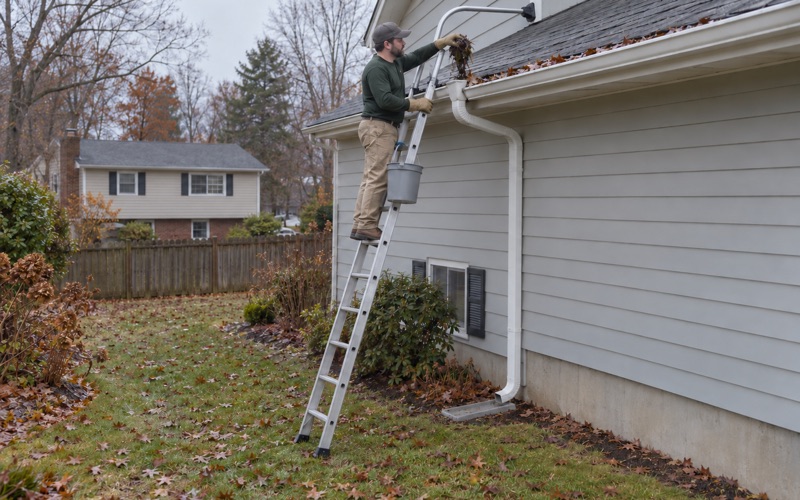
Our cleaning visits clear every run by hand and then flush each downspout to confirm water moves freely from the outlet to the ground. Debris is bagged and taken with us, so nothing ends up on your lawn or at the curb. While we are up there, we look for loose hangers, open seams and a pitch that has flattened, and we photograph the gutters before and after so you can see the work without climbing a ladder.
On narrow lots we also check that each downspout extension is still attached and pointed where it should be. A splash block kicked aside by a mower, or an extension knocked loose in a storm, puts the water right back at the side lot line, and catching that during a routine cleaning costs far less than finding it after a wet season.
- 20+ Years in Business
- Seamless Gutters Formed On Site
- Before-and-After Photos