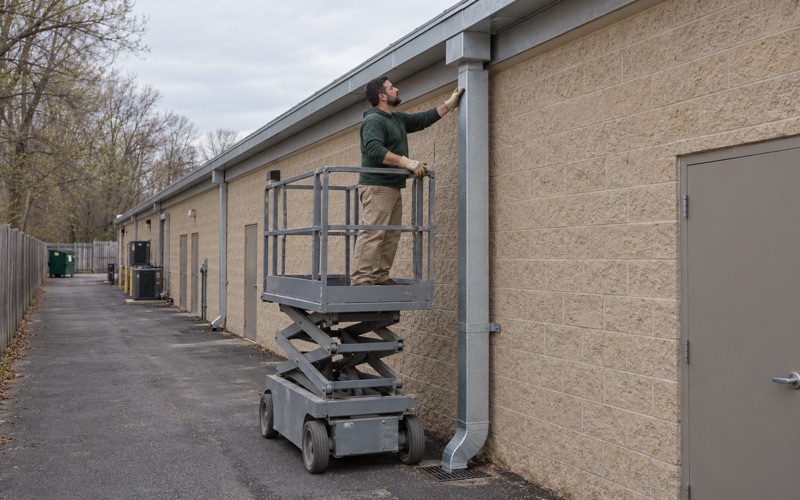
Howell Gutters installs, repairs and cleans gutters in Allenwood, and after more than 20 years of this work we treat every job as a question of where the water goes once it leaves the roof. A gutter that holds its pitch is only half the system. The downspout, the elbow at its foot and the spot where the water finally lands decide whether a house stays dry.
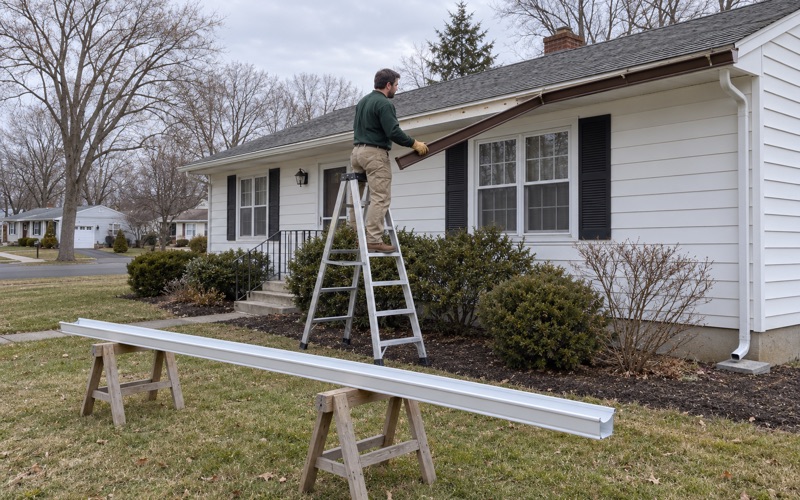
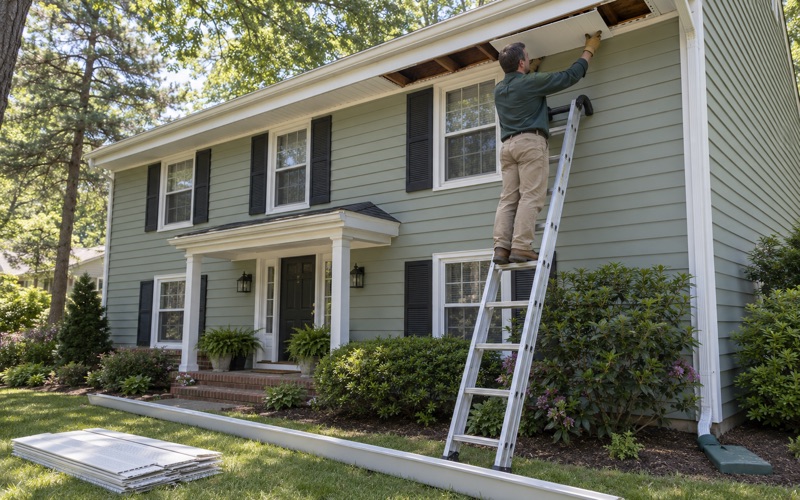
We form seamless gutters on site from aluminum coil, one continuous piece for each run, and we size both the gutter and its downspouts to the roof area that actually drains into them. Before anything new is hung, we check the fascia board behind it for rot. If the wood is soft, we show it to you first and replace it only once you have seen it.
Our estimates put new gutters and repair work on separate lines, because New Jersey taxes the two differently, and each estimate names where every leader will discharge. Our contracts follow the state’s home improvement rules, three-day cancellation notice included. Below is what changes about that work in Allenwood specifically.
Allenwood Sits on Its Neighbors’ Water Supply
A Treatment Plant on Hospital Road
Plenty of drivers pass through Allenwood without noticing that a regional water plant sits inside it. The Manasquan Water Treatment Plant is on Hospital Road in the Allenwood section of Wall Township. The Southeast Monmouth Municipal Utilities Authority owns the plant, and the New Jersey Water Supply Authority operates it.
According to the authority’s 2025 water quality report, the plant provides an average of 60% of the water used by residents of Brielle, Sea Girt, Spring Lake, Spring Lake Heights and Wall Township. The system also provides raw water to New Jersey American Water. That is a large share of five towns’ supply leaving from one address in a small census-designated place.
Where the Plant Draws Its Water
The plant’s raw water comes from two places: the Manasquan River in Wall Township and the Manasquan Reservoir in Howell Township. State rules place the system’s raw water intake and reservoir pump station on the river at Hospital Road. In plain terms, the stretch of river along part of Allenwood’s southern edge is a working source, not just scenery.
We bring this up because it shapes how we think about a downspout on a lot near the river. Nothing in the report singles out Allenwood houses or their gutters. We simply think a homeowner living beside a public water source deserves a contractor who plans each discharge point on purpose rather than by accident.
Looking for gutters closer to Brick? See Gutters in Brick.
When the Manasquan Rises Beside Allenwood
What the Allenwood Gauge Recorded
The U.S. Geological Survey keeps a stream gauge named Manasquan River near Allenwood, and its annual peak record shows how hard this river can climb. On August 28, 2011, the gauge recorded 12,600 cubic feet per second at a gage height of 20.38 feet. Other annual peaks, in 2005, 1975, 1977 and 2014, ran between 3,470 and 3,880 cubic feet per second.
In 2018 the river crested twice at levels worth noting, reaching 3,460 cubic feet per second on May 27 and 3,020 on November 25. Two strong rises in one year are a reminder that the Manasquan does not wait for a once-in-a-generation storm to come up. A high peak can arrive in late spring or late fall.
What a Rising River Means for a Downspout
A downspout cannot hold back a river, and we will never pretend otherwise. What it can do is keep the roof’s own water from adding to a problem the ground already has. On a lot that slopes toward the Manasquan, water dumped at the corner of the house follows the grade, and on wet days that grade is already carrying plenty.
We look at which way each leader points, how far its water travels before it soaks in or runs off, and what lies downhill. A leader aimed at the foundation, a window well or a low side yard gets moved or extended. One aimed across a neighbor’s property line gets rethought too, because that water becomes someone else’s problem.
We Do Not Read Flood Maps for You
Wall Township has its own flood map panels, and one of them covers the West Allenwood area. We do not tell anyone whether their house sits in a mapped flood zone, because we have not read that for any address and it is not our call. If you need that answer, the township’s flood hazard information and your insurer are the right sources.
What we can tell you is how your roof water behaves on your lot today. We walk the property, trace where the existing downspouts drop their water, and point out any spot where it pools against the house. That information is useful no matter what a map says, and it is the part of the picture a gutter contractor actually owns.
Where Allenwood Downspouts Should Let Go
Following Every Leader to the Ground
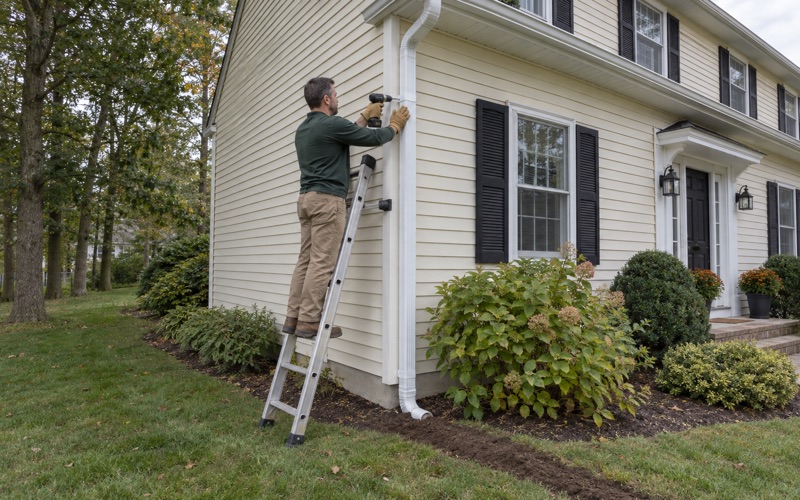
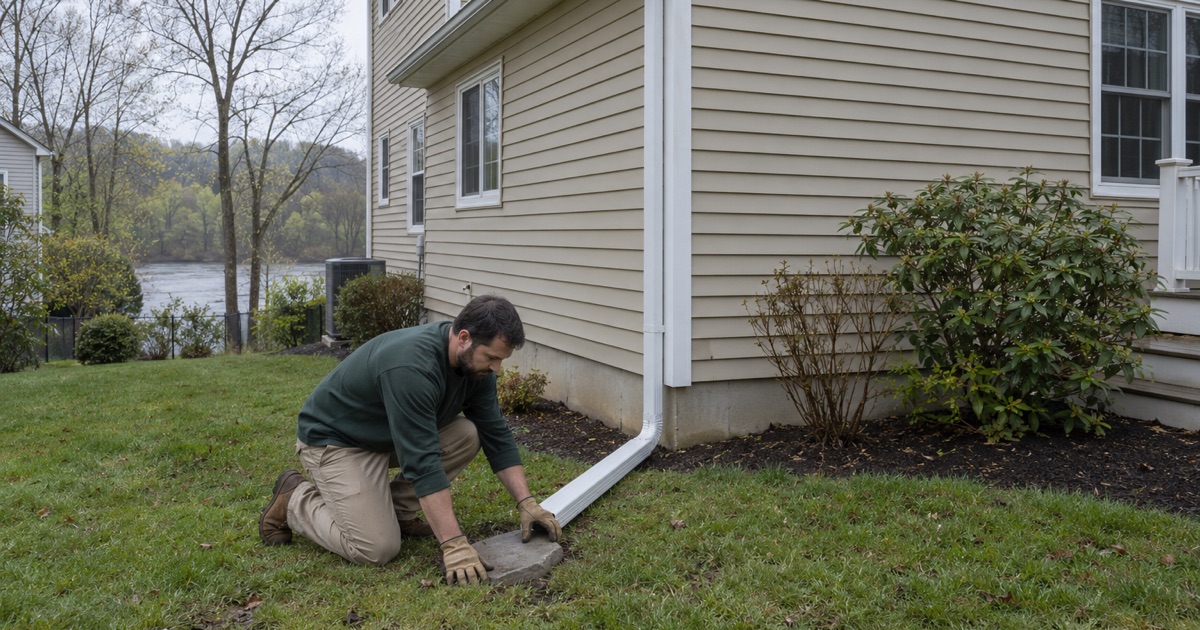
On every Allenwood job we follow each downspout from the outlet to the spot where its water lands. When that spot is against the foundation, we propose a fix and price it on the estimate: a longer extension, a pop-up drainage emitter at the end of an underground line, or a drywell where the ground suits one.
The building code’s own guide is a good starting point. The 2021 New Jersey edition of the residential code calls for the grade to fall 6 inches within the first 10 feet from the foundation. Where a yard does not have that fall, a downspout that empties right at the wall works against it, so the discharge has to move farther out.
Never Into the Sanitary Sewer
Some older houses have leaders that disappear into a pipe at grade, and the current owner may not know where that pipe goes. We never tie a leader outlet into a sanitary sewer, and if an existing one seems to run that way, we tell you before going further. Our estimate states in writing where each outlet will discharge once the job is done.
The Allenwood housing stock makes this worth checking. Census estimates count 88 homes here built in 1939 or earlier and another 33 from the 1940s, and drainage on houses that old may have been changed by several owners. A buried leader line from decades ago deserves a look before we connect a new downspout to it.
Choosing the Landing Spot
Where a downspout lets go is a choice, and on a lot near the river we make it deliberately. We favor a spot where the water spreads across lawn or a planting bed well clear of the house, rather than one that sends a concentrated stream straight down a driveway or toward a low corner of the yard.
Splash blocks and short extensions shift, get knocked loose by mowers and end up pointing the wrong way. If an Allenwood downspout needs to move water more than a few feet, an underground line to a pop-up emitter usually holds its position better. We show you both options with prices so the choice stays yours.
Gutters for Allenwood’s Detached Houses, One Lot at a Time
Every House Here Stands on Its Own Lot
Census estimates put every Allenwood home in their count, 265 of 265, in the single-family detached category, and 226 of the 237 occupied homes are lived in by their owners. That means the gutters, the downspouts and the place their water lands are usually one owner’s decision on one lot, with no shared wall or shared roofline to negotiate.
It also means each house gets its own layout. We measure the roof planes that feed each run and size the gutter and downspouts to that area. A long rear run collecting two roof faces may call for 6-inch K-style seamless gutters and 3x4 downspouts, while a short porch run needs far less.
Older Houses, Older Trim
Those prewar houses matter for the trim, too, since the fascia behind a gutter on an old house is often original or close to it. When that fascia is painted and the house predates 1978, the EPA’s Renovation, Repair and Painting rule governs how the paint gets disturbed, and we plan the job with that in mind.
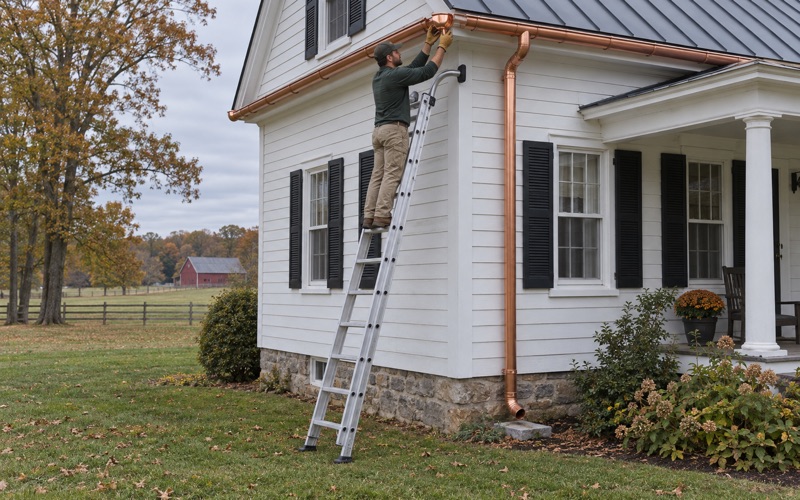
On a house of that age, copper or half-round gutters sometimes suit the architecture better than modern K-style. We match that work to the age and style of the house, using 16-ounce copper and half-round profiles with a double bead where they fit, and we explain how copper weathers to a patina over time.
Cleaning, Guards and Records
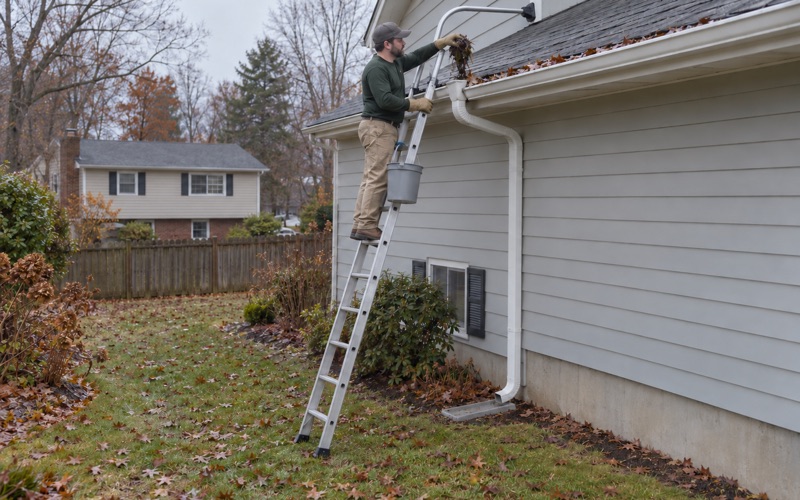
Cleaning visits are where a gutter system near the river stays honest. We flush every downspout, bag the debris and haul it off rather than leaving it on the lawn or at the curb. You get before-and-after photos of each cleaning and each repair, so you can see the condition of gutters you would rather not climb up to inspect.
If you want guards, we pick the screen for the trees that actually shed onto your roof, since pine needles and oak leaves call for different products. Stainless steel micro-mesh is one option we install. Monmouth County Mosquito Control also asks residents to keep gutters clean and properly pitched, because standing water in a sagging trough breeds mosquitoes.
Allenwood is in Wall Township, so Wall’s code and construction office is the local authority for building questions here, not Howell’s. Wherever the paperwork sits, our part stays the same: gutters sized for the roof, fascia checked before anything goes up, and every downspout sent somewhere that makes sense for a house near the Manasquan.
- 20+ Years in Business
- Seamless Gutters Formed On Site
- Before-and-After Photos